zimsam
- 3
- 0
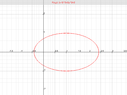
The discussion centers on the calculation of the derivative dy/dt at the endpoint of the minor axis for the equation (x-1)² + 2y² = 2. Participants confirm that dy/dt equals zero at the point (1,1), indicating a transition in the rate of change of y from increasing to decreasing. The implicit differentiation process is correctly applied, leading to the conclusion that while dy/dt is zero at this specific point, it does not imply that y is constant over time. The relationship dy/dx = (-dx/dt(x-1))/(2y) is also highlighted.
PREREQUISITESStudents and educators in calculus, physicists analyzing motion, and mathematicians interested in conic sections and their properties.