Huh? Seeing crisp vitreous floaters while using microscope

  • Context: High School 
  • Thread starter Thread starter djfontaine
  • Start date Start date
  • Tags Tags
    Microscope Virtual image
Click For Summary

Discussion Overview

The discussion centers around the phenomenon of observing vitreous floaters while using a microscope at high magnification. Participants explore the optical mechanisms that might explain the clarity and visibility of these floaters, particularly under specific lighting and magnification conditions. The conversation includes both personal experiences and speculative optical theories.

Discussion Character

  • Exploratory
  • Technical explanation
  • Debate/contested

Main Points Raised

  • One participant describes seeing crisp virtual images of their vitreous floaters through a microscope, suggesting that light rays may project a focused shadow of the floaters onto the retina.
  • Another participant notes that floaters are always imaged on the retina, and the brain's processing can affect awareness of them, indicating that specific lighting conditions can make them more visible.
  • A different participant proposes a connection to Schlieren photography, speculating that the convergence of light may play a role in the visibility of floaters.
  • One contributor suggests that limiting the entrance pupil size can enhance visibility of eye imperfections, and that high magnification microscopes create a small exit pupil that helps highlight floaters.
  • Another participant shares their experience with different magnifications, noting that 400x seems optimal for visibility, while higher magnifications provide less context due to smaller fields of view.
  • A participant speculates that the low numerical aperture in the microscope's image space may increase contrast, making floaters more visible, and relates this to the effects of aperture size in photography.
  • One participant mentions that using a pinhole to view floaters can yield sharp images, comparing this to the exit pupil of a microscope, which can also enhance visibility.

Areas of Agreement / Disagreement

Participants express various hypotheses and observations regarding the visibility of floaters, but no consensus is reached on a definitive explanation or model. Multiple competing views and speculative ideas remain present throughout the discussion.

Contextual Notes

Participants acknowledge limitations in their understanding and the need for further exploration of the optical principles involved. Some comments suggest a dependence on specific conditions, such as lighting and magnification, which may affect the observations made.

djfontaine
Messages
2
Reaction score
1
TL;DR
Looking to understand the optics of how I can be repeatably seeing a crisp virtual image of my vitreous floaters while using microscope at high power
This seems crazy, but I've discovered that when using my microscope at high power - a 10x eyepiece and 40x objective for 400x magnification - and a plain bright field I can get a clear virtual image of my own vitreous floaters. The images are crisp, in a tight focal plane, move in that sluggish "gelatinous" way with my eye movements, and are readily repeatable. It appears that the light rays are somehow projecting a focused shadow of the floaters onto my retina.

Obviously, I can't photograph what I'm seeing with my own eyes in my own eyes, but I've attached a rough approximation of what I'm seeing - only it's MUCH sharper and well-defined in the scope.

Can anyone provide an optical explanation for how this could be occurring? Is this something that could be diagrammed or modeled with ray tracing software? Can anyone else with floaters and a microscope duplicate my experience?

I'd love to know what some of you with deep optics backgrounds might have to say about this.

dj
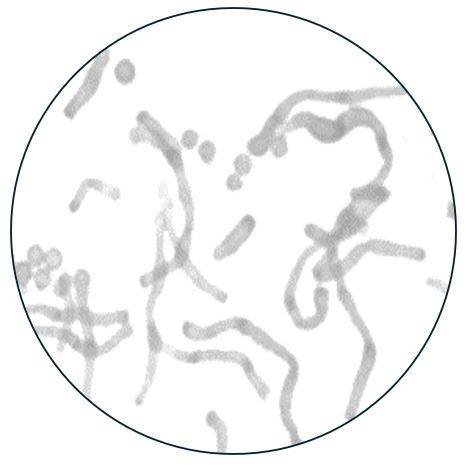
Floaters.JPG
 
Last edited by a moderator:
  • Like
Likes   Reactions: OmCheeto
Science news on Phys.org
Your experience isn’t unusual.
They’re in the path from light source to retina so always imaged on the retina. Whether we’re aware of them or not depends on how the brain processes the signals from the retina; you’ve found lighting conditions in which your brain isn’t editing them out.
 
After spending half an hour googling, I could not find any reasonable explanations.
My complete and utter guess is that it is related to Schlieren photography, where the light source converges to a point somewhere along its path.
I've long wondered why I could see my eyelashes, seemingly in focus, when they got bent between my eyeball and the eyepiece looking into my microscope. It simply made no sense to me at all.

I think @Andy Resnick is well versed in microscopy. He might know.
 
To observe the floaters you need to limit the entrance pupil to the minimum possible size and look against evenly illuminated bright background. The pin-point entrance pupil would produce the best visibility of in eye imperfections. Using high magnification microscope or telescope does provide a very small exit pupil which helps to highlight the floaters. That would be limiting factor for observers with floater to use a small exit pupil (high magnification).
 
  • Like
Likes   Reactions: djfontaine
Thanks for your inputs, all.

Regarding the exit pupil, it appears 400x must provide a bit of a sweet spot. At lower magnification (100x), I do not see them. At higher magnification (1000x), I see them larger, but naturally with a much smaller field of view and depth of field, providing a jumpier view and less "context".

The reference to exit pupil also got me down a different web search path, where I came across this similar post on a microscopy forum - https://www.microbehunter.com/microscopy-forum/viewtopic.php?t=7058

I will add that this isn't just scientific curiosity. I've got reason to believe they're actually pathogenic, not the usual collagen tangles, as I've been told by 2 previous retinologists in 2 years. In fact, what I see actually lines up perfectly with online micrographs of the suspect organism (fungal). It's a worsening problem for me, so I wanted to have firmer footing before going to see specialist #3 to avoid further gaslighting.

Thanks for confirming I'm not nuts. Well, not about that anyway! 🤣
 
djfontaine said:
TL;DR Summary: Looking to understand the optics of how I can be repeatably seeing a crisp virtual image of my vitreous floaters while using microscope at high power

This seems crazy, but I've discovered that when using my microscope at high power - a 10x eyepiece and 40x objective for 400x magnification - and a plain bright field I can get a clear virtual image of my own vitreous floaters. The images are crisp, in a tight focal plane, move in that sluggish "gelatinous" way with my eye movements, and are readily repeatable. It appears that the light rays are somehow projecting a focused shadow of the floaters onto my retina.
I have not seen this phenomena specifically, but I have seen similar optical effects.

My suspicion is that in the microscope's 'image space' (where your eyeball is located), the numerical aperture is very low- approaching zero- meaning the light entering your eye consists of plane waves (off-axis image points are created by tilted plane waves). This increases contrast created by floaters and dirt on the sensor, so they are more visible.

That's just my guess...
 
Andy Resnick said:
My suspicion is that in the microscope's 'image space' (where your eyeball is located), the numerical aperture is very low- approaching zero- meaning the light entering your eye consists of plane waves (off-axis image points are created by tilted plane waves). This increases contrast created by floaters and dirt on the sensor, so they are more visible.
That makes sense. If the direction of light passing through each of the parts of the floaters then they will 'throw distinct shadows' on parts of the retina - looking better defined.

There is a similar effect when you compare photographs taken with small and large apertures. I vaguely remember reading about this. Small apertures give better depth of focus for the wanted object but dust on the surface of the sensor makes stronger imperfections with a small aperture but the light ariving from the whole area of the lens comes from a variety of directions and blurs the dust. I think I have actually seen this, in the past. Does this make sense?
 
  • Like
Likes   Reactions: Andy Resnick
djfontaine said:
... it's MUCH sharper and well-defined in the scope.

Can anyone provide an optical explanation for how this could be occurring? Is this something that could be diagrammed or modeled with ray tracing software? Can anyone else with floaters and a microscope duplicate my experience?

It is a shadow image. In my experience the easiest way to view floaters is looking through a pinhole at a bright surface. The smaller the pinhole the better, but not too small. I got the sharpest view of my floaters with a 0.2 mm pinhole, made by poking a very tiny hole in a piece of aluminium foil.
When using a microscope, the exit pupil of the microscope is comparable to the pinhole. A microscope I used yesterday had an exit pupil diameter of about 1 mm at a magnification of 400x. My floaters appeared about as crisp as when looking through a simple 1 mm pinhole.
 
  • Like
Likes   Reactions: Charles Link

Similar threads

  • · Replies 2 ·
Replies
2
Views
5K
  • · Replies 12 ·
Replies
12
Views
3K
Replies
1
Views
2K