Hydrodynamic drag of a rotating paddle wheel

Click For Summary
SUMMARY

The discussion focuses on calculating the hydrodynamic drag and torque required for a rotating paddle wheel submerged in water. The user, anorlunda, aims to utilize the Drag equation to derive the total moment necessary for selecting an electric motor. Key calculations involve determining the average speed at the midpoint of the paddle wheel, resulting in a speed of 10.6 meters per second and a torque of 4.1 Nm. The conversation emphasizes the need for a differential approach to integrate forces across varying radial locations to achieve an accurate solution.

PREREQUISITES
  • Understanding of the Drag equation in fluid dynamics
  • Basic calculus for setting up and solving differential equations
  • Knowledge of rotational motion and its conversion to linear motion
  • Familiarity with torque calculations in mechanical systems
NEXT STEPS
  • Research the application of the Drag equation in rotational systems
  • Learn about integrating differential equations in fluid dynamics
  • Explore torque calculations for rotating bodies in fluid environments
  • Investigate electric motor selection criteria based on torque requirements
USEFUL FOR

Mechanical engineers, fluid dynamics researchers, and anyone involved in the design and optimization of rotating machinery in aquatic environments.

erlend
Messages
4
Reaction score
0
Hello, i have a problem that look's easy to solve but really is not.

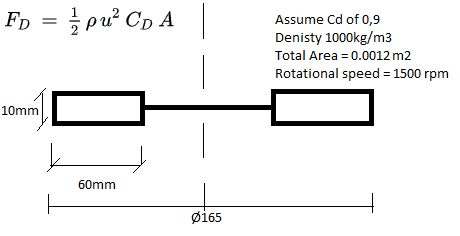
It involves a rotating paddle wheel submerged in water and i want to know the force exerted on the wheels and the torque required to rotate it. I have made a simple drawing to illustrate the problem below. I want to use the Drag equation to solve it, even though it is for linear motion, we can convert rotational motion to linear. But since the diameter changes the speed at any radial location and the force is based on a square function i can't get an exact solution for the problem.
1581264977590.png


Can you help me with this problem?
 
Engineering news on Phys.org
:welcome:
This sounds like homework. Is it?
 
Hi anorlunda.

Actually this is not a homework problem.

I want to reduce the drag of something that is rotating in water and want to know the exact solution to it, i already have a rough estimate that would suffice for basic engineering. Just curious i quess :)
 
My current solution:
I assume the average speed to be in the middle of the paddle wheel. That point is located at Ø135 or r=0.0675M

v= r x RPM x rad/s
v =0.0675m x 1500rpm x 0.10472 = 10.6 meter / second

Drag equation using the speed:
1581269703732.png

So the combined torque for both sides of the paddle wheel would be:
Nm= 60 Newton * 0,0675M = 4.1 Nm
 
Last edited:
Why not set up the differential drag on a differential[ length and then integrate? But isn't the thing you want actually the total moment?
 
  • Like
Likes   Reactions: Chestermiller
Hi Dr.D.

Yes i think you are correct that this is a calculus problem. If i replace v with r x RPM x rad/s in the drag equation, i could maybe setup an differential equation? The total moment is what I am after, i need to know the torque for selecting an electric motor.
 
erlend said:
Hi Dr.D.

Yes i think you are correct that this is a calculus problem. If i replace v with r x RPM x rad/s in the drag equation, i could maybe setup an differential equation? The total moment is what I am after, i need to know the torque for selecting an electric motor.
Let's see your attempt to do this.
 
Its not hard. Just look at the force on a differential length, calculate the moment of that force, and then integrate to get the total moment.
 

Similar threads

Replies
9
Views
2K
Replies
6
Views
4K
  • · Replies 32 ·
2
Replies
32
Views
2K
  • · Replies 4 ·
Replies
4
Views
3K
  • · Replies 25 ·
Replies
25
Views
2K
Replies
9
Views
2K
  • · Replies 2 ·
Replies
2
Views
2K
Replies
10
Views
3K
  • · Replies 15 ·
Replies
15
Views
4K
