Discussion Overview
The discussion revolves around the validity of conventional vector combination theory, particularly in the context of graphical vector addition and its applicability to scenarios involving opposing vector components. Participants explore the implications of vector addition in various physical contexts, including force analysis and internal force equilibrium.
Discussion Character
- Debate/contested
- Technical explanation
- Conceptual clarification
Main Points Raised
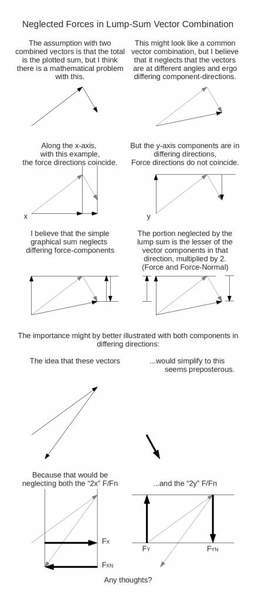
- One participant argues that conventional vector addition neglects portions of vectors when they have opposite-facing components, suggesting that the theory is only valid for parallel vectors.
- Another participant dismisses the initial claim, asserting that the conventional method of vector addition is sound.
- A different participant supports the initial claim by stating that the graphical representation provided is accurate, but questions the application of vector addition in the context of internal forces and deformation physics.
- One participant emphasizes that while conventional vector addition works on a macro scale, it may not adequately represent internal forces in certain physical scenarios, such as finite element analysis (FEA).
- Another participant counters that the conventional method of vector addition is the only logical approach, criticizing the suggestion that the order of addition could yield different results.
Areas of Agreement / Disagreement
Participants express disagreement regarding the validity of conventional vector combination theory. Some support the critique of the theory, while others defend the conventional approach as sound and necessary.
Contextual Notes
The discussion highlights limitations in the applicability of conventional vector addition, particularly in specific physical contexts like internal force equilibrium and deformation physics, but does not resolve these limitations or assumptions.