Ideal gas undergoes cycle process

Click For Summary
SUMMARY

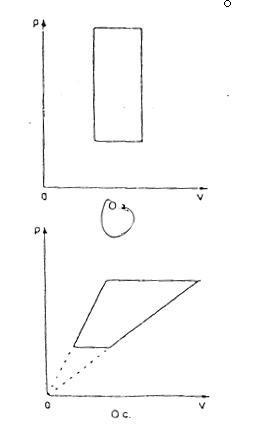
An ideal gas undergoes a cycle process represented in a PV graph, demonstrating the relationship between pressure (p), volume (V), and temperature (T) as defined by the equation pV = nRT. The upper graph illustrates linear relationships between temperature and pressure, indicating constant volume, which results in vertical lines in the p-V graph. In contrast, the lower graph fails to meet these criteria, as it does not maintain the necessary conditions for an ideal gas during the cycle process.

PREREQUISITES
  • Understanding of the ideal gas law (pV = nRT)
  • Familiarity with PV diagrams and their interpretation
  • Knowledge of thermodynamic processes and cycles
  • Basic principles of gas behavior under varying conditions
NEXT STEPS
  • Study the implications of the ideal gas law in different thermodynamic processes
  • Explore the characteristics of isothermal and adiabatic processes in PV diagrams
  • Learn about the Carnot cycle and its significance in thermodynamics
  • Investigate real gas behavior and deviations from ideal gas laws
USEFUL FOR

Students of thermodynamics, physics enthusiasts, and professionals in engineering fields who require a deeper understanding of gas behavior in cycle processes.

b_andries
Messages
13
Reaction score
0
Hi,

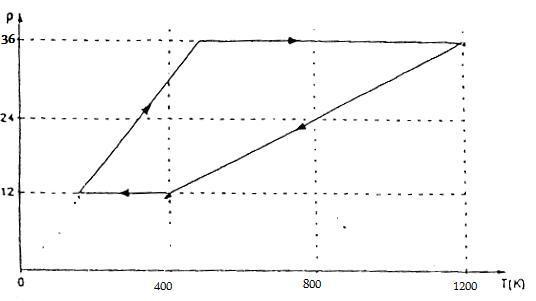
An amount of ideal gas undergoes the folowing cycle process in the following graph:
attachment.php?attachmentid=33655&stc=1&d=1301348391.jpg


This process can be presented by the following PV-graph :
attachment.php?attachmentid=33656&stc=1&d=1301348391.jpg


The answer has to be the upper graph but why can't it be the lower graph ?
Thank you!
 

Attachments

  • cycle process.jpg
    cycle process.jpg
    13.1 KB · Views: 553
  • grafiek.jpg
    grafiek.jpg
    5.8 KB · Views: 615
Physics news on Phys.org
An ideal gas has: p V = n R T

That is: V = n R T / p

As you can see in the upper graph there are linear relations between T and p, meaning V must be constant, resulting in vertical lines in the p-V-graph.
Note that the diagonal lines in the upper graph can be extended to intersect the axes at the origin.
 

Similar threads

  • · Replies 33 ·
2
Replies
33
Views
3K
  • · Replies 4 ·
Replies
4
Views
3K
  • · Replies 3 ·
Replies
3
Views
2K
  • · Replies 1 ·
Replies
1
Views
866
  • · Replies 4 ·
Replies
4
Views
3K
  • · Replies 6 ·
Replies
6
Views
4K
  • · Replies 1 ·
Replies
1
Views
1K
  • · Replies 10 ·
Replies
10
Views
3K
  • · Replies 7 ·
Replies
7
Views
2K
Replies
2
Views
1K