Identifying circuits from lamp brightness in two black boxes

  • Thread starter Thread starter Physdiot
  • Start date Start date
  • Tags Tags
    Box Circuits
Join the discussion
Registration is free. Start your own thread to ask a follow-up.
12 replies · 6K views · last reply
Physdiot
Messages
3
Reaction score
1
Hi

I'm experimenting with some black boxes and I'm trying to figure out what's their circuit. I can't seem to find what these two circuits could be.. Could someone please help me out?

The purple crosses mark which ports are connected to the power source (6V). The yellow marks show how hard every lamp is burning.

Circuit 1 w/ switch:

Two hand-drawn diagrams of black boxes, each with four ports and lamps shown above, with yellow shading indicating lamp brightness and purple crosses marking the power connections. The right diagram has an arrow pointing to a switch.

The second setup shows the lamps when the switch is pushed.

Circuit 2 without switch:
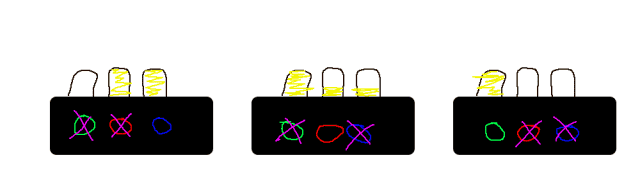
Three black boxes each with three ports and three lamps shown as circles, with purple crosses marking powered ports and yellow scribbles showing lamp brightness levels.


The purpose is to get something like this: (this is from another black box I tried)

Wiring diagram with three labelled terminals: GREEN and RED each lead to a lamp symbol, and both lamps join a wire that connects down to BLUE.


If anyone could help me with this, I'd be glad! Thanks!
 
Attachments
  • Two hand-drawn diagrams of black boxes, each with four ports and lamps shown above, with yellow shading indicating lamp brightness and purple crosses marking the power connections. The right diagram has an arrow pointing to a switch.
    circuit-1.png
    3.5 KB · Views: 868
  • Three black boxes each with three ports and three lamps shown as circles, with purple crosses marking powered ports and yellow scribbles showing lamp brightness levels.
    circuit-2.png
    5.1 KB · Views: 847
  • Wiring diagram with three labelled terminals: GREEN and RED each lead to a lamp symbol, and both lamps join a wire that connects down to BLUE.
    example.png
    2.7 KB · Views: 861
Engineering news on Phys.org
@scottdave They refer to the colors of the ports where you can plug the wires into. The wires are connected to a power supply (6V). The purpose is to get a circuit that you could rebuild the black box with.
 
Is this a problem you made up yourself?

There is not enough information for us to understand what you mean or what you are trying to accomplish.
 
I have attached my suggested circuits.
Two hand-drawn circuit schematics labelled Case 1 and Case 2, each with terminals labelled G, R and B and several lamp symbols connected by wires.
 
Attachments
  • Two hand-drawn circuit schematics labelled Case 1 and Case 2, each with terminals labelled G, R and B and several lamp symbols connected by wires.
    upload_2019-2-16_21-3-15.png
    7.4 KB · Views: 779
scottdave said:
OK, the circle with an x is a light bulb. I hadn't seen that used before.
The Wiki article shows it as an incandescent lamp used as an indicator. It is taught to the kids at school in the UK. I don't like the symbol myself.
https://en.wikipedia.org/wiki/Electronic_symbol
 
  • Like
Likes   Reactions: davenn
And in the US, the Ladder Diagram used in industrial control schematics shows this for a lamp (although the Switch symbol shown here is rarely seen):

Circuit schematic of a 120 VAC supply through a fuse feeding a switch and lamp between lines L1 and L2, with a ground symbol on L2 and a transformer shown at the top.


from: https://www.allaboutcircuits.com/textbook/digital/chpt-6/ladder-diagrams/
 
Attachments
  • Circuit schematic of a 120 VAC supply through a fuse feeding a switch and lamp between lines L1 and L2, with a ground symbol on L2 and a transformer shown at the top.
    04006.png
    2.5 KB · Views: 632
scottdave said:
OK, the circle with an x is a light bulb. I hadn't seen that used before.
tech99 said:
The Wiki article shows it as an incandescent lamp used as an indicator. It is taught to the kids at school in the UK.

Yeah, pretty standard here in Australia and New Zealand as well :smile:
 
Thank you very much all for your replies! Thanks to you guys I was able to solve my problem!
 
  • Like
Likes   Reactions: berkeman