If f(x)=(e^x+e^-x)/2, what is the inverse function?

Join the discussion
Registration is free. Ask a follow-up in this thread, or start your own.
16 replies · 3K views
Darkmisc
Messages
222
Reaction score
31
Homework Statement
If f(x)=(e^x+e^-x)/2, what is the inverse function?
Relevant Equations
f(x)=(e^x+e^-x)/2
Hi everyone

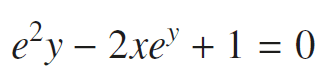
This is the solution for the problem.
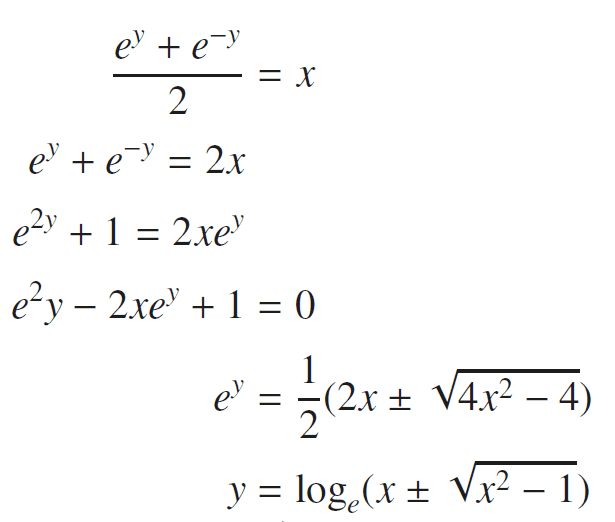
image_2022-06-18_142157071.png


I don't understand how they got from
image_2022-06-18_142300299.png

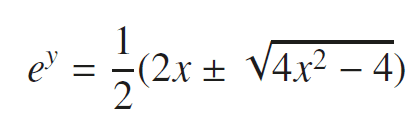
To
1655526208447.png


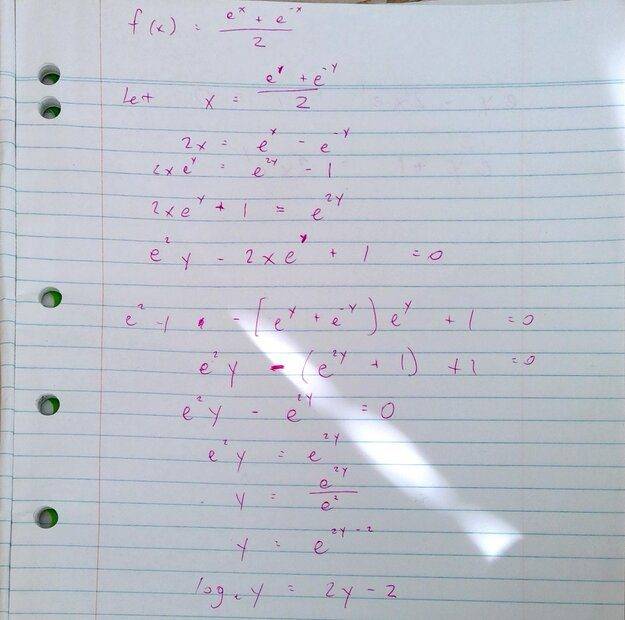
This was my attempt at a solution

WIN_20220618_14_09_15_Scan.jpg


I can't seem to get rid of one of the y terms and am left with one on each side.

Could someone explain the solution to me please?

Thanks
 
Physics news on Phys.org
##e^x + e^{-x}## is not injective in ##\mathbb R## (even function). You should assume either ##x<0## or ##x>0##.
 
  • Like
Likes   Reactions: Darkmisc and Delta2
mathwonk said:
note: x = (1/2)(e^y + e^-y) = cos(iy). so the inverse is -i.arccos(x).

We call that function "cosh", so the inverse is [itex]\operatorname{arccosh}(x)[/itex].
 
  • Like
Likes   Reactions: PeroK
er sorry $$\operatorname{arccosh}(x)=-i\arccos(x)$$?

Btw there is a silly typo that was spotted successfully by @FactChecker the quadratic with respect to ##e^y## is ##(e^y)^2-2xe^y+1=0## for which you can set ##z=e^y## solve it for z(x) as a normal quadratic and then take $$e^y=z(x)\Rightarrow y=\ln z(x)$$.
 
  • Like
Likes   Reactions: Maarten Havinga
Delta2 said:
er sorry $$\operatorname{arccosh}(x)=-i\arccos(x)$$?

Btw there is a silly typo that was spotted successfully by @FactChecker the quadratic with respect to ##e^y## is ##(e^y)^2-2xe^y+1=0## for which you can set ##z=e^y## solve it for z(x) as a normal quadratic and then take $$e^y=z(x)\Rightarrow y=\ln z(x)$$.
With the caveats that ##z(x) >0##, and, for well definedness, its an injection, I guess.
 
Delta2 said:
$$\operatorname{arccosh}(x)=-i\arccos(x)$$?
You're probably confused because you're thinking of cosine defined for reals. If you consider the cosine function defined for complex numbers, it makes sense.

WWGD said:
With the caveats that ##z(x) >0##, and, for well definedness, its an injection, I guess.
If ##y## is real, then ##e^y>0##.

Note that the quadratic has two solutions, ##y_+## and ##y_-##. To make the inverse a function, we arbitrarily choose the positive root and map ##x## to ##y_+##.

It's not obvious, but you can show that ##y_- = -y_+##.
 
  • Like
  • Skeptical
Likes   Reactions: Delta2 and FactChecker
Orodruin said:
Am I the only one reacting on the use of ”arccosh” instead of the standard ”arcosh”?
I think the "arc" notation is pretty common. Mathematica, for example, calls the function ArcCosh.

In fact, until you pointed it out, I didn't know "arcosh" was the standard way to write it. :smile:
 
  • Like
Likes   Reactions: PeroK
vela said:
Mathematica, for example, calls the function ArcCosh.
Mathematica is then not up to ISO 80000-2 standard. 🤔

But yes, it is a fairly common mistake but arccosh would be a misnomer as the function does not relate to arc length but to area (unless measuring in Minkowski geometry….)
 
vela said:
You're probably confused because you're thinking of cosine defined for reals. If you consider the cosine function defined for complex numbers, it makes sense.If ##y## is real, then ##e^y>0##.

Note that the quadratic has two solutions, ##y_+## and ##y_-##. To make the inverse a function, we arbitrarily choose the positive root and map ##x## to ##y_+##.

It's not obvious, but you can show that ##y_- = -y_+##.
Ah, I missed that result before log(z(x)).
 
vela said:
Hint: ##(x + \sqrt{x^2-1})(x-\sqrt{x^2-1})=1##.
Ehm that is correct but all you can actually prove with this is that ##y_{+}=\frac{1}{y_{-}}##.

Ah ok you mean the solutions to ##e^y=z(x)## or ##e^y=\frac{1}{z(x)}##
 
Last edited:
For invertibility of ##\cosh x## (in ##\mathbb R##), we usually mean
[tex] \cosh : [0,\infty) \to [1,\infty),\quad \cosh(x) := \frac{e^x+e^{-x}}{2}.[/tex]
Putting
[tex] g : [1,\infty ) \to [0,\infty ),\quad g(x) := \ln (x+\sqrt{x^2-1})[/tex]
one can verify that ##g\circ \cosh## and ##\cosh \circ g## are the identities. From ##y_+y_- = 1## it follows that ## \ln y_- < 0##, so it couldn't be the correct choice in this case.

But it's completely fine to define ##\cosh## on the negative side. In that case, for the inverse, one also opts for ##\ln y_-##.