Impact of Atmospheric Pressure on the Water in a Tank and a Pipe

Click For Summary

Discussion Overview

The discussion revolves around understanding the behavior of water in a tank and a pipe under atmospheric pressure, particularly focusing on the dynamics of fluid levels when a valve is opened. Participants explore the relationship between atmospheric pressure, water pressure, and fluid movement in a closed system.

Discussion Character

  • Exploratory
  • Technical explanation
  • Conceptual clarification
  • Debate/contested

Main Points Raised

  • One participant questions why water rises in the vertical tube when atmospheric pressure is greater, suggesting that the decrease in water level in the tank affects the pressure dynamics.
  • Another participant clarifies that the pipe is blocked at the lower end, which is crucial for understanding the pressure conditions.
  • There is a discussion about the pressure differences at various depths, with one participant asserting that water pressure increases significantly with depth, particularly in the context of a lake.
  • Another participant argues that the water pressure at the bottom of the tube is greater than atmospheric pressure, which contributes to the water rising in the tube.
  • One participant explains that the air pressure does not increase as rapidly as water pressure with depth due to the lower density of air.
  • A later reply introduces the concept of equilibrium, suggesting that the pressures will balance out when the water levels in the tank and tube are equal.
  • A question is posed about the implications of blocking the top of the tube before opening the valve in the tank, indicating further exploration of the system's behavior.

Areas of Agreement / Disagreement

Participants express varying views on the dynamics of pressure in the system, with no consensus reached on the specific mechanics of fluid movement and pressure interactions. Multiple competing explanations are presented.

Contextual Notes

Participants reference the effects of atmospheric pressure and water pressure without resolving the assumptions about fluid behavior in closed systems. The discussion includes hypothetical scenarios that remain unresolved.

Who May Find This Useful

This discussion may be of interest to individuals studying fluid dynamics, physics students exploring pressure concepts, or anyone curious about the behavior of fluids in closed systems.

tomtomtom1
Messages
160
Reaction score
8
TL;DR
Impact of Atmospheric Pressure on Water in a Tank and Pipe
Hello all

I was hoping someone could help with understanding how fluids level out under atmospheric pressure. For example:-

Below is a picture of a tank of water with a closed door at the bottom, the door leads to an inclined pipe that is closed off at the end there is another pipe connected vertically.

I have drawn arrows in red to represent the atmospheric pressure which gets greater due to depth and I have drawn arrows in blue to represent the water pressure which also gets greater due to depth.
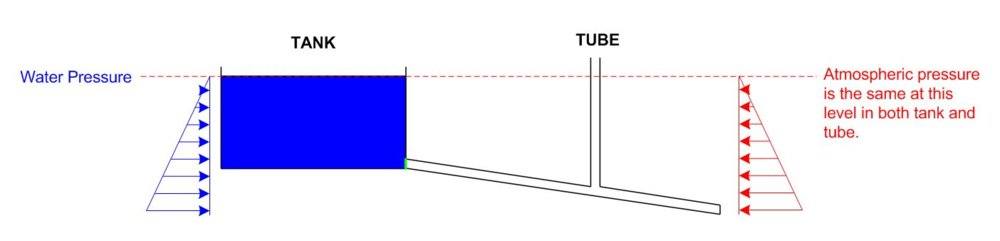
one.JPG

Now if i opened the green door and allowed the water to flow, but let's say for now the water did not rise up the tube then my diagram would look like:-
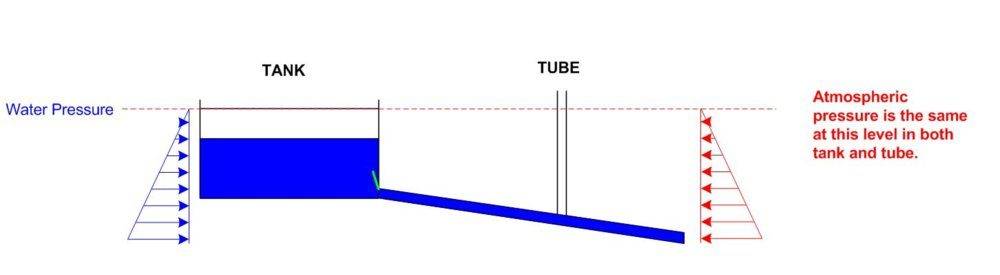
two.JPG


The question is why does the water rise up the tube and stop rising until the water in the tank and the water in the fluid are at the same level?

What i think is correct is that; as the water in the tank flows down into the pipe, the water level in the tank decreases which means that the force due to the pressure in the tank decreases but the atmosphere pressure in the tank increases.

But i am struggling to understand why the water would rise UP the tube when there is more atmospheric pressure pushing down?

Can anyone explain?

Thank you.
 
Last edited:
Engineering news on Phys.org
Is the water flowing out the pipe while this is going on, or is the water blocked at the lower end after the water fills the pipe?
 
The pipe is blocked at the lower end.
 
OK. So down low, right below the vertical tube, do you think that the water pressure is very high or do you think it is not very high? (For example, do you think that about 10 m below the water surface in a lake, the water pressure is much higher than near the surface, or not very high?)
 
Chestermiller said:
OK. So down low, right below the vertical tube, do you think that the water pressure is very high or do you think it is not very high? (For example, do you think that about 10 m below the water surface in a lake, the water pressure is much higher than near the surface, or not very high?)

I would say that it is high because the water flowing in from the tank is making it high.
 
tomtomtom1 said:
I would say that it is high because the water flowing in from the tank is making it high.
That's the reason it rises into the vertical tube. The air pressure doesn't increase nearly as fast as water pressure with depth because air density is very low.
 
  • Like
Likes   Reactions: tomtomtom1
The pressure at the bottom of the empty tube is greater than atmospheric pressure, by about 7 arrows. (Atmospheric pressure can be ignored because it is bearing on both the water in the tank and the water in the tube).

The additional pressure in the tube will push water up the tube and as the level in the tube goes up the pressure at the top of that water reduces due to the height and the pressures will tend to balance out. When the level in the tube is the same as the level in the tank you have equilibrium.

It is how water level sight glasses work. You could put one in your tube to measure the level of water in the tank.
https://inspectapedia.com/heat/Steam_Boiler_Sight_Glass.php

What would happen if you blocked the top of the tube before you opened the "door" (valve) in the tank?
 
  • Like
Likes   Reactions: tomtomtom1

Similar threads

  • · Replies 26 ·
Replies
26
Views
2K
Replies
50
Views
7K
  • · Replies 14 ·
Replies
14
Views
2K
Replies
2
Views
2K
Replies
2
Views
3K
  • · Replies 37 ·
2
Replies
37
Views
4K
  • · Replies 16 ·
Replies
16
Views
8K
  • · Replies 2 ·
Replies
2
Views
4K
Replies
8
Views
2K
  • · Replies 8 ·
Replies
8
Views
3K