Implication, Boolean Expression and Venn Diagrams

Click For Summary

Discussion Overview

The discussion revolves around understanding the logical relations "A implies B" and "A if and only if B" through the lens of Boolean expressions and Venn diagrams. Participants explore the compatibility of various Venn diagrams with the corresponding truth tables for these logical statements, raising questions about the validity of certain diagrams and the implications of specific hypotheses.

Discussion Character

  • Exploratory
  • Technical explanation
  • Debate/contested
  • Mathematical reasoning

Main Points Raised

  • One participant expresses confusion about the representation of "A implies B" using the Boolean expression "¬A + B" and its corresponding Venn diagrams, questioning the compatibility of certain diagrams with the truth table.
  • Another participant clarifies that "A implies B" means if an element is in A, it must also be in B, suggesting that A is a subset of B.
  • There is a discussion about the implications of the Boolean expression and whether it is equivalent to "A implies B," with some participants questioning the validity of certain diagrams based on their interpretations.
  • Some participants propose hypotheses regarding the relationships between sets A and B that could lead to rejecting specific Venn diagrams.
  • One participant suggests that only one Venn diagram can represent the full truth table due to the number of areas it covers, indicating that other diagrams illustrate special cases.
  • Another participant discusses the nuances of equivalence in set theory, emphasizing that equivalence does not necessarily imply equality of sets.

Areas of Agreement / Disagreement

Participants exhibit a mix of agreement and disagreement regarding the interpretations of the diagrams and their compatibility with the truth tables. Some participants agree on the definitions and implications of "A implies B" and "A if and only if B," while others challenge the validity of specific diagrams and the assumptions made.

Contextual Notes

Participants mention specific hypotheses that could affect the interpretation of the diagrams, such as the intersection of sets and the conditions under which certain diagrams may be valid or invalid. There is also an acknowledgment of the limitations of certain sources of information, such as Wikipedia, in providing reliable representations of these concepts.

Who May Find This Useful

This discussion may be useful for students or individuals studying logic, set theory, or Boolean algebra, particularly those interested in the relationships between logical expressions and their visual representations through Venn diagrams.

DanielMB
Messages
24
Reaction score
12
TL;DR
Relationship among implication, Boolean expression and Venn diagrams
Hello, I’m having difficulties understanding logical relations “A implies B” and “A if and only if” using Boolean expressions and Venn diagrams, there is something where I’m wrong, but I could not find it out. Please, be benevolent and tell me where I’m wrong. Thanks

Note : Obviously I’m supposing that A,B are not null sets

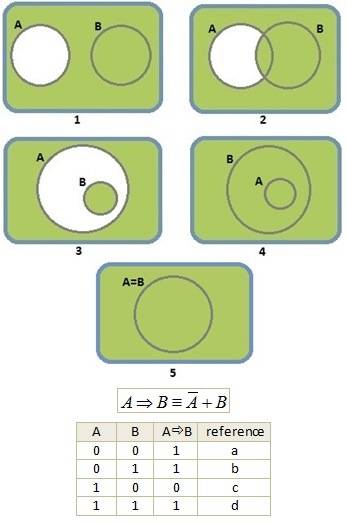
A implies B
246351


Representing “A implies B” using Boolean expression as “–A+B” and the correlated Venn diagrams, knowing that the truth table for “A implies B” is (see attached image)

“A implies B” can be represented by the following Venn diagrams, all of them acomplishing “-A+B” expression (see attached image)

But I’ve found that those diagrams (Vn) are not full compatible with the corresponding truth table

V1: a, b, -c, -d -> Not according to truth table​
V2: a, b, -c, d -> According to truth table​
V3: a, -b, -c, d -> Not according to truth table (but according to “A if and only if B” truth table)​
V4: a, b, -c, d -> According to truth table​
V5: a, -b, -c, d -> Not according to truth table (but according to “A if and only if B” truth table)​

Should I discard (V1, V3, V5)? Are there additional hypotheses?, like the following

H1) A, B with not null intersection : to reject V1​
H2) B is not an A subset : to reject V3​
H3) A not equal to B : to reject V5​

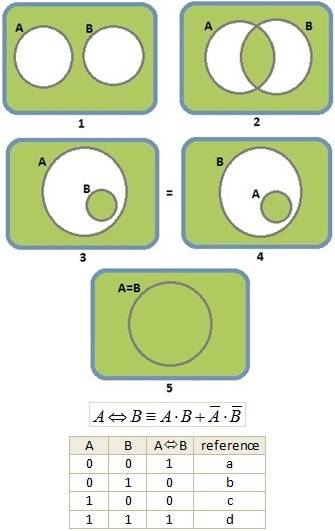
A if and only if B

246352


Representing “A if and only if B” using Boolean expression as “(A.B)+(-A.-B)” and the correlated Venn diagrams, knowing that the truth table for “A if and only if B” is (see attached image)

“A if and only if B” can be represented by the following Venn diagrams, all of them acomplishing “(A.B)+(-A.-B)” expression (see attached image)

Note : V3 and V4 are equivalent, because “A if and only if” is conmutative

But I’ve found that those diagrams (Vn) are not full compatible with the corresponding truth table

V1: a, -b, -c, -d -> Not according to truth table​
V2: a, -b, -c, d -> According to truth table​
V3: a, -b, -c, d -> According to truth table​
V4: a, -b, -c, d -> According to truth table​
V5: a, -b, -c, d -> According to truth table​

Should I discard (V1)? Are there additional hypotheses?, like the following

H1) A, B with not null intersection : to reject V1​

Thanks
 
Physics news on Phys.org
I have difficulties to understand your diagrams. ##A \Longrightarrow B## means, that if ##x\in A## then ##x\in B##, i.e. ##A\subseteq B## (#4).

And for the other one we have ##A \subseteq B ## and ##B\subseteq A## (#5).

What is it that you don't understand?
 
fresh_42 said:
I have difficulties to understand your diagrams. ##A \Longrightarrow B## means, that if ##x\in A## then ##x\in B##, i.e. ##A\subseteq B## (#4).

And for the other one we have ##A \subseteq B ## and ##B\subseteq A## (#5).

What is it that you don't understand?
Thanks fresh_42,

In the case of "A implies B" Boolean expression "-A + B" includes Venn diagrams 1, 3 and 5, Why those diagrams do not accomplish the truth table? Is that the Boolean expression is not equivalent to "A implies B"?
 
  • Like
Likes   Reactions: Klystron
DanielMB said:
Thanks fresh_42,

In the case of "A implies B" Boolean expression "-A + B" includes Venn diagrams 1, 3 and 5, Why those diagrams do not accomplish the truth table? Is that the Boolean expression is not equivalent to "A implies B"?
We can't say anything about ##\lnot A \wedge B## if ##A \Longrightarrow B## is given. It makes a statement under the condition that ##A## is true. If ##A## is false, then we have no statement and anything can be, ##B## as well as ##\lnot B##.

E.g.:
If it rains, the road will be wet. (##A## = it rains; ##B## = wet road; ##A \Longrightarrow B##)
Now if it does not rain, then the road can be dry, or wet because a cleaning machine ran over it, or someone has washed his car or whatever. Everything is possible, except that it rains.
 
  • Like
Likes   Reactions: Michael Price
Thanks Justin, I'll watch the videos

@fresh_42 Well, you can say that: if A(1) ⇒B(1) is also certain that B(0) ⇒ A(0)

I understand your example

Please, look at the "if and only if" image, specifically the diagram #2 (green parts are according to boolean expression), I can't assert that x ∈ A ⇒ x ∈ B and viz., the only valid graph for the biconditional is #5, representing the equivalence relationship between A and B. I know that Wikipedia is not a trustable source of information, but why uses diagram #2.? Am I wrong?
 
DanielMB said:
Thanks Justin, I'll watch the videos

@fresh_42 Well, you can say that: if A(1) ⇒B(1) is also certain that B(0) ⇒ A(0)
Yes, ##\left( A \Longrightarrow B \right) \Longleftrightarrow \left( \lnot B \Longrightarrow \lnot A \right)##
I understand your example

Please, look at the "if and only if" image, specifically the diagram #2 (green parts are according to boolean expression), I can't assert that x ∈ A ⇒ x ∈ B and viz.,...
Why not? ##\left( A \Longleftrightarrow B \right) \Longleftrightarrow \left( (A \Longrightarrow B ) \wedge (B \Longrightarrow A)\right)## or in set speak: ##A \subseteq B \wedge B\subseteq A
\Longleftrightarrow A=B##
... the only valid graph for the biconditional is #5, representing the equivalence relationship between A and B.
Right, two equal sets.
I know that Wikipedia is not a trustable source of information,...
The mathematical section isn't so bad. Wiki cannot be trusted for what you read about celebrities or politicians, because they want to look good. Venn diagrams don't care what people think. More professional is nLab but not as easy.
... but why uses diagram #2.? Am I wrong?
Please give us a precise link and reference. Diagram 2 in what you wrote about ##A\Longleftrightarrow B## shows ##A\cap B## which is ##A \wedge B##, or the exclusive OR, depending on whether you mean the intersection or the white sets. Neither is an equivalence.

Equivalence means the same sets; at least here. Equivalence isn't equality, so it does not mean the same sets - only if you use those Venn diagrams. E.g. one could say that ##\frac{2}{4}=\frac{1}{2}##, or that they are equivalent, because it makes a difference whether you come home with ##\frac{2}{4}## pieces of cake or with half a cake. But if we only draw sets ##A=\{\,\frac{2}{4}\,\}## and ##B=\{\,\frac{1}{2}\,\}## and ask whether they are equivalent, then we have to say ##A=B##.
 
  • Like
Likes   Reactions: DanielMB
I think there is a simpler way to look at this: the truth tables have 4 rows; only 1 of the Venn diagrams in each set has 4 areas so only that diagram can represent the full truth table.

To put it another way, all of the diagrams except Diagram 2 illustrate a special case - for instance Diagram 1 illustrates the special case ## A \cap B = \emptyset ##, so the fourth line in the truth table is not represented by any part of the diagram. Can you identify the other special cases and the related rows in the truth tables?
 
pbuk said:
I think there is a simpler way to look at this: the truth tables have 4 rows; only 1 of the Venn diagrams in each set has 4 areas so only that diagram can represent the full truth table.

To put it another way, all of the diagrams except Diagram 2 illustrate a special case - for instance Diagram 1 illustrates the special case ## A \cap B = \emptyset ##, so the fourth line in the truth table is not represented by any part of the diagram. Can you identify the other special cases and the related rows in the truth tables?

Thanks pbuk,

I tried to identify for both cases the accomplishing or not for the related rows in the truth table

"A ⇒ B"
Diagram #1 : (1, 2 , nothing, nothing) ⇒ OK​
Diagram #2 : (1, 2, 3, 4) ⇒ OK​
Diagram #3 : (1, not 2, 3, 4) ⇒ Not according with the truth table !?​
Diagram #4 : (1, 2, 3, 4) ⇒ OK​
Diagram #5 : (1, nothing, nothing, 4) ⇒ OK​

"A ⇔ B"
Diagram #1 : (1, nothing , nothing, nothing) ⇒ OK​
Diagram #2 : (1, 2, 3, 4) ⇒ OK​
Diagram #3 : (1, 2, 3, 4) ⇒ OK​
Diagram #4 : (1, 2, 3, 4) ⇒ OK​
Diagram #5 : (1, nothing, nothing, 4) ⇒ OK​

Please, tell me if I'm wrong
 
  • #10
Which area of Diagram 3 shows ## B \wedge A ##, the second line of the truth table? What about Diagram 4?
 
  • Like
Likes   Reactions: DanielMB
  • #11
pbuk said:
Which area of Diagram 3 shows ## B \wedge A ##, the second line of the truth table? What about Diagram 4?

Yes, you are right, it doesn't appear represented in the diagram 3 (A implies B)
In the diagram 4 (A implies B) each line in the truth table has its own representation
 
  • #12
DanielMB said:
In the diagram 4 (A implies B) each line in the truth table has its own representation
Including line 3 ## A \wedge B ## ?
 
  • #13
@pbuk

The whole diagram is allowed (green) but it is not posible, since A is a subset of B, so A determines B value
 

Similar threads

  • · Replies 1 ·
Replies
1
Views
3K
  • · Replies 11 ·
Replies
11
Views
3K
  • · Replies 2 ·
Replies
2
Views
3K
Replies
2
Views
4K
Replies
24
Views
5K
  • · Replies 14 ·
Replies
14
Views
5K
  • · Replies 7 ·
Replies
7
Views
3K
  • · Replies 16 ·
Replies
16
Views
2K
  • · Replies 1 ·
Replies
1
Views
3K
  • · Replies 73 ·
3
Replies
73
Views
5K