Implication, Boolean Expression and Venn Diagrams

Click For Summary
SUMMARY

This discussion focuses on the logical relations represented by "A implies B" and "A if and only if B" using Boolean expressions and Venn diagrams. The Boolean expression for "A implies B" is represented as "¬A + B", while "A if and only if B" is expressed as "(A · B) + (¬A · ¬B)". Participants analyze various Venn diagrams (V1 to V5) to determine their compatibility with the corresponding truth tables, concluding that certain diagrams do not accurately represent the logical relationships. The discussion emphasizes the importance of correctly interpreting Venn diagrams in relation to Boolean expressions.

PREREQUISITES
  • Understanding of Boolean algebra and expressions
  • Familiarity with Venn diagrams and their representations
  • Knowledge of logical implications and biconditional statements
  • Ability to analyze truth tables for logical expressions
NEXT STEPS
  • Study the construction and interpretation of truth tables for complex logical expressions
  • Explore advanced topics in Boolean algebra, including De Morgan's laws
  • Learn about the application of Venn diagrams in set theory and logic
  • Investigate the implications of logical equivalence in mathematical proofs
USEFUL FOR

Students of mathematics, logic enthusiasts, educators teaching Boolean algebra, and anyone interested in the applications of Venn diagrams in logical reasoning.

DanielMB
Messages
24
Reaction score
12
TL;DR
Relationship among implication, Boolean expression and Venn diagrams
Hello, I’m having difficulties understanding logical relations “A implies B” and “A if and only if” using Boolean expressions and Venn diagrams, there is something where I’m wrong, but I could not find it out. Please, be benevolent and tell me where I’m wrong. Thanks

Note : Obviously I’m supposing that A,B are not null sets

A implies B
246351


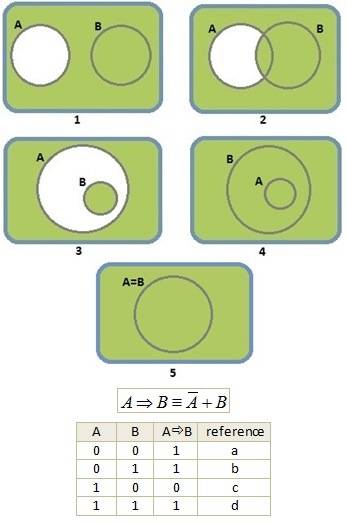
Representing “A implies B” using Boolean expression as “–A+B” and the correlated Venn diagrams, knowing that the truth table for “A implies B” is (see attached image)

“A implies B” can be represented by the following Venn diagrams, all of them acomplishing “-A+B” expression (see attached image)

But I’ve found that those diagrams (Vn) are not full compatible with the corresponding truth table

V1: a, b, -c, -d -> Not according to truth table​
V2: a, b, -c, d -> According to truth table​
V3: a, -b, -c, d -> Not according to truth table (but according to “A if and only if B” truth table)​
V4: a, b, -c, d -> According to truth table​
V5: a, -b, -c, d -> Not according to truth table (but according to “A if and only if B” truth table)​

Should I discard (V1, V3, V5)? Are there additional hypotheses?, like the following

H1) A, B with not null intersection : to reject V1​
H2) B is not an A subset : to reject V3​
H3) A not equal to B : to reject V5​

A if and only if B

246352


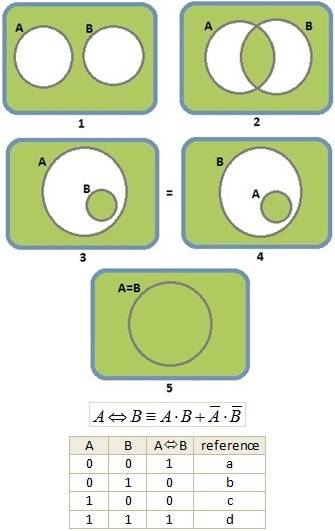
Representing “A if and only if B” using Boolean expression as “(A.B)+(-A.-B)” and the correlated Venn diagrams, knowing that the truth table for “A if and only if B” is (see attached image)

“A if and only if B” can be represented by the following Venn diagrams, all of them acomplishing “(A.B)+(-A.-B)” expression (see attached image)

Note : V3 and V4 are equivalent, because “A if and only if” is conmutative

But I’ve found that those diagrams (Vn) are not full compatible with the corresponding truth table

V1: a, -b, -c, -d -> Not according to truth table​
V2: a, -b, -c, d -> According to truth table​
V3: a, -b, -c, d -> According to truth table​
V4: a, -b, -c, d -> According to truth table​
V5: a, -b, -c, d -> According to truth table​

Should I discard (V1)? Are there additional hypotheses?, like the following

H1) A, B with not null intersection : to reject V1​

Thanks
 
Physics news on Phys.org
I have difficulties to understand your diagrams. ##A \Longrightarrow B## means, that if ##x\in A## then ##x\in B##, i.e. ##A\subseteq B## (#4).

And for the other one we have ##A \subseteq B ## and ##B\subseteq A## (#5).

What is it that you don't understand?
 
fresh_42 said:
I have difficulties to understand your diagrams. ##A \Longrightarrow B## means, that if ##x\in A## then ##x\in B##, i.e. ##A\subseteq B## (#4).

And for the other one we have ##A \subseteq B ## and ##B\subseteq A## (#5).

What is it that you don't understand?
Thanks fresh_42,

In the case of "A implies B" Boolean expression "-A + B" includes Venn diagrams 1, 3 and 5, Why those diagrams do not accomplish the truth table? Is that the Boolean expression is not equivalent to "A implies B"?
 
  • Like
Likes   Reactions: Klystron
DanielMB said:
Thanks fresh_42,

In the case of "A implies B" Boolean expression "-A + B" includes Venn diagrams 1, 3 and 5, Why those diagrams do not accomplish the truth table? Is that the Boolean expression is not equivalent to "A implies B"?
We can't say anything about ##\lnot A \wedge B## if ##A \Longrightarrow B## is given. It makes a statement under the condition that ##A## is true. If ##A## is false, then we have no statement and anything can be, ##B## as well as ##\lnot B##.

E.g.:
If it rains, the road will be wet. (##A## = it rains; ##B## = wet road; ##A \Longrightarrow B##)
Now if it does not rain, then the road can be dry, or wet because a cleaning machine ran over it, or someone has washed his car or whatever. Everything is possible, except that it rains.
 
  • Like
Likes   Reactions: Michael Price
Thanks Justin, I'll watch the videos

@fresh_42 Well, you can say that: if A(1) ⇒B(1) is also certain that B(0) ⇒ A(0)

I understand your example

Please, look at the "if and only if" image, specifically the diagram #2 (green parts are according to boolean expression), I can't assert that x ∈ A ⇒ x ∈ B and viz., the only valid graph for the biconditional is #5, representing the equivalence relationship between A and B. I know that Wikipedia is not a trustable source of information, but why uses diagram #2.? Am I wrong?
 
DanielMB said:
Thanks Justin, I'll watch the videos

@fresh_42 Well, you can say that: if A(1) ⇒B(1) is also certain that B(0) ⇒ A(0)
Yes, ##\left( A \Longrightarrow B \right) \Longleftrightarrow \left( \lnot B \Longrightarrow \lnot A \right)##
I understand your example

Please, look at the "if and only if" image, specifically the diagram #2 (green parts are according to boolean expression), I can't assert that x ∈ A ⇒ x ∈ B and viz.,...
Why not? ##\left( A \Longleftrightarrow B \right) \Longleftrightarrow \left( (A \Longrightarrow B ) \wedge (B \Longrightarrow A)\right)## or in set speak: ##A \subseteq B \wedge B\subseteq A
\Longleftrightarrow A=B##
... the only valid graph for the biconditional is #5, representing the equivalence relationship between A and B.
Right, two equal sets.
I know that Wikipedia is not a trustable source of information,...
The mathematical section isn't so bad. Wiki cannot be trusted for what you read about celebrities or politicians, because they want to look good. Venn diagrams don't care what people think. More professional is nLab but not as easy.
... but why uses diagram #2.? Am I wrong?
Please give us a precise link and reference. Diagram 2 in what you wrote about ##A\Longleftrightarrow B## shows ##A\cap B## which is ##A \wedge B##, or the exclusive OR, depending on whether you mean the intersection or the white sets. Neither is an equivalence.

Equivalence means the same sets; at least here. Equivalence isn't equality, so it does not mean the same sets - only if you use those Venn diagrams. E.g. one could say that ##\frac{2}{4}=\frac{1}{2}##, or that they are equivalent, because it makes a difference whether you come home with ##\frac{2}{4}## pieces of cake or with half a cake. But if we only draw sets ##A=\{\,\frac{2}{4}\,\}## and ##B=\{\,\frac{1}{2}\,\}## and ask whether they are equivalent, then we have to say ##A=B##.
 
  • Like
Likes   Reactions: DanielMB
I think there is a simpler way to look at this: the truth tables have 4 rows; only 1 of the Venn diagrams in each set has 4 areas so only that diagram can represent the full truth table.

To put it another way, all of the diagrams except Diagram 2 illustrate a special case - for instance Diagram 1 illustrates the special case ## A \cap B = \emptyset ##, so the fourth line in the truth table is not represented by any part of the diagram. Can you identify the other special cases and the related rows in the truth tables?
 
pbuk said:
I think there is a simpler way to look at this: the truth tables have 4 rows; only 1 of the Venn diagrams in each set has 4 areas so only that diagram can represent the full truth table.

To put it another way, all of the diagrams except Diagram 2 illustrate a special case - for instance Diagram 1 illustrates the special case ## A \cap B = \emptyset ##, so the fourth line in the truth table is not represented by any part of the diagram. Can you identify the other special cases and the related rows in the truth tables?

Thanks pbuk,

I tried to identify for both cases the accomplishing or not for the related rows in the truth table

"A ⇒ B"
Diagram #1 : (1, 2 , nothing, nothing) ⇒ OK​
Diagram #2 : (1, 2, 3, 4) ⇒ OK​
Diagram #3 : (1, not 2, 3, 4) ⇒ Not according with the truth table !?​
Diagram #4 : (1, 2, 3, 4) ⇒ OK​
Diagram #5 : (1, nothing, nothing, 4) ⇒ OK​

"A ⇔ B"
Diagram #1 : (1, nothing , nothing, nothing) ⇒ OK​
Diagram #2 : (1, 2, 3, 4) ⇒ OK​
Diagram #3 : (1, 2, 3, 4) ⇒ OK​
Diagram #4 : (1, 2, 3, 4) ⇒ OK​
Diagram #5 : (1, nothing, nothing, 4) ⇒ OK​

Please, tell me if I'm wrong
 
  • #10
Which area of Diagram 3 shows ## B \wedge A ##, the second line of the truth table? What about Diagram 4?
 
  • Like
Likes   Reactions: DanielMB
  • #11
pbuk said:
Which area of Diagram 3 shows ## B \wedge A ##, the second line of the truth table? What about Diagram 4?

Yes, you are right, it doesn't appear represented in the diagram 3 (A implies B)
In the diagram 4 (A implies B) each line in the truth table has its own representation
 
  • #12
DanielMB said:
In the diagram 4 (A implies B) each line in the truth table has its own representation
Including line 3 ## A \wedge B ## ?
 
  • #13
@pbuk

The whole diagram is allowed (green) but it is not posible, since A is a subset of B, so A determines B value
 

Similar threads

  • · Replies 1 ·
Replies
1
Views
3K
  • · Replies 11 ·
Replies
11
Views
3K
  • · Replies 2 ·
Replies
2
Views
3K
Replies
2
Views
4K
Replies
24
Views
5K
  • · Replies 14 ·
Replies
14
Views
5K
  • · Replies 7 ·
Replies
7
Views
3K
  • · Replies 16 ·
Replies
16
Views
2K
  • · Replies 1 ·
Replies
1
Views
2K
  • · Replies 63 ·
3
Replies
63
Views
2K