Induced voltage with coil between 2 magnets

Click For Summary
SUMMARY

The discussion centers on the induced voltage in a coil positioned between two rare Earth magnets in a seismometer setup. It is established that the orientation of the magnets significantly affects the induced voltage; specifically, configurations that align the magnets in a N-S-N-S or S-N-S-N pattern produce a flowing magnetic flux, while N-S-S-N or S-N-N-S arrangements result in negligible flux and thus no induced voltage. The movement of the coil relative to the magnets during seismic activity is crucial for generating a measurable signal.

PREREQUISITES
  • Understanding of electromagnetic principles, particularly Faraday's Law of Induction.
  • Familiarity with the behavior of magnetic fields and flux.
  • Knowledge of seismometer design and functionality.
  • Experience with rare Earth magnets and their applications in electromagnetic devices.
NEXT STEPS
  • Research the principles of Faraday's Law of Induction in detail.
  • Explore different configurations of magnets and their effects on magnetic flux.
  • Investigate the design and optimization of seismometers using various magnet types.
  • Learn about the use of damping mechanisms in pendulum systems to enhance measurement accuracy.
USEFUL FOR

Engineers, physicists, and hobbyists involved in designing or improving seismometers, as well as those interested in the practical applications of electromagnetic principles in sensing technologies.

davenn
Science Advisor
Gold Member
Messages
9,715
Reaction score
11,708
hi gang,

Just building a seismometer I have 2 x 2.5cm disc rare Earth magnets spaced far enough apart for a coil of wire to move between them.

Would you expect there to be any difference in induced voltage into a coil between 2 magnets when the magnets are orientated to attract or repel ?
I'm thinking no difference, but really have no idea

see pic for idea of what I'm doing. ignore that fact the builder of shown unit is using 4 x disc magnets, 2 top and 2 bottom.
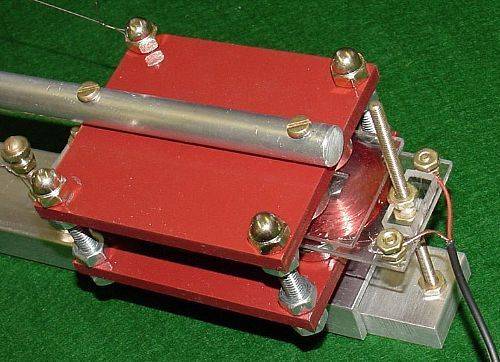
attachment.php?attachmentid=37345&stc=1&d=1311162625.jpg


if there is a difference between the two options ... why ?

cheers
Dave
 

Attachments

  • coil_inserted2a.jpg
    coil_inserted2a.jpg
    37.6 KB · Views: 659
Last edited by a moderator:
Engineering news on Phys.org
Well.. can't see any picture. Got link to it ?
 
GRRR sorry about that

I posted it and saw the pic, thought nothing more of it
then after your comment in the email, I visited the page and saw the pic was missing
Should be ok now :)

cheers
Dave
 
I'm not very familiar with that kind of stuff.. but.. from general elekctromagnetics:

I take that magnets are on opposite sides of coil and when there is earthquake you have some coil-magnets movement, correct ?
If yes then there are significant diffrences for diffrent magnets setups. You can observe signal because there is some movement between magnets and coils. Magnetic flux changes and this induces voltage in coil. The essence here is the magnetic flux generated by magnets. If they are set up in the same side N-S-N-S (or S-N-S-N) the flux is flowing, but if You set them up like N-S-S-N (or S-N-N-S) the magnetic flux will be near zero (it's like two sources set opposite). No flux = no signal.
 
gerbi said:
I'm not very familiar with that kind of stuff.. but.. from general elekctromagnetics:

I take that magnets are on opposite sides of coil and when there is earthquake you have some coil-magnets movement, correct ?
If yes then there are significant diffrences for diffrent magnets setups. You can observe signal because there is some movement between magnets and coils. Magnetic flux changes and this induces voltage in coil.

yes, that's correct. Some guys use horseshoe magnets. But strong and physically relatively small ones are not readily available. So the other main choice these days are to use several rare Earth disc magnets.

The essence here is the magnetic flux generated by magnets. If they are set up in the same side N-S-N-S (or S-N-S-N) the flux is flowing, but if You set them up like N-S-S-N (or S-N-N-S) the magnetic flux will be near zero (it's like two sources set opposite). No flux = no signal.

Just for your info... at the other end of the "red" assembly there are more magnets mounted. They have a piece of aluminium between them. This is used for dampening of the pendulum arm, so that it doesn't go into free natural oscillation. Else you are just recording the motion of the pendulum and not the earth.
Tecnically its the frame of the seismometer that is moving, not the pendulum, due to the large mass on the end of the pendulum arm. but because the pendulum isn't totally isolated from the frame it will start to oscillate as well.

Thanks for your insights :)


Dave
 

Similar threads

Replies
12
Views
3K
Replies
7
Views
5K
Replies
4
Views
4K
  • · Replies 3 ·
Replies
3
Views
1K
  • · Replies 10 ·
Replies
10
Views
3K
  • · Replies 17 ·
Replies
17
Views
4K
  • · Replies 7 ·
Replies
7
Views
3K
  • · Replies 16 ·
Replies
16
Views
11K
  • · Replies 6 ·
Replies
6
Views
2K
  • · Replies 2 ·
Replies
2
Views
2K