Inductance of a Solenoid with a Core inside

Click For Summary
SUMMARY

The discussion focuses on calculating the inductance of a solenoid with a core, utilizing the formulas for magnetic field strength and energy. The magnetic field inside the solenoid with a core is given by ##B_{with~core} = \mu n I##, while the field without the core is ##B_{without~core} = \mu_0 n I##. The total inductance is derived from the contributions of both sections of the solenoid, leading to the formula ##L_{total} = L_1 + L_2##. The energy density of the magnetic field is clarified as ##\frac{1}{2} \frac{B^2}{\mu}##, which must be multiplied by the respective cross-sectional areas to find total energy.

PREREQUISITES
  • Understanding of solenoid inductance calculations
  • Familiarity with magnetic field equations, specifically ##B = \mu n I## and ##B = \mu_0 n I##
  • Knowledge of energy density in magnetic fields, particularly ##\frac{1}{2} \frac{B^2}{\mu}##
  • Basic proficiency in LaTeX for formatting equations
NEXT STEPS
  • Research the concept of mutual inductance and its impact on solenoid calculations
  • Study the derivation of energy stored in magnetic fields in more detail
  • Explore the effects of different core materials on solenoid inductance
  • Learn about the application of the Biot-Savart law in calculating magnetic fields
USEFUL FOR

Electrical engineers, physics students, and anyone involved in designing or analyzing electromagnetic systems, particularly those focused on solenoid applications.

titansarus
Messages
62
Reaction score
0
Homework Statement
We have an Ideal Solenoid with current ##I## and turn per length ##n## and a core with magnetic permittivity of ##\mu## is inside it like the figure. the length ##x_0## of solenoid has the core and the rest is empty. Find the Inductance of a Solenoid.
Relevant Equations
##\int B ds = \mu I##, ##L_T = L_1 + L_2##

The question said the ##\mu## in question is the ##\mu## in the above equation so no need to worry about scale factor.
For finding magnetic field ##B##, We see this question like two Solenoids. for the first one, we have ##\int B ds = \mu I## so ##B x_0 = \mu I n x_0 ## so ##B = \mu n I##. For the second one we have ##B = \mu_0 n I##. For the Inductance we have ##L = \mu l n^2 A## so we have ##L_1 = \mu x_0 n^2 A## and for the second one we have ##L_2 = \mu_0 (L-x_0) n^2 A##. And the ##L_{total} = L_1 + L_2##

Is my reasoning right? I think I didn't considered mutual Inductance but the question is from an exam and it was orally said you don't need to consider mutual inductance.
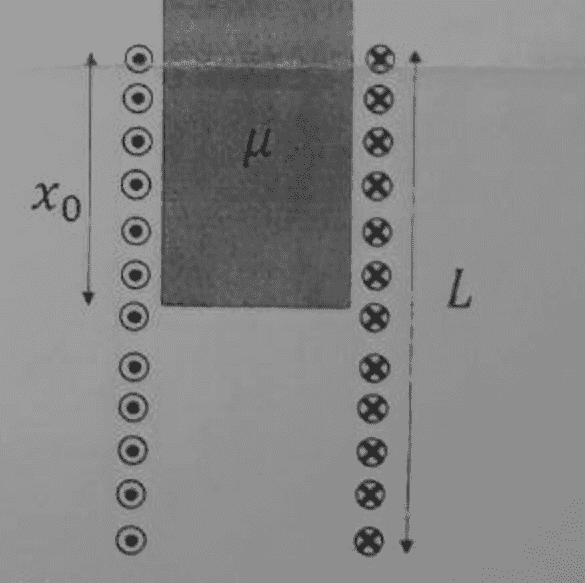
inductance.png
 
Physics news on Phys.org
Ignoring mutual inductance makes no sense. The inductance for any solenoid is approximately calculated assuming full coupling between each winding. That's where all those n^2 and N^2 terms come from. Why should it be different for the same solenoid except part of it has a slug inside?

I would approach this from an energy viewpoint. Very straightforward that way.
 
  • Like
Likes   Reactions: titansarus
rude man said:
Ignoring mutual inductance makes no sense. The inductance for any solenoid is approximately calculated assuming full coupling between each winding. That's where all those n^2 and N^2 terms come from. Why should it be different for the same solenoid except part of it has a slug inside?

I would approach this from an energy viewpoint. Very straightforward that way.
I don't know how to solve this with energy? How is that? I just know energy is ##\frac{1}{2} L i^2##. But I don't know how to use this the calculate inductance in this question.
 
titansarus said:
I don't know how to solve this with energy? How is that? I just know energy is ##\frac{1}{2} L i^2##. But I don't know how to use this the calculate inductance in this question.
You're off to a good start. Now, what are the B fields in both parts of the solenoid, and then the energies of the B fields in both parts of the solenoid?

BTW were you given the cross-sectional area of the solenoid? You need that parameter.
 
  • Like
Likes   Reactions: titansarus
rude man said:
You're off to a good start. Now, what are the B fields in both parts of the solenoid, and then the energies of the B fields in both parts of the solenoid?

BTW were you given the cross-sectional area of the solenoid? You need that parameter.

I will get ##B## as ##B_{with~ core} = \mu n I ## and ##B_{without~core} = \mu_0 n I##, Right? And the energy of ##B## field is ##\frac{1}{2}\frac{B^2}{\mu}## where ##\mu## is the magnetic permittivity of that region of space. is this Right? Should I say that sum of these two energies of ##B## fields equals ##\frac{1}{2} L i^2## where ##L## is the equivalent induction?

For the cross-section area, The area of Core and Solenoid are both equal to ##A##. (The core completely fits into the solenoid)
 
Is 1/2 BH = 1/2 B^2/μ energy or energy density?
BTW you can help me too. How did you manage to write B^2 the right way, i.e. B superscript 2?
 
  • Like
Likes   Reactions: titansarus
rude man said:
Is 1/2 BH = 1/2 B^2/μ energy or energy density?
BTW you can help me too. How did you manage to write B^2 the right way, i.e. B superscript 2?
I think i was wrong. ##\frac{1}{2} \frac{B^2}{ \mu}## is energy density. I think I must multiply it by ##A * x## for the part that has the core and by ##A * (L-x)## for the part that hasn't. Beside this, Is my way correct.

For the subscript and superscript and actually any formula, you must write the formula between two #. Like this picture:

##\int_0^\infty \mu_1^2 \frac{1}{2} dx##
latex2.png
 
titansarus said:
I think i was wrong. ##\frac{1}{2} \frac{B^2}{ \mu}## is energy density. I think I must multiply it by ##A * x## for the part that has the core and by ##A * (L-x)## for the part that hasn't. Beside this, Is my way correct.

For the subscript and superscript and actually any formula, you must write the formula between two #. Like this picture:

##\int_0^\infty \mu_1^2 \frac{1}{2} dx##View attachment 245286
Right! You're there!

I'm familiar (sort of) with LaTex so OK now I know. Before the latest console revision you could write subscripts and superscripts without resorting to LaTex. Thx.
 
  • Like
Likes   Reactions: titansarus

Similar threads

Replies
7
Views
1K
  • · Replies 3 ·
Replies
3
Views
2K
Replies
25
Views
3K
  • · Replies 5 ·
Replies
5
Views
2K
  • · Replies 9 ·
Replies
9
Views
2K
  • · Replies 15 ·
Replies
15
Views
1K
  • · Replies 2 ·
Replies
2
Views
3K
  • · Replies 3 ·
Replies
3
Views
4K
Replies
5
Views
2K
  • · Replies 16 ·
Replies
16
Views
4K