Inductance of a Solenoid with a Core inside

Click For Summary

Homework Help Overview

The discussion revolves around the inductance of a solenoid with a core inside, focusing on the magnetic field calculations and the implications of mutual inductance. Participants are exploring the relationships between the magnetic fields in different sections of the solenoid and how these relate to the overall inductance.

Discussion Character

  • Exploratory, Conceptual clarification, Mathematical reasoning

Approaches and Questions Raised

  • Participants discuss the calculation of the magnetic field for solenoids with and without a core, questioning the neglect of mutual inductance. Some suggest an energy-based approach to understanding inductance, while others express uncertainty about how to apply energy concepts to the problem.

Discussion Status

The conversation is active, with participants sharing their reasoning and questioning assumptions. Some guidance has been offered regarding the calculation of energy densities and the need for specific parameters like cross-sectional area. There is an ongoing exploration of different interpretations of the problem.

Contextual Notes

Participants note the importance of the cross-sectional area of the solenoid and the core, which is stated to be equal. There is also a mention of homework constraints regarding the consideration of mutual inductance.

titansarus
Messages
62
Reaction score
0
Homework Statement
We have an Ideal Solenoid with current ##I## and turn per length ##n## and a core with magnetic permittivity of ##\mu## is inside it like the figure. the length ##x_0## of solenoid has the core and the rest is empty. Find the Inductance of a Solenoid.
Relevant Equations
##\int B ds = \mu I##, ##L_T = L_1 + L_2##

The question said the ##\mu## in question is the ##\mu## in the above equation so no need to worry about scale factor.
For finding magnetic field ##B##, We see this question like two Solenoids. for the first one, we have ##\int B ds = \mu I## so ##B x_0 = \mu I n x_0 ## so ##B = \mu n I##. For the second one we have ##B = \mu_0 n I##. For the Inductance we have ##L = \mu l n^2 A## so we have ##L_1 = \mu x_0 n^2 A## and for the second one we have ##L_2 = \mu_0 (L-x_0) n^2 A##. And the ##L_{total} = L_1 + L_2##

Is my reasoning right? I think I didn't considered mutual Inductance but the question is from an exam and it was orally said you don't need to consider mutual inductance.
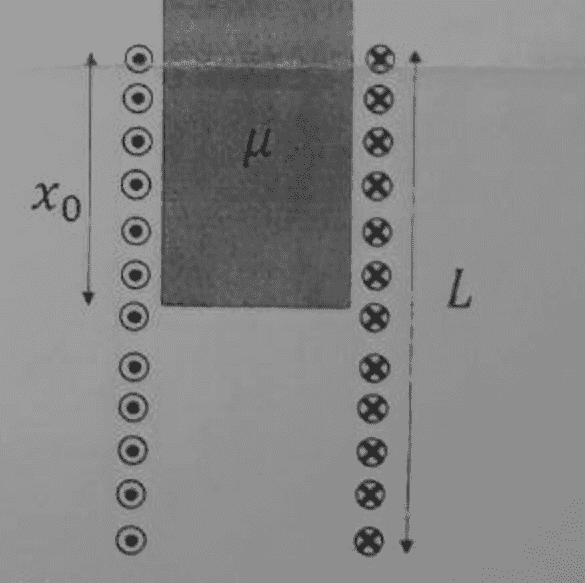
inductance.png
 
Physics news on Phys.org
Ignoring mutual inductance makes no sense. The inductance for any solenoid is approximately calculated assuming full coupling between each winding. That's where all those n^2 and N^2 terms come from. Why should it be different for the same solenoid except part of it has a slug inside?

I would approach this from an energy viewpoint. Very straightforward that way.
 
  • Like
Likes   Reactions: titansarus
rude man said:
Ignoring mutual inductance makes no sense. The inductance for any solenoid is approximately calculated assuming full coupling between each winding. That's where all those n^2 and N^2 terms come from. Why should it be different for the same solenoid except part of it has a slug inside?

I would approach this from an energy viewpoint. Very straightforward that way.
I don't know how to solve this with energy? How is that? I just know energy is ##\frac{1}{2} L i^2##. But I don't know how to use this the calculate inductance in this question.
 
titansarus said:
I don't know how to solve this with energy? How is that? I just know energy is ##\frac{1}{2} L i^2##. But I don't know how to use this the calculate inductance in this question.
You're off to a good start. Now, what are the B fields in both parts of the solenoid, and then the energies of the B fields in both parts of the solenoid?

BTW were you given the cross-sectional area of the solenoid? You need that parameter.
 
  • Like
Likes   Reactions: titansarus
rude man said:
You're off to a good start. Now, what are the B fields in both parts of the solenoid, and then the energies of the B fields in both parts of the solenoid?

BTW were you given the cross-sectional area of the solenoid? You need that parameter.

I will get ##B## as ##B_{with~ core} = \mu n I ## and ##B_{without~core} = \mu_0 n I##, Right? And the energy of ##B## field is ##\frac{1}{2}\frac{B^2}{\mu}## where ##\mu## is the magnetic permittivity of that region of space. is this Right? Should I say that sum of these two energies of ##B## fields equals ##\frac{1}{2} L i^2## where ##L## is the equivalent induction?

For the cross-section area, The area of Core and Solenoid are both equal to ##A##. (The core completely fits into the solenoid)
 
Is 1/2 BH = 1/2 B^2/μ energy or energy density?
BTW you can help me too. How did you manage to write B^2 the right way, i.e. B superscript 2?
 
  • Like
Likes   Reactions: titansarus
rude man said:
Is 1/2 BH = 1/2 B^2/μ energy or energy density?
BTW you can help me too. How did you manage to write B^2 the right way, i.e. B superscript 2?
I think i was wrong. ##\frac{1}{2} \frac{B^2}{ \mu}## is energy density. I think I must multiply it by ##A * x## for the part that has the core and by ##A * (L-x)## for the part that hasn't. Beside this, Is my way correct.

For the subscript and superscript and actually any formula, you must write the formula between two #. Like this picture:

##\int_0^\infty \mu_1^2 \frac{1}{2} dx##
latex2.png
 
titansarus said:
I think i was wrong. ##\frac{1}{2} \frac{B^2}{ \mu}## is energy density. I think I must multiply it by ##A * x## for the part that has the core and by ##A * (L-x)## for the part that hasn't. Beside this, Is my way correct.

For the subscript and superscript and actually any formula, you must write the formula between two #. Like this picture:

##\int_0^\infty \mu_1^2 \frac{1}{2} dx##View attachment 245286
Right! You're there!

I'm familiar (sort of) with LaTex so OK now I know. Before the latest console revision you could write subscripts and superscripts without resorting to LaTex. Thx.
 
  • Like
Likes   Reactions: titansarus

Similar threads

Replies
7
Views
2K
  • · Replies 3 ·
Replies
3
Views
2K
Replies
25
Views
3K
  • · Replies 5 ·
Replies
5
Views
2K
  • · Replies 9 ·
Replies
9
Views
2K
  • · Replies 15 ·
Replies
15
Views
2K
  • · Replies 2 ·
Replies
2
Views
3K
  • · Replies 3 ·
Replies
3
Views
4K
Replies
5
Views
2K
  • · Replies 16 ·
Replies
16
Views
5K