Inelastic collision and momentum

Click For Summary
SUMMARY

The discussion centers on the conservation of momentum during inelastic collisions, specifically addressing the misconception that momentum is not conserved when kinetic energy is lost. Participants clarify that while kinetic energy can dissipate into other forms (e.g., heat, deformation), momentum remains conserved as long as no external forces act on the system. The conversation emphasizes the importance of distinguishing between momentum and kinetic energy, noting that they are fundamentally different quantities. The example of two carts colliding inelastically illustrates that total momentum is maintained despite a decrease in kinetic energy.

PREREQUISITES
  • Understanding of basic physics concepts, particularly momentum and kinetic energy.
  • Familiarity with inelastic collisions and their characteristics.
  • Knowledge of vector quantities versus scalar quantities.
  • Ability to perform basic algebraic calculations related to momentum and energy.
NEXT STEPS
  • Study the principles of conservation of momentum in various collision types, including elastic and inelastic collisions.
  • Learn about the mathematical representation of momentum and kinetic energy, including relevant formulas.
  • Explore real-world applications of momentum conservation in physics experiments and simulations.
  • Investigate the effects of external forces on momentum conservation in different systems.
USEFUL FOR

Students of physics, educators teaching mechanics, and anyone interested in understanding the principles of momentum conservation in collisions.
Karan Punjabi
Messages
127
Reaction score
3
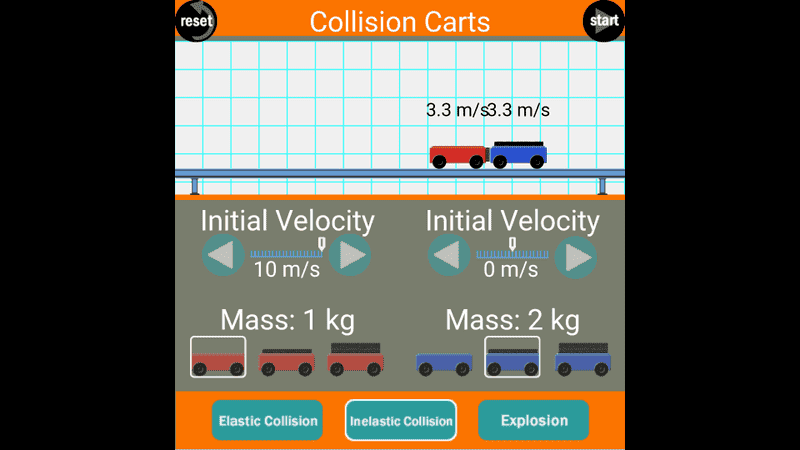
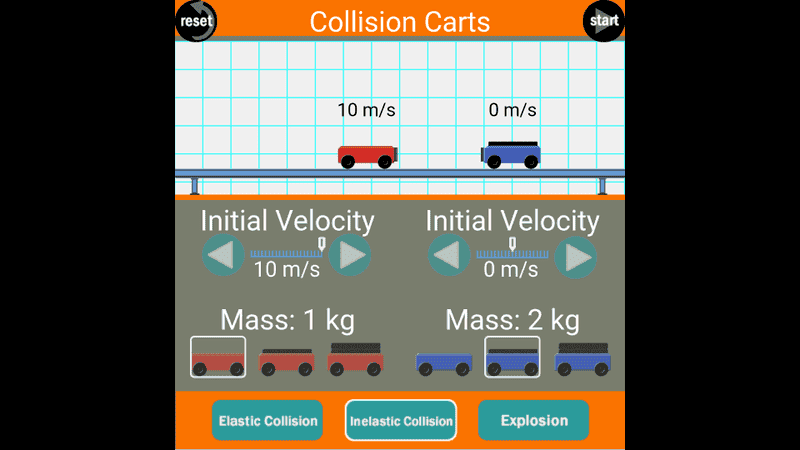
Guys, I'm confused that how momentum is conserved when kinetic energy is lost?...I know this question is asked by many people and i searched for it but I'm not getting the reason. Here i have sent two photos which shows that momentum is not conserved from www.simbucket.com. If I am wrong at any point please correct me. Thankyou
Screenshot_20160317-103325.png
Screenshot_20160317-103318.png
 
Physics news on Phys.org
Karan Punjabi said:
Here i have sent two photos which shows that momentum is not conserved
The 3.3 m/s is rounded up. It's actually 3.333... m/s.
 
A.T. said:
The 3.3 m/s is rounded up. It's actually 3.333... m/s.
But still its not equal right?I don't think that approximations should be taken
 
Karan Punjabi said:
I don't think that approximations should be taken
If you cannot interpret numerical results, do the symbolic math yourself.
 
Karan Punjabi said:
Guys, I'm confused that how momentum is conserved when kinetic energy is lost?...I know this question is asked by many people and i searched for it but I'm not getting the reason. Here i have sent two photos which shows that momentum is not conserved from www.simbucket.com. If I am wrong at any point please correct me. Thankyou
You have just confirmed my suspicion about using simulations to 'prove' ideas in Science. The difference you think you have found is just because of the inevitable rounding in the calculations.
First of all, believe that Momentum is Conserved, which as been proved by measurement, time and time again (and to greater and greater accuracy). A simulation is not a measurement. Then stick with the 'algebra' to get answers - putting in the numbers at the very last moment.
 
sophiecentaur said:
The difference you think you have found is just because of the inevitable rounding in the calculations.
I'm sure the issue here in not calculation accuracy, but merely screen space.
 
Karan Punjabi said:
But still its not equal right?I don't think that approximations should be taken

What EXACTLY are you asking in this thread?

Are you asking if this simulation has a mistake in that the result doesn't EXACTLY show that momentum must be conserved, or are you trying to refute the principle of conservation of momentum in the case of inelastic collision?

If you are asking for the former, then I believe there has been sufficient answers given already.

If you are asking about the latter, then you need your head examined for using a made-up "simulation" as your evidence.

Zz.
 
A.T. said:
The 3.3 m/s is rounded up. It's actually 3.333... m/s.
Karan Punjabi said:
But still its not equal right?I don't think that approximations should be taken

3.3 is the approximation displayed by your simulation. 3.33333333... (or ##3 \frac{1}{3}##) is the exact value. Substitute that exact value into the calculation for the total momentum in your first diagram (the final state after collision) and you'll see that it does follow conservation of momentum.
 
A.T. said:
I'm sure the issue here in not calculation accuracy, but merely screen space.
Yes and no. The display was rounded more than we might like but, otoh, that sort of confusion would never occur in a symbolic approach. The fact that the OP actually thought he might have found a 'loophole' due to the results of a simulation is worrying. (Not his fault but the fault of the common belief in simulations.)
 
  • #10
ZapperZ said:
What EXACTLY are you asking in this thread?

Are you asking if this simulation has a mistake in that the result doesn't EXACTLY show that momentum must be conserved, or are you trying to refute the principle of conservation of momentum in the case of inelastic collision?

If you are asking for the former, then I believe there has been sufficient answers given already.

If you are asking about the latter, then you need your head examined for using a made-up "simulation" as your evidence.

Zz.
I'm asking about conservation of momentum in an inelastic collision... How momentum is comserved when some of the kinetic energy is lost?
 
  • #11
Karan Punjabi said:
I'm asking about conservation of momentum in an inelastic collision... How momentum is comserved when some of the kinetic energy is lost?

But what exactly do you mean by "how momentum is conserved"? I mean, how is momentum conserved in elastic collision? You appear to not have a problem with that!

Conservation of momentum means that there are no external forces acting on the system. All the push/pull came ONLY from within the system, regardless if there is energy loss or not. That is HOW momentum is conserved.

You could have easily asked this without trying to justify your question by using this simulation AND misinterpreting the result.

Zz.
 
  • #12
Karan Punjabi said:
How momentum is comserved when some of the kinetic energy is lost?
They are different quantities, so one can change while the other stays the same.
 
  • #13
Karan Punjabi said:
I'm asking about conservation of momentum in an inelastic collision... How momentum is comserved when some of the kinetic energy is lost?
You seem to be looking for something that just doesn't have to be there. Momentum and KE are very significantly different.
Take identical two bullets, fired at each other at the same speeds (momentums would be +P and -P). The total momentum is zero but the KE could be many tens of Joules, and all that KE would go to zero and the total momentum would stay at zero. KE just doesn't have to be conserved in ANY model used in Physics. That simulation has done you no favours at all, I think.
 
  • #14
Karan Punjabi said:
I'm asking about conservation of momentum in an inelastic collision... How momentum is conserved when some of the kinetic energy is lost?

It's actually not quite right to say that the kinetic energy is "lost" - it's more that some of the kinetic energy goes somewhere else where we aren't counting it. In the example you started with, a 1 kg cart traveling to the right at 10 m/s collides inelastically with a 2 kg cart at rest and they both end up moving to the right at ##3\frac{1}{3}## m/s. Momentum is conserved (10 kg-meters/sec before and after, either as ##1\times{10}## or ##3\frac{1}{3}\times{3}##) but the kinetic energy before is 50 joules (by ##E_K=mv^2/2##) but only a bit more than 16 Joules after (same formula). The "lost" energy isn't really lost - it went into the work needed to smash and deform and bend the two carts, heat from friction in the collision, maybe sound waves from the noise of the collision, various other things.
 
  • #15
I'm fairly new to these forums but have noticed more than once where someone's honest question exposes him to a barrage of snarky comments. I was hoping for something better.

Now to address the OP's question, keep in mind that momentum is a vector quantity, with magnitude and direction, whereas energy is a scalar. As an example, suppose there are two identical objects moving toward each other with the same speed. The initial total momentum of the system is therefore zero and there is some kinetic energy. If there is an inelastic collision, the resulting kinetic energy is lower than before the collision but the total momentum is still zero as the objects move away from each other with equal (reduced) speed. So some kinetic energy is lost but momentum is conserved.
 

Similar threads

  • · Replies 12 ·
Replies
12
Views
1K
  • · Replies 25 ·
Replies
25
Views
4K
  • · Replies 3 ·
Replies
3
Views
2K
  • · Replies 7 ·
Replies
7
Views
6K
  • · Replies 3 ·
Replies
3
Views
2K
  • · Replies 53 ·
2
Replies
53
Views
5K
  • · Replies 8 ·
Replies
8
Views
2K
  • · Replies 6 ·
Replies
6
Views
2K
  • · Replies 11 ·
Replies
11
Views
4K
  • · Replies 18 ·
Replies
18
Views
2K