Inelastic collision problem: Bullet striking a wood block

Click For Summary
SUMMARY

The discussion focuses on calculating the total work done during an inelastic collision between a bullet and a wood block. The bullet has a mass of 0.01 kg and an initial velocity of 700 m/s, while the block has a mass of 0.3 kg and a final speed of 22.6 m/s after the collision. The work done on the bullet is determined by the change in its kinetic energy, calculated using the formula K = 1/2 * m * v^2. The work done on the block is similarly derived from its change in kinetic energy, with the total energy loss attributed to deformation, heat, and sound, rather than traditional mechanical work.

PREREQUISITES
  • Understanding of kinetic energy calculations
  • Familiarity with inelastic collision concepts
  • Knowledge of work-energy principles in mechanics
  • Ability to perform basic algebraic manipulations
NEXT STEPS
  • Study the principles of inelastic collisions in detail
  • Learn how to calculate changes in kinetic energy for various scenarios
  • Explore the concept of center of mass work and its implications
  • Investigate energy loss mechanisms during collisions, such as deformation and heat
USEFUL FOR

Physics students, mechanical engineers, and anyone interested in understanding the dynamics of collisions and energy transformations in mechanical systems.

naji0044
Messages
7
Reaction score
0
Hey everyone

I'm struggling on the last part of this assignment. I need to find the total work done by the block and the bullet, when the collision happens. The informations is:

mblock=0.3 kg
mbullet=0.01 kg
vg=700 m/s
Height=0.72m

The final speed after the collision is vf=22.6 m/s and the distance X=8.66 which i have calculated.
My thought on the work done on the bullet must be kinetic energy that is impressed as K=1/2*m*vg^2
The work done on the block is probably using (k-k0)+(U-U0)=0, where we have potentiel energy. Picture of the situation is showed in the picture down below. Would appreciate if you could tell me which kind of formula you are using and why
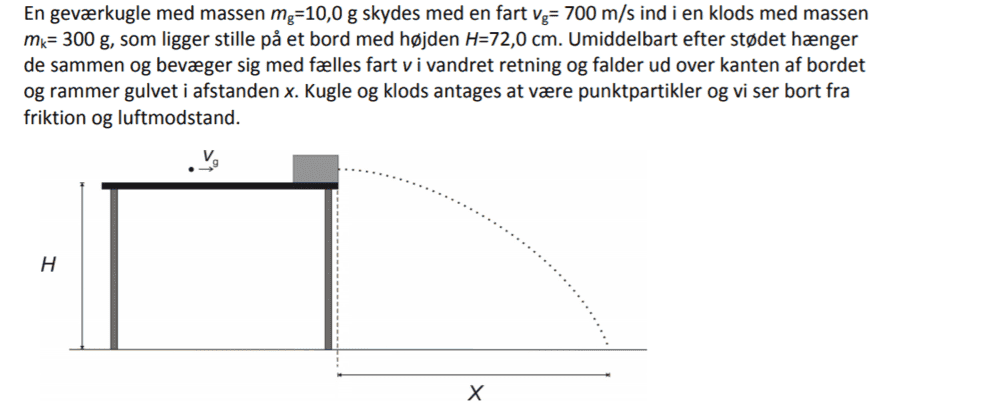
Udklip.PNG


[Moderator's note: Moved from a technical forum and thus no template.]
 
Last edited by a moderator:
Physics news on Phys.org
The wording may be killing you. Unfortunately I cannot read German. Also, I did not check your calculation of the final speed.

Consider the bullet. You have got a mass,a velocity before, and a velocity after. The kinetic energy therefore changes by an amount you can calculate. The work done on the bullet is just the change in kinetic energy.

Also consider the same things for the block. You have a change in kinetic energy you can calculate. And you can then get the work done on the block.

After that you can look at the total kinetic energy before and the total after. For an inelastic collision, the after value is less. The difference is the energy lost to things such as deforming the bullet or block, heating the two objects, sound, etc. From a mechanics point of view this is not work. Work is "f dot D" that is, force times distance it acts. It's not the thermodynamics idea of work.
 
DEvens said:
From a mechanics point of view this is not work. Work is "f dot D" that is, force times distance it acts.
Your calculations of work done on an object based on the change in bulk kinetic energy of the object indicate that you are talking about "center of mass" work. Center of mass work is not force times distance it acts. Center of mass work is force times distance the center of mass moves while it acts.
 

Similar threads

  • · Replies 2 ·
Replies
2
Views
2K
  • · Replies 8 ·
Replies
8
Views
3K
Replies
11
Views
3K
Replies
1
Views
2K
  • · Replies 7 ·
Replies
7
Views
2K
  • · Replies 4 ·
Replies
4
Views
4K
  • · Replies 9 ·
Replies
9
Views
4K
  • · Replies 2 ·
Replies
2
Views
2K
Replies
6
Views
2K
  • · Replies 1 ·
Replies
1
Views
2K