SohailS
- 5
- 0
I am unsure how to proceed with this problem because it is asking for the final velocity of one of the two objects given the initial velocities. This is an inelastic collision not a completely inelastic collision, which means the two objects do not stick together. The book makes a distinction between the two.
If you can give me some hints as how to proceed it would be truly helpful.
A 0.800 kg target slides along the ice at 3.0 m/s [W], when it is hit by a 20.0 g arrow
moving at 260 m/s [N], as part of a show. Find the final velocity of the target after the
inelastic collision.
Given:
let east and north be positive
m1 = 0.800 kg
v1 = 3.0 m/s [W]
m2 = 0.0200 kg
v2 = 260 m/s [N]
find v1f
Pti=Ptf
m1v1i + m2v2i = m1v1f + m2v2f
The question is asking for the final velocity of the target which is find v1f
This is an inelastic collision, not a completely inelastic collision, this means the arrow will not stick to the target.
vix = -3.0 m/s
viy = 260 m/s
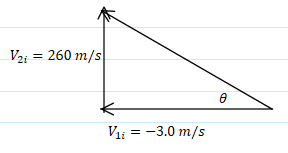
Pxi=(0.8)(-3)=-2.4 Ns
Pyi=(0.02)(260)=5.2 Ns
If you can give me some hints as how to proceed it would be truly helpful.
Homework Statement
A 0.800 kg target slides along the ice at 3.0 m/s [W], when it is hit by a 20.0 g arrow
moving at 260 m/s [N], as part of a show. Find the final velocity of the target after the
inelastic collision.
Given:
let east and north be positive
m1 = 0.800 kg
v1 = 3.0 m/s [W]
m2 = 0.0200 kg
v2 = 260 m/s [N]
find v1f
Homework Equations
Pti=Ptf
m1v1i + m2v2i = m1v1f + m2v2f
The Attempt at a Solution
The question is asking for the final velocity of the target which is find v1f
This is an inelastic collision, not a completely inelastic collision, this means the arrow will not stick to the target.
vix = -3.0 m/s
viy = 260 m/s
Pxi=(0.8)(-3)=-2.4 Ns
Pyi=(0.02)(260)=5.2 Ns
Last edited: