Inf. Parallel Plate Capacitors and Potential Energy

Click For Summary

Homework Help Overview

The discussion centers around a problem involving infinite parallel plate capacitors, specifically focusing on the behavior of an electron moving between the plates and beyond. The problem involves calculating the kinetic and potential energy of the electron at various points, as well as determining the minimum speed required for the electron to escape to infinity.

Discussion Character

  • Exploratory, Conceptual clarification, Mathematical reasoning, Assumption checking

Approaches and Questions Raised

  • Participants discuss the relationship between electric potential and kinetic energy, questioning how to calculate energies at point P and the implications of the electric field outside the plates. There are inquiries about the initial position of the electron and the principles of superposition and potential due to a single plate.

Discussion Status

Participants are actively engaging with the problem, exploring various aspects of electric potential and energy conservation. Some guidance has been provided regarding the potential difference and charge density, but there is no explicit consensus on the calculations or assumptions being made.

Contextual Notes

There is a noted lack of information regarding the surface density of the plates, which is relevant to the calculations being discussed. Additionally, the problem constraints include the assumption that the electron starts from rest and the established potential difference between the plates.

kevtimc25
Messages
5
Reaction score
0
Hopefully no one minds that I post a couple questions in a row as long as I'm following the rules:

1. Homework Statement

phyd.png

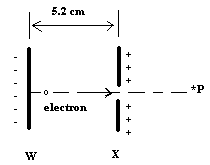
Two infinite parallel plates labelled W and X are separated by 5.2 cm. The electric potential between the plates is 150 V. An electron starts from rest at time tW and reaches plate X at time tX. The electron continues through the opening and reaches point P at time tP

c.) Find the electron’s kinetic energy and potential energy at point *P.
d.) Find the minimum speed of the electron at time tw needed for it to escape to infinity.


Homework Equations


U = qV , energy conserved

The Attempt at a Solution


We can calc. the KE X easily: Ux = 0, Ex = Uw, Uw = 150V * -1.60*10^-19 C = 1/2 m(e) v^2 so we have v and there is no electric field once it is outside of the plates. A previous given answer indicates that the speed is constant once we hit X (I don't understand why other than that no outside forces are acting on the electron if we exclude gravity), so how can we calculate U and K at *P?
 
Physics news on Phys.org
Do we know the initial position of the electron?
If the electron is accelerated through a potential difference of V then it's kinetic energy is V electron-volts.

Per your question: do you know how to calculate the potential due to a single plate?
Do you know the superposition principle?
 
Yes it is at rest at W.

I know the EF is σ/2e0 everywhere due to each plate and you can find V by integrating E through a distance. And I know you can also find V by adding the potentials from each plate. But we don't now the Surface density of the plates.
 
You also know the potential difference between the plates is 150V... this gives you the kinetic energy at X.
Per the charge density - just put it equal to ##+\sigma## for the +ve plate and ##-\sigma## for the -ve plate.
 
Right, outside of the PPC the EF is 0 everywhere, so the ΔV would have to be 0 right? That means the potential doesn't change so the KE can't change as well (at point X and beyond).
 

Similar threads

  • · Replies 6 ·
Replies
6
Views
2K
Replies
5
Views
2K
  • · Replies 14 ·
Replies
14
Views
2K
Replies
3
Views
9K
  • · Replies 8 ·
Replies
8
Views
2K
Replies
4
Views
2K
  • · Replies 1 ·
Replies
1
Views
2K
  • · Replies 28 ·
Replies
28
Views
3K
  • · Replies 5 ·
Replies
5
Views
2K
  • · Replies 6 ·
Replies
6
Views
14K