Infinite potential well problem normalization

Join the discussion
Ask a follow-up here, or get your own question answered by working scientists, mathematicians and engineers — people, not an autocomplete.
Real named experts · corrections over time · the nuance an AI answer skips
12 replies · 3K views
Ashish Somwanshi
Messages
31
Reaction score
4
Homework Statement
Suppose an electron in an infinite potential well with width, L, has a wavefunction,
ϕ(z)=Az(z−L) for 0<z<L
Normalize this wavefunction and derive an expression for the constant A in terms of L.
Relevant Equations
∫|ψ(x,t)|^2dx=1, integral lower bound: minus infinity
Upper bound: positive infinity
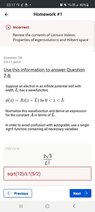
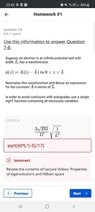
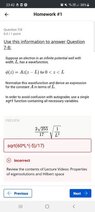
I have attached my attempt and proof that my attempts were incorrect.
 

Attachments
  • images.jpeg
    images.jpeg
    31.6 KB · Views: 196
  • Screenshot_20221002_231727.jpg
    Screenshot_20221002_231727.jpg
    21.7 KB · Views: 189
  • Homework attempt.pdf
    Homework attempt.pdf
    663.8 KB · Views: 181
  • Screenshot_20221002_234217.jpg
    Screenshot_20221002_234217.jpg
    22.8 KB · Views: 170
Last edited:
Physics news on Phys.org
PeroK said:
According to the homework guidelines you must make your best attempt at this before we can help.
 

Attachments

PeroK said:
Your method is fine. Double check your final calculations- using ##60## as a common denominator, perhaps.
Yeah, doesn't work. Please do provide your solution.
 
Last edited by a moderator:
Ashish Somwanshi said:
Yeah, doesn't work. Plz do provide your solution.
Screenshot_20221002_233441.jpg
 
Ashish Somwanshi said:
Yeah, doesn't work. Plz do provide your solution.
This is my final attempt despite using 60 as common denominator.
 

Attachments

  • Screenshot_20221002_234217.jpg
    Screenshot_20221002_234217.jpg
    21.7 KB · Views: 180
topsquark said:
Okay, let's try this again. ##\dfrac{1}{5} - \dfrac{2}{4} + \dfrac{1}{3}## is what?

-Dan
Sorry, I don't understand how to add three fractions using common denominator, in my first attempt I did the old way but still incorrect. Plz do provide the solution if anyone can solve their way. Either the autograder must be faulty or something I must be missing...
 
topsquark said:
Okay, let's try this again. ##\dfrac{1}{5} - \dfrac{2}{4} + \dfrac{1}{3}## is what?

-Dan
It's 1/12 according to evaluating two fractions one at a time.
 
  • Skeptical
Likes   Reactions: berkeman
Ashish Somwanshi said:
Plz do provide the solution if anyone can solve their way.
No, we do not provide solutions. You really don't understand how to add those fractions? Also, please do not use text speak at PF like "please". Thank you.
 
  • Like
Likes   Reactions: topsquark
I will redo the solution as I have made silly mistakes in evaluating the fractions...Thanks for spotting it.
 
Ashish Somwanshi said:
I will redo the solution as I have made silly mistakes in evaluating the fractions...Thanks for spotting it.
Guys, Thank you soo much. I've got a passing grade. It is mind boggling to see myself perform childish mistakes doing advanced quantum physics. I am currently analyzing reasons responsible for such performance.
 
  • Like
Likes   Reactions: PeroK