Integral problem / mathematical induction

Click For Summary
SUMMARY

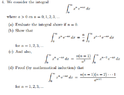
The discussion focuses on solving an integral problem using mathematical induction and integration techniques. The user successfully computed the integral $\int_{0}^{\infty} e^{-ax} \, dx = \frac{1}{a}$ but struggled with subsequent steps. The expert advised using integration by parts for part (b) and suggested leveraging the result from part (b) for part (c). This structured approach clarifies the method for tackling similar integral problems.

PREREQUISITES
  • Understanding of integral calculus, specifically improper integrals.
  • Familiarity with integration by parts technique.
  • Knowledge of mathematical induction principles.
  • Basic proficiency in handling exponential functions in integrals.
NEXT STEPS
  • Study the method of integration by parts in detail.
  • Practice solving improper integrals involving exponential functions.
  • Explore mathematical induction applications in calculus.
  • Review examples of sequential integral problems to build confidence.
USEFUL FOR

Students and educators in mathematics, particularly those focusing on calculus and integral techniques, as well as anyone looking to enhance their problem-solving skills in mathematical induction and integration methods.

Samme013
Messages
15
Reaction score
0
View attachment 3411
Ok so i got step (a) and found that $\int_{0}^{\infty} \,d (x^0)*e^(-ax)dx=1/a$
But i do not get how i should go about starting the next steps using the info from the first step(have not done a similar problem before so i need to get a grasp on the method)
 

Attachments

  • wHwxPHf.png
    wHwxPHf.png
    11.4 KB · Views: 123
Physics news on Phys.org
Samme013 said:
View attachment 3411
Ok so i got step (a) and found that $\int_{0}^{\infty} \,d (x^0)*e^(-ax)dx=1/a$
But i do not get how i should go about starting the next steps using the info from the first step(have not done a similar problem before so i need to get a grasp on the method)

Hi Samme013,

To solve (b), use integration by parts directly. Do not use the result in (a). To solve (c), use the result of part (b) and integration by parts.
 

Similar threads

  • · Replies 1 ·
Replies
1
Views
3K
  • · Replies 3 ·
Replies
3
Views
2K
  • · Replies 19 ·
Replies
19
Views
4K
  • · Replies 3 ·
Replies
3
Views
2K
  • · Replies 10 ·
Replies
10
Views
3K
  • · Replies 2 ·
Replies
2
Views
3K
  • · Replies 29 ·
Replies
29
Views
5K
  • · Replies 33 ·
2
Replies
33
Views
4K
  • · Replies 2 ·
Replies
2
Views
1K
  • · Replies 2 ·
Replies
2
Views
2K