Undergrad Integration by Parts without using u, v

Click For Summary
The discussion revolves around a new approach to Integration by Parts that avoids explicitly using the variables u and v. Instead, it substitutes d(___) for dx, which some participants clarify is simply dv. The method is described as a "reverse product rule," emphasizing that it operates similarly to the product rule for differentiation. An example is provided, demonstrating the integration of ln(x) multiplied by x, showcasing the technique's effectiveness without traditional variable notation. This approach aims to simplify the process and reduce confusion in applying Integration by Parts.
Sang Ho Lee
Messages
4
Reaction score
0
Hello, I'm currently taking calc 1 as an undergraduate student, and my professor just showed us a new? way of solving Integration By Parts.

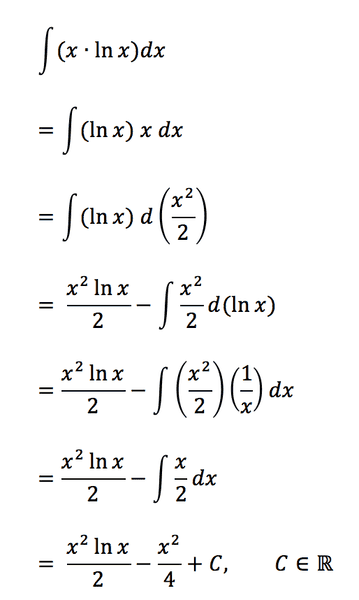
This is the example he gave"
nht7MtzfGAU-Rje5sUvqRKRVDv0USCmVtHRQd4UQTtW3EeglrdPKleQtaVWuuXTOAycrQTG-eXPW933y_Uw=w514-h858-no.png


Is there a name for this technique that substitutes d(___) instead of dx?

Thank you,
 
Physics news on Phys.org
Sang Ho Lee said:
Hello, I'm currently taking calc 1 as an undergraduate student, and my professor just showed us a new? way of solving Integration By Parts.

This is the example he gave"

nht7MtzfGAU-Rje5sUvqRKRVDv0USCmVtHRQd4UQTtW3EeglrdPKleQtaVWuuXTOAycrQTG-eXPW933y_Uw=w514-h858-no.png


Is there a name for this technique that substitutes d(___) instead of dx?

Thank you,
It doesn't substitute d(___) instead of dx. What you're calling d(___) is just dv.

This is nothing more than integration by parts, but without stating dv explicitly. Here ##u = \ln x## and ##dv = xdx##. From the latter, we get ##v = \frac{x^2}2##.
 
  • Like
Likes Sang Ho Lee
I've never used ##u, v## and have never really understood the point. I would rename integration by parts as the "reverse product rule", because it's just the product rule for differentiation in reverse. Anyway, what I do is:

##\int f(x)g(x) dx = f(x) \int g(x)dx - \int f'(x) (\int g(x)dx)dx## (*)

I don't see why you need any other variables. You pick ##f## because it's easy to differentiate and/or ##g## because you know how to integrate it already. Your one I would do:

##\int (ln(x)) x dx = (ln(x)) \frac{x^2}{2} - \int (\frac{1}{x})(\frac{x^2}{2})dx = \frac{x^2ln(x)}{2} - \int \frac{x}{2} dx = \frac{x^2ln(x)}{2} - \frac{x^2}{4} + C##

I knew how to differentiate ##ln(x)## and how to integrate ##x##.

PS To prove (*), I would imagine that you already know the integral of ##g## is ##h##, which means ##h'(x) = g(x)##. So:

## \int f(x)g(x) + f'(x)h(x)dx = \int f(x)h'(x) + f'(x)h(x)dx = \int \frac{d}{dx} (f(x)h(x))dx = f(x)h(x) + C##

Hence:

## \int f(x)g(x)dx = f(x)h(x) -\int f'(x)h(x)dx+ C##

Where ##\int g(x)dx = h(x) + C##

And that seems to me to take some of the "magic" out of integration by parts.
 
  • Like
Likes Sang Ho Lee

Similar threads

  • · Replies 4 ·
Replies
4
Views
3K
  • · Replies 2 ·
Replies
2
Views
2K
  • · Replies 8 ·
Replies
8
Views
3K
  • · Replies 15 ·
Replies
15
Views
4K
  • · Replies 6 ·
Replies
6
Views
3K
  • · Replies 5 ·
Replies
5
Views
2K
  • · Replies 1 ·
Replies
1
Views
2K
  • · Replies 8 ·
Replies
8
Views
2K
  • · Replies 19 ·
Replies
19
Views
4K
Replies
5
Views
2K