Integration problem using inscribed rectangles

Join the discussion
Ask a follow-up here, or get your own question answered by working scientists, mathematicians and engineers — people, not an autocomplete.
Real named experts · corrections over time · the nuance an AI answer skips
14 replies · 3K views
chwala
Gold Member
Messages
2,843
Reaction score
428
Homework Statement
see attached
Relevant Equations
Integration -Hyperbolic Functions
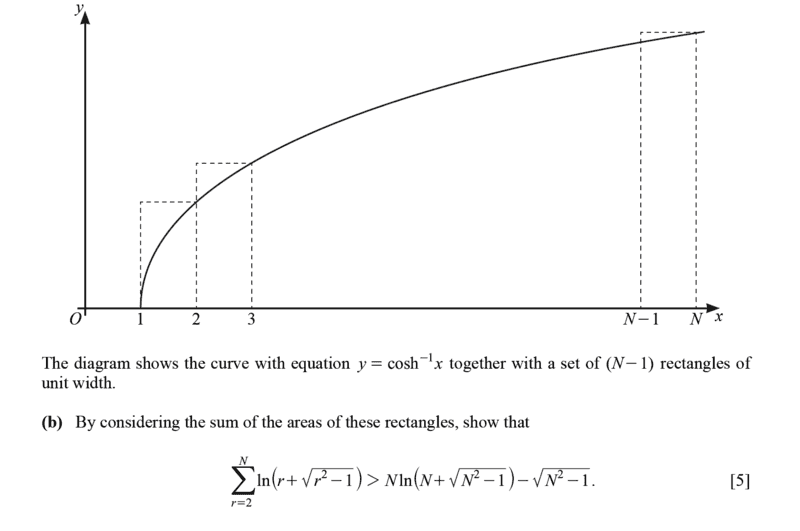
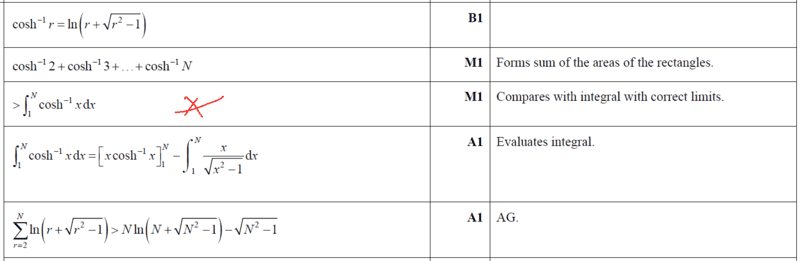
Just went through this...steps pretty clear. I refreshed on Riemann integrals { sum of rectangles approximate area under curves}. My question is on the highlighted part in Red. The approximation of area under curve may be smaller or larger than the actual value. Thus the inequality may be ##<## or ##>##. Correct?

In the case of this question they chose ##>##. My point is they could have as well chosen to use ##<## with no implications.
1713046275919.png


1713046303668.png


My general comments on the ms approach is as follows,

##\cosh^{-1} r = \ln (r + \sqrt {r^2 -1} )## stems from one understanding the following steps

Let ##y = \cosh^{-1} x##

then

##x = \cosh y = \dfrac {e^y + e^{-y}}{2}##

##x= \dfrac{e^y + e^{-y}}{2}##

##2xe^y = e^{2y}+1##

...
##⇒ e^y = x ± \ln (x + \sqrt {x^2 -1} )##

##y = x ± \ln (x + \sqrt {x^2 -1} )##

They also used integration by parts noting that

##u = \cosh^{-1} x##

using
## \cosh^2 y - \sinh^2y = 1## and letting ## y =\cosh^{-1} x## then ##x = \cosh y##

##\dfrac{dy}{dx} = \dfrac{1}{\sinh y}##

##\sinh y = \sqrt{\cosh^2y -1}##

##\dfrac{dy}{dx}= \dfrac{1}{\sqrt{x^2-1)}}##

and lastly,


##\ln (r + \sqrt {r^2 -1} ) > [x \ln r + \sqrt {r^2-1}]_1^N - [\sqrt {x^2-1}]_1^N##

##\ln (r + \sqrt {r^2 -1} ) > N \ln N +\sqrt {N^2-1} -0-\sqrt {N^2-1}+0##

##\ln (r + \sqrt {r^2 -1} ) > N \ln N +\sqrt {N^2-1}-\sqrt {N^2-1}+0##
 
Last edited:
Physics news on Phys.org
chwala said:
The approximation of area under curve may be smaller or larger than the actual value. Thus the inequality may be ##<## or ##>##. Correct?
The correct inequality is
$$\sum_{i=2}^N\cosh ^{-1}i>\int^N_1 \cosh ^{-1}x dx$$
because the Riemann sum uses the right endpoints of each subinterval and the function is increasing. The inequality could be wrong depending on if it's a left, middle, or trapezoidal Riemann sum.
 
Reply
  • Informative
  • Like
Likes   Reactions: SammyS and chwala
For a general Riemann sum is evaluated over the interval ##[a,b]##, if we evaluate the sum using increasingly narrower rectangles, the limit as the width of the rectangles go to zero is exact integral. Specifically using the right endpoint rule, with partition ##a=x_1<\cdots <x_n=b##,
$$\lim_{n\to \infty}\sum^{n}_{i=1}f(x_{i+1})(x_{i+1}-x_i)=\int^b_af(x)dx.$$
 
Reply
  • Like
Likes   Reactions: chwala
The above is the meaning/definition of Riemann integrability. The convergence in the sense that as ##Lim ||P||_{\rightarrow 0}##, meaning the maximum width of the rectangles becomes indefinitely small, the value of the Riemann Integral becomes indefinitely -close to a value ##R## ; in a" ## P-\epsilon##" sense, of the Riemann integral. This is called Net Convergence.
 
Reply
  • Informative
  • Like
Likes   Reactions: docnet and chwala
WWGD said:
The above is the meaning/definition of Riemann integrability. The convergence in the sense that as ##Lim ||P||_{\rightarrow 0}##, meaning the maximum width of the rectangles becomes indefinitely small, the value of the Riemann Integral becomes indefinitely -close to a value ##R## ; in a" ## P-\epsilon##" sense, of the Riemann integral. This is called Net Convergence.
Just want to say, I noticed that my comment isn't right. I stated the limit as the number of rectangles go to infinity, but I didn't specify that the width of every rectangle goes to zero, or equivalently that ##P=\text{max}_{i\in I}\left(x_{i+1}-x_i\right),## ##I=\{1,...,N\}## goes to zero. I had a feeling that something was off, but didn't notice it right away.

Does the '##P - \epsilon##' sense of convergence mean that, for every ##\epsilon>0##, there exists a ##P## such that the corresponding Riemann sum and the value ##R## differ by ##\epsilon##?
 
docnet said:
Just want to say, I noticed that my comment isn't right. I stated the limit as the number of rectangles go to infinity, but I didn't specify that the width of every rectangle goes to zero, or equivalently that ##P=\text{max}_{i\in I}\left(x_{i+1}-x_i\right),## ##I=\{1,...,N\}## goes to zero. I had a feeling that something was off, but didn't notice it right away.

Does the '##P - \epsilon##' sense of convergence mean that, for every ##\epsilon>0##, there exists a ##P## such that the corresponding Riemann sum and the value ##R## differ by ##\epsilon##?
Let ##R(f)## be the Riemann sum associated with ##f##.Then the Riemann Integral of ##f## converges to ##R## means that for every ##\epsilon >0##, there is a## \delta## , so that ##|R(f) -R|<\epsilon## for any partition ##P## with ##||P||<\delta##.
 
Reply
  • Like
Likes   Reactions: docnet
pasmith said:
I'm commenting on the OP's choice of thread title.
I changed the thread title to "Integration problem using inscribed rectangles." I hope this better describes what the thread is about. Possibly @pasmith's recommendation of "integral comparison test" might be a better choice, though.
 
Reply
  • Like
Likes   Reactions: chwala
Mark44 said:
I changed the thread title to "Integration problem using inscribed rectangles." I hope this better describes what the thread is about. Possibly @pasmith's recommendation of "integral comparison test" might be a better choice, though.
Then we may have to go through several likes of " proof this solution" , " Avance Calculas" I've seen. Should I point them out to staff?
 
WWGD said:
Then we may have to go through several likes of " proof this solution" , " Avance Calculas" I've seen. Should I point them out to staff?
I regularly edit thread titles with gross typos, but haven't seen any lately like the ones you cited. @berkeman also changes thread titles if they don't match the thread content very well or aren't descriptive.
If you see any that you think ought to be changed, of relatively recent threads, yes, go ahead and report them.
 
Reply
  • Like
Likes   Reactions: berkeman
WWGD said:
Let ##R(f)## be the Riemann sum associated with ##f##.Then the Riemann Integral of ##f## converges to ##R## means that for every ##\epsilon >0##, there is a## \delta## , so that ##|R(f) -R|<\epsilon## for any partition ##P## with ##||P||<\delta##.
If I understand correctly, then ##||P||## means $$\sqrt{\sum_i\left(\Delta x_i^2\right)}?$$ Thanks