rotemtsafrir
- 1
- 0
- TL;DR
- a website that lets users play with antennas and visualize the electromagnetic field.
Hi,
I’ve been working on an interactive browser-based antenna/EM field simulator as a personal project:
https://rotemtsafrir.github.io/dipole_sim/
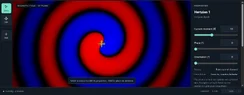
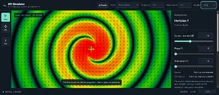
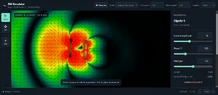
The main goal is to provide an intuitive way to experiment with antenna configurations and directly visualize the resulting electromagnetic fields.
At the moment it supports:
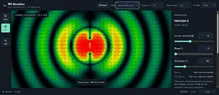
The simulator can display the electric field, magnetic field, and an energy-flow visualization, and the fields evolve with time.
The underlying model is deliberately simpler than a full-wave EM solver. The antenna current distributions are prescribed and discretized into small current elements, and their complex field contributions are superposed over the observation plane.
As a result, the current version does not solve for things such as:
One of the things I find useful about it is that some antenna-array results become much more intuitive when you can actually see the fields. For example, with a two-element end-fire array, the phase difference that maximizes the field exactly in the forward direction is not necessarily the phase difference that produces a null in the opposite direction.
I’d be very interested in feedback from people with more RF/antenna experience, particularly regarding:
The simulator runs entirely in the browser using JavaScript/p5.js.
Source code:
https://github.com/rotemTsafrir/dipole_sim
I’ve been working on an interactive browser-based antenna/EM field simulator as a personal project:
https://rotemtsafrir.github.io/dipole_sim/
The main goal is to provide an intuitive way to experiment with antenna configurations and directly visualize the resulting electromagnetic fields.
At the moment it supports:
- center-fed dipoles
- Hertzian dipoles
- small circular loops
- linear arrays of Hertzian dipoles or small loops
The simulator can display the electric field, magnetic field, and an energy-flow visualization, and the fields evolve with time.
The underlying model is deliberately simpler than a full-wave EM solver. The antenna current distributions are prescribed and discretized into small current elements, and their complex field contributions are superposed over the observation plane.
As a result, the current version does not solve for things such as:
- mutual coupling between antennas
- feed impedance or matching
- induced currents
- passive conducting structures / PEC boundaries
One of the things I find useful about it is that some antenna-array results become much more intuitive when you can actually see the fields. For example, with a two-element end-fire array, the phase difference that maximizes the field exactly in the forward direction is not necessarily the phase difference that produces a null in the opposite direction.
I’d be very interested in feedback from people with more RF/antenna experience, particularly regarding:
- whether any of the current modeling assumptions could produce misleading visualizations
- how best to represent the transition between near-field and far-field behavior
- useful antenna models to add next
- whether a dedicated far-field radiation-pattern view would be worthwhile
The simulator runs entirely in the browser using JavaScript/p5.js.
Source code:
https://github.com/rotemTsafrir/dipole_sim
Attachments