Will closing the slit affect the clarity of observing light interference?

  • Thread starter Thread starter Josielle Abdilla
  • Start date Start date
  • Tags Tags
    Interference Light
Click For Summary
SUMMARY

Closing the slit S_a in a double slit experiment affects the intensity of light observed but does not alter the diffraction pattern itself. As the slit width approaches the wavelength of light, diffraction increases, leading to a broader range of angles for light transmission. This results in a decrease in light intensity reaching the observer's retina, impacting clarity. The interplay between slit width and diffraction is crucial for understanding light behavior in optical experiments.

PREREQUISITES
  • Understanding of double slit diffraction patterns
  • Knowledge of light wavelength and its relation to slit width
  • Familiarity with concepts of intensity and diffraction in optics
  • Basic principles of light transmission and observation
NEXT STEPS
  • Research the principles of single slit diffraction patterns
  • Study the effects of slit width on light intensity and diffraction
  • Explore the mathematical models for predicting diffraction patterns
  • Learn about optical instruments used to measure light intensity
USEFUL FOR

Students and professionals in physics, particularly those focused on optics, as well as educators teaching concepts related to light behavior and diffraction.

Josielle Abdilla
Messages
50
Reaction score
4
Homework Statement
If a student observes a slit illuminated by a light source, through a slit Sa which is almost closed what will he observe?
Relevant Equations
The answer to this question does not involve any mathematical equations but is mainly descriptive
My guesses are that if slit is almost closed, then the width is comparable to the wavelength and diffraction will occur. does this means that he will observe the slit S clearly or less clearly?

[Picture cleaned up a bit by a Mentor]
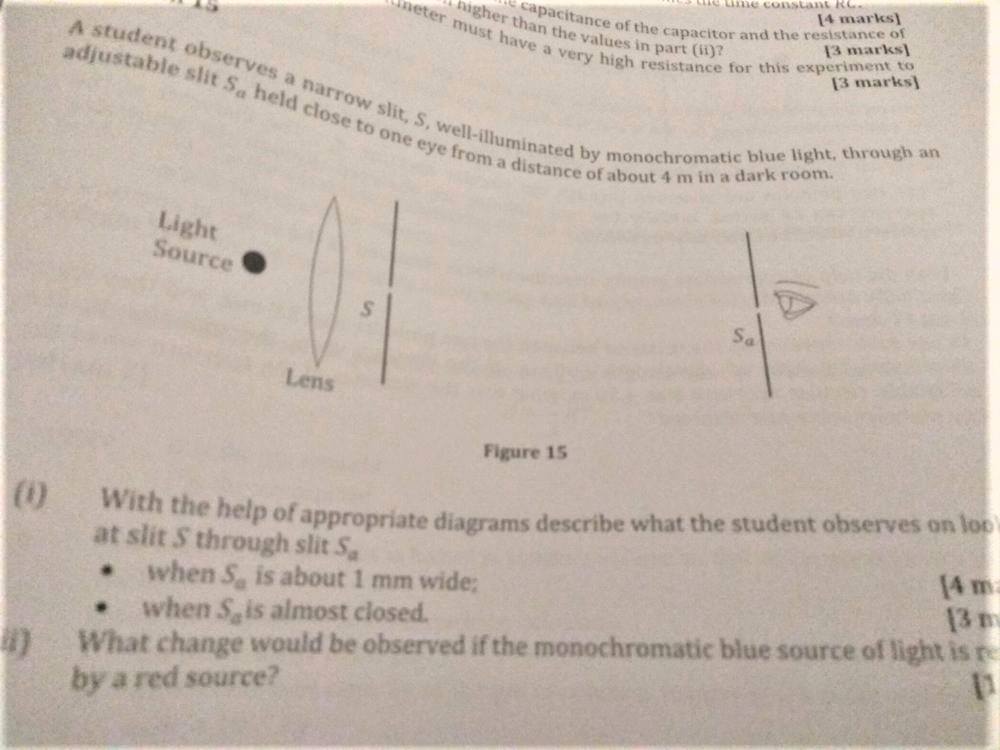
Light Interference Pic.jpg
 

Attachments

  • 1587833973047261313699.jpg
    1587833973047261313699.jpg
    45.2 KB · Views: 154
Last edited by a moderator:
Physics news on Phys.org
Any ideas please?
 
Last edited by a moderator:
I am not entirely sure on this question, though there are a few things we can say with reasonable certainty.

Do you know what a double slit diffraction pattern looks like? Then, changing the width of ##S_a## does not affect that diffraction pattern, but it will change the amount of light that passes through ##S_a## and by extension the power transmitted through the second slit. If the eye being 'close' enough is to imply that all transmitted light will be detected by it somehow or another regardless of diffraction out of ##S_a##, then the obvious difference to me is the intensity on the retina.

However, the water is muddied by the fact that decreasing the width of ##S_a## also increases the amount of diffraction in that all of the angles to different points in the single slit diffraction pattern increase. I'm not sure if this is also meant to be taken into account.

Perhaps someone more knowledgeable with optics will comment later on!
 
  • Like
Likes berkeman and Josielle Abdilla
Thanks
 
The book claims the answer is that all the magnitudes are the same because "the gravitational force on the penguin is the same". I'm having trouble understanding this. I thought the buoyant force was equal to the weight of the fluid displaced. Weight depends on mass which depends on density. Therefore, due to the differing densities the buoyant force will be different in each case? Is this incorrect?

Similar threads

  • · Replies 3 ·
Replies
3
Views
992
Replies
1
Views
4K
  • · Replies 8 ·
Replies
8
Views
3K
  • · Replies 5 ·
Replies
5
Views
4K
Replies
55
Views
5K
  • · Replies 3 ·
Replies
3
Views
4K
  • · Replies 5 ·
Replies
5
Views
4K
  • · Replies 4 ·
Replies
4
Views
4K
Replies
9
Views
4K
  • · Replies 6 ·
Replies
6
Views
4K