Interior and Closure in a Topological Space .... .... remark by Willard

Click For Summary
SUMMARY

The discussion centers on the relationship between closure and interior in a topological space as presented in Stephen Willard's "General Topology." Specifically, the formula X - E^{\circ} = \overline{X - E} is analyzed, with participants providing formal proofs based on definitions of closure and interior. Peter outlines the necessary biconditional relationships and offers a direct argument to demonstrate the equivalence of the two expressions. The conversation emphasizes the importance of rigorous definitions in understanding topological concepts.

PREREQUISITES
  • Understanding of basic topological concepts such as open and closed sets.
  • Familiarity with the definitions of closure and interior in a topological space.
  • Knowledge of biconditional statements and their implications in mathematical proofs.
  • Experience with formal mathematical reasoning and proof techniques.
NEXT STEPS
  • Study the definitions of closure and interior in detail from "General Topology" by Stephen Willard.
  • Explore the properties of open and closed sets in various topological spaces.
  • Learn about biconditional statements and their applications in topology.
  • Practice formal proofs involving closure and interior to solidify understanding.
USEFUL FOR

Mathematicians, students of topology, and anyone seeking to deepen their understanding of the relationships between closure and interior in topological spaces.

Math Amateur
Gold Member
MHB
Messages
3,920
Reaction score
48
TL;DR
I need help in order to prove a result stated by Willard linking the notions of interior and closure in a topological space ...
I am reading Stephen Willard: General Topology ... ... and am currently focused on Chapter 2: Topological Spaces and am currently focused on Section 3: Fundamental Concepts ... ...

I need help in order to fully understand a result or formula given by Willard concerning a link between closure and interior in a topological space ... ..The relevant text reads as follows:
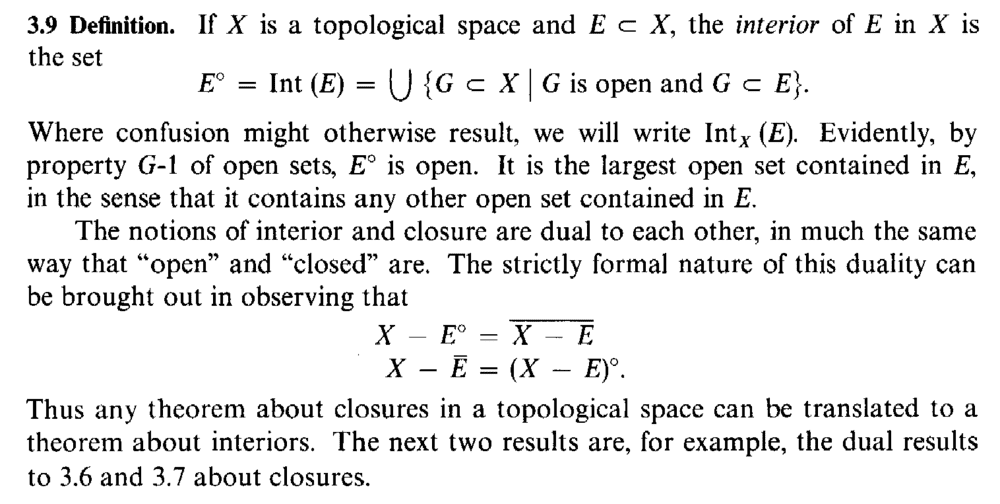
Willard - Defn 3.9 plus remarks ... .png

In the above text by Willard we read the following:

" ... ... The strictly formal nature of this duality can be brought out in observing that

##X - E^{ \circ } = \overline{ X - E }## ... ... "Can someone please demonstrate (formally and rigorously) that ... given the definitions and results regarding closure and interior used by Willard ... ##X - E^{ \circ } = \overline{ X - E }## ... ...The definitions and results regarding closure used by Willard are as follows:
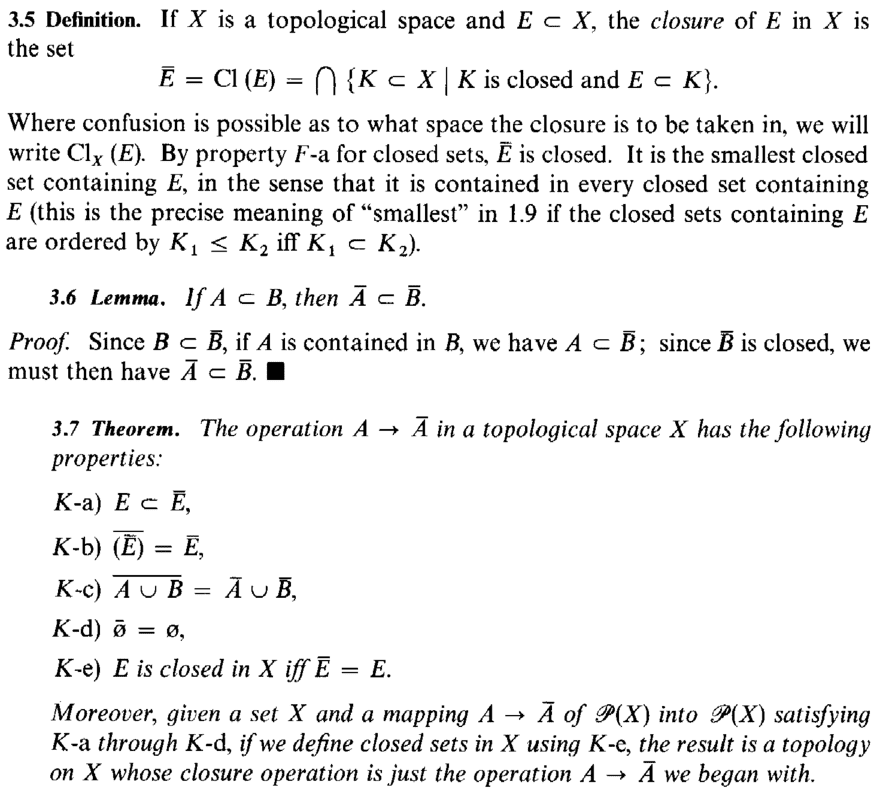
Willard - Defn 3.5, Lemma 3..6 and Theorem 3.7 .png


Help will be much appreciated ... ...

Peter
 
Physics news on Phys.org
Let's follow the definitions:
We have ##p\in X-E^\circ## if and only if every open set containing ##p## intersects ##X-E## nontrivially if and only if ##p## is in the closure of ##X-E.##

The first biconditional is just the negation of your definition of interior. The second is the following fact: Let ##X## be a topological space and let ##E\subset X##. Then ##p\in \overline{E}## if and only if every neighborhood of ##p## intersects ##E## nontrivially. Is this fact okay, or do you also want an argument here?

Edit: A little more direct argument using your definitions is:

##X-E^\circ=X-\bigcup_{G\subset E \ \text{open}} G=\bigcap_{G\subset E \text{ open}} (X-G)=\bigcap_{F\supset X-E \text{ closed}}F=\overline{X-E}.##
 
Last edited:
  • Like
Likes   Reactions: member 587159 and Math Amateur
Thanks so much Infrared ...

Working through your post just now ...

Very much appreciate your help ...

Peter
 
Last edited:

Similar threads

  • · Replies 2 ·
Replies
2
Views
2K
  • · Replies 5 ·
Replies
5
Views
2K
  • · Replies 6 ·
Replies
6
Views
2K
  • · Replies 3 ·
Replies
3
Views
2K
  • · Replies 2 ·
Replies
2
Views
2K
  • · Replies 5 ·
Replies
5
Views
1K
  • · Replies 3 ·
Replies
3
Views
2K
  • · Replies 2 ·
Replies
2
Views
2K
  • · Replies 5 ·
Replies
5
Views
3K
  • · Replies 4 ·
Replies
4
Views
3K