SUMMARY
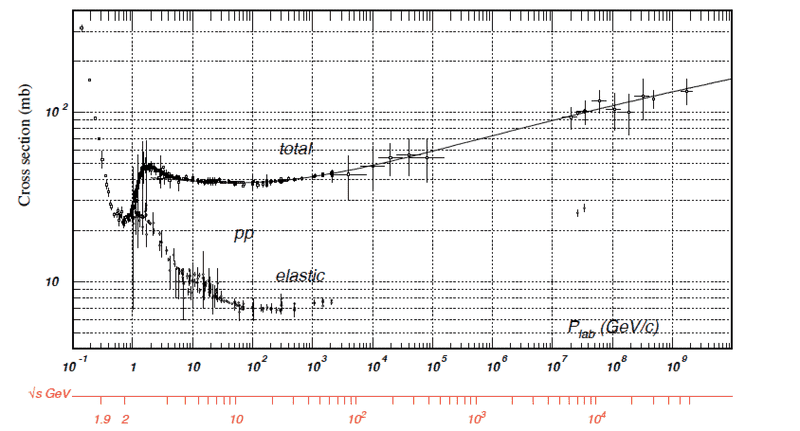
The discussion centers on the interpretation of proton-proton cross section versus energy as presented in DeAngelis' "Introduction to Particle and Astroparticle Physics." It is established that the total cross section equals the elastic cross section when there is insufficient energy to create new particles, specifically at 1 GeV. Participants confirm that beyond 1 GeV, additional particles are indeed produced during collisions, indicating a transition in the interaction dynamics.
PREREQUISITES
- Understanding of particle physics concepts, particularly cross sections.
- Familiarity with energy levels in particle collisions, specifically 1 GeV.
- Knowledge of elastic versus inelastic scattering in particle interactions.
- Basic comprehension of the principles outlined in DeAngelis' "Introduction to Particle and Astroparticle Physics."
NEXT STEPS
- Research the implications of energy thresholds in particle collisions.
- Study the differences between elastic and inelastic scattering in detail.
- Explore advanced topics in particle creation during high-energy collisions.
- Examine graphical representations of cross sections in particle physics literature.
USEFUL FOR
This discussion is beneficial for students and researchers in particle physics, particularly those studying collision dynamics and energy thresholds in proton interactions.