How to know the cross section in this Figure

Click For Summary

Discussion Overview

The discussion revolves around determining the cross section for the process (p p → γγ b b~) based on a provided figure. Participants explore methods for calculating the cross section from a histogram, considering the relationship between the number of events, luminosity, and cross section, while addressing specific values and potential discrepancies in calculations.

Discussion Character

  • Technical explanation
  • Mathematical reasoning
  • Debate/contested

Main Points Raised

  • One participant questions how to find the cross section from the histogram, noting the relationship between cross section and number of events.
  • Another participant suggests summing over all bins to calculate the total cross section, providing a specific example calculation for a bin width.
  • A different viewpoint proposes using the maximum of the histogram to estimate the cross section, leading to a calculated value that raises concerns about discrepancies with standard model predictions.
  • One participant challenges the method of using the maximum of the histogram, emphasizing the need to sum over all bins for an accurate total cross section.
  • Another participant clarifies that calculating the cross section from a single bin yields a differential cross section, and stresses the importance of integrating over all bins for the total cross section.

Areas of Agreement / Disagreement

Participants express differing opinions on the method for calculating the cross section, with no consensus on the best approach. Some advocate for summing over all bins, while others suggest using the maximum value from the histogram. Discrepancies with standard model predictions are also noted, contributing to the unresolved nature of the discussion.

Contextual Notes

There are unresolved assumptions regarding the interpretation of the histogram and the calculations involved in determining the cross section. Specific values and methods are debated without reaching a definitive conclusion.

Safinaz
Messages
255
Reaction score
8
Hi all,

Do anyone familiar with these analysis of cross section ?

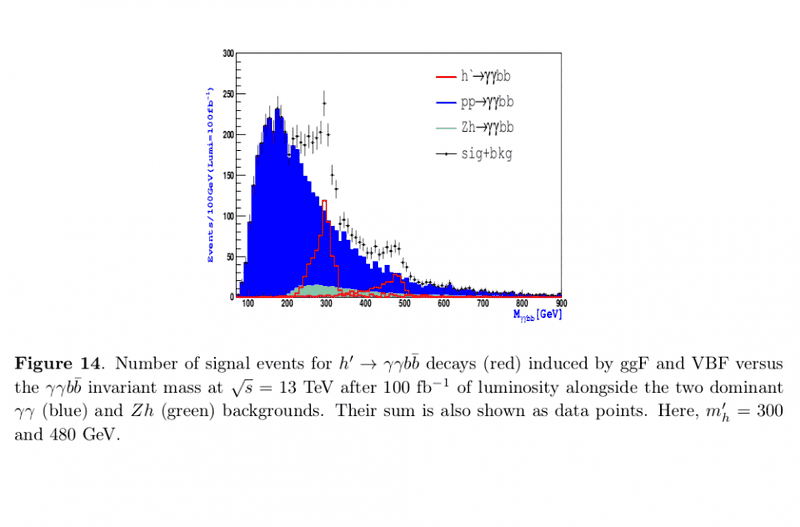
I wonder how to find the cross section of ( p p ## \to \gamma \gamma## b b~) (blue region) in the opposite plot, the y-axis is the number of events divided by 100 GeV with luminosity = 100 ##\mbox{fb}^{−1 }##..
Untitled.png
The Fig. from [arXiv:1601.07934 [hep-ph]]. It's known that ## \sigma \times ## luminosity = Number of events, and also ## \mbox{GeV}^{−2}=0.3894~ \mbox{mb}=0.0389~ \mbox{fm}^2 ##, but i still stuck to find sigma at 250 for instance ..
 

Attachments

  • Untitled.png
    Untitled.png
    76.5 KB · Views: 623
Physics news on Phys.org
That's a weird axis, but it works. You have to sum over all bins. Let's take the one that goes from 250 to 260 (?), its value is about "110/(100 GeV)" (130 is the sum of pp and Zh, Zh is about 20). The bin width is 10 GeV, so we have 110/(100 GeV) * 10 GeV = 11 events. We have those with 100/fb, so the cross section from this bin is 11/(100/fb) = 0.11 fb. Sum over all bins to get the total cross section.
 
I think we can determine the cross section by the maximum of the histogram at around 240 on the y-axis .. so that the number of events =(240/100 )*10=24, the cross section = 24/100 fb =0.24 fb , so we can say p p > 2 gamma 2b as this plot = 0.24 fb, is it right ?

Because actually I don't know how to sum over all bins to get the exact cross section ..

However when I calculate sigma p p > 2 gamma 2 b in standrad model via any cross section calculator like Madgraph , it gives sigma = 346 fb , some thing getting strange here ..
 
Last edited:
Safinaz said:
I think we can determine the cross section by the maximum of the histogram at around 240 on the y-axis
No we cannot.
Safinaz said:
Because actually I don't know how to sum over all bins to get the exact cross section ..
Do the calculation I showed for each bin, then add the values.
 
Thanx :)
 
Safinaz said:
I think we can determine the cross section by the maximum of the histogram at around 240 on the y-axis
if instead of taking all the events you want to take only the events that are in a single bin i, what you are calculating is the cross section in that bin (differential cross section d \sigma / dX, where X represents the variable in which you bin the histogram). Obviously you have to integrate that over all X values (sum over all bins) to get the cross section.
Now I wouldn't try to count it with the eye ...
 

Similar threads

  • · Replies 9 ·
Replies
9
Views
3K
Replies
1
Views
1K
  • · Replies 2 ·
Replies
2
Views
2K
  • · Replies 7 ·
Replies
7
Views
2K
Replies
4
Views
3K
  • · Replies 14 ·
Replies
14
Views
3K
  • · Replies 1 ·
Replies
1
Views
2K
  • · Replies 1 ·
Replies
1
Views
3K
  • · Replies 2 ·
Replies
2
Views
3K
  • · Replies 5 ·
Replies
5
Views
2K