Interpreting force in rotational motion

Click For Summary
SUMMARY

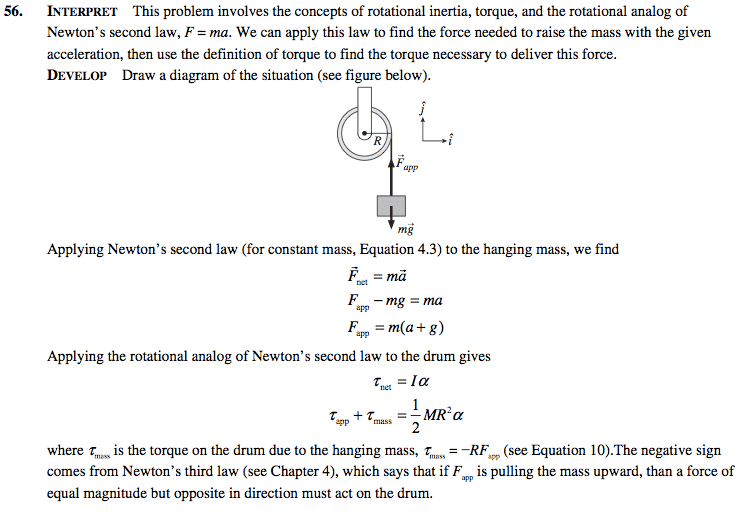
The discussion focuses on calculating the torque required by a motor to lift a 38-kg weight using a solid cylindrical drum with a diameter of 1.2 m and mass of 51 kg. The applied force is determined using the equation Fapp = m(a + g), where a is the acceleration (1.1 m/s2) and g is the acceleration due to gravity. The net torque is derived from the relationship τnet = Iα, leading to the conclusion that the torque applied by the motor must account for both the weight of the mass and the additional acceleration, resulting in τapp = τnet - τmass.

PREREQUISITES
  • Understanding of Newton's second law (F = ma)
  • Familiarity with torque calculations (τ = rF)
  • Knowledge of rotational dynamics (Iα relationship)
  • Basic concepts of linear and angular acceleration
NEXT STEPS
  • Study the principles of rotational motion and torque in detail
  • Learn about moment of inertia (I) for various shapes
  • Explore the relationship between linear and angular acceleration in depth
  • Investigate real-world applications of torque in mechanical systems
USEFUL FOR

Students and professionals in physics, mechanical engineering, and anyone interested in understanding the dynamics of rotational motion and torque calculations.

MathewsMD
Messages
430
Reaction score
7
56. A motor is connected to a solid cylindrical drum with diameter 1.2 m and mass 51 kg. A massless rope is attached to the drum and tied at the other end to a 38-kg weight, so the rope will wind onto the drum as it turns. What torque must the motor apply if the weight is to be lifted with acceleration 1.1 m/s2?

Solution:
J97fIRe.png

NddpeV9.png


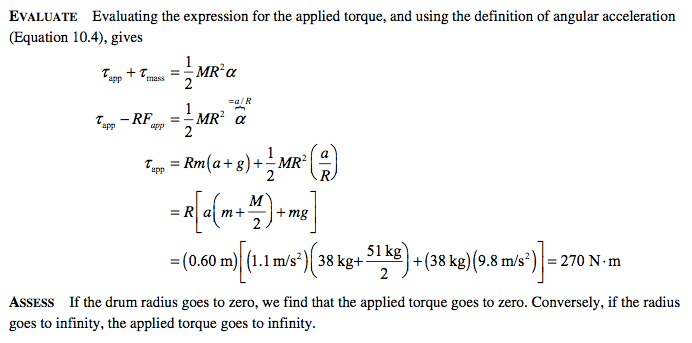
I understand almost all the steps. The part where I am confused is when they say Fapp = m(a+g), which makes sense on its own. But then in the next part, they τapp + τmass = 1/2MR(a/R) where τapp = Rm(a+g). Why is this not just RFg which is equal to Rmg? They way they answered the question makes me think they already took into account the torque applied into the torque due to mass since its linear acceleration, by itself, is only g but they included a which is from the applied torque.

Any help is greatly appreciated!
 
Physics news on Phys.org
You know that a in F=ma=F_{app}-mg is a=1.1m/s^2. Because F_{app} is known \left(\; F_{app}=m(a+g)\;\right), and is applied with moment arm R, the torque for the entire mass is \tau_{mass}=-RF_{app}= -Rm(a+g). Because the net torque \tau_{net}=I\alpha where \alpha=\frac{a}{R} (because it's just angular acceleration and you know that a distance R from the center, the linear acceleration is a), you could see now how \tau_{net}=\tau_{app}+\tau_{mass}\\<br /> \Rightarrow \tau_{app}=\tau_{net}-\tau_{mass}= I \frac{a}{R} -\left(-Rm(a+g)\right)

edit: You account for F_g in F_{app}, because the block isn't just falling. There is another force applied so that it's net acceleration is a. This is why they don't just use RF_g, but they use RF_{app} = Rma - RF_g
 
  • Like
Likes   Reactions: 1 person
lucasem_ said:
You know that a in F=ma=F_{app}-mg is a=1.1m/s^2. Because F_{app} is known \left(\; F_{app}=m(a+g)\;\right), and is applied with moment arm R, the torque for the entire mass is \tau_{mass}=-RF_{app}= -Rm(a+g). Because the net torque \tau_{net}=I\alpha where \alpha=\frac{a}{R} (because it's just angular acceleration and you know that a distance R from the center, the linear acceleration is a), you could see now how \tau_{net}=\tau_{app}+\tau_{mass}\\<br /> \Rightarrow \tau_{app}=\tau_{net}-\tau_{mass}= I \frac{a}{R} -\left(-Rm(a+g)\right)

edit: You account for F_g in F_{app}, because the block isn't just falling. There is another force applied so that it's net acceleration is a. This is why they don't just use RF_g, but they use RF_{app} = Rma - RF_g

Thanks for the clarification!
 

Similar threads

  • · Replies 9 ·
Replies
9
Views
3K
Replies
6
Views
3K
Replies
2
Views
2K
  • · Replies 1 ·
Replies
1
Views
2K
  • · Replies 10 ·
Replies
10
Views
8K
Replies
13
Views
2K
  • · Replies 9 ·
Replies
9
Views
2K
  • · Replies 5 ·
Replies
5
Views
4K
Replies
4
Views
1K
  • · Replies 19 ·
Replies
19
Views
4K