Intersection of a tangent of a hyperbola with asymptotes

Join the discussion
Registration is free. Start your own thread to ask a follow-up.
10 replies · 2K views
ElectronicTeaCup
Messages
23
Reaction score
1
Summary:: Question: Show that the segment of a tangent to a hyperbola which lies between the asymptotes is bisected at the point of tangency.

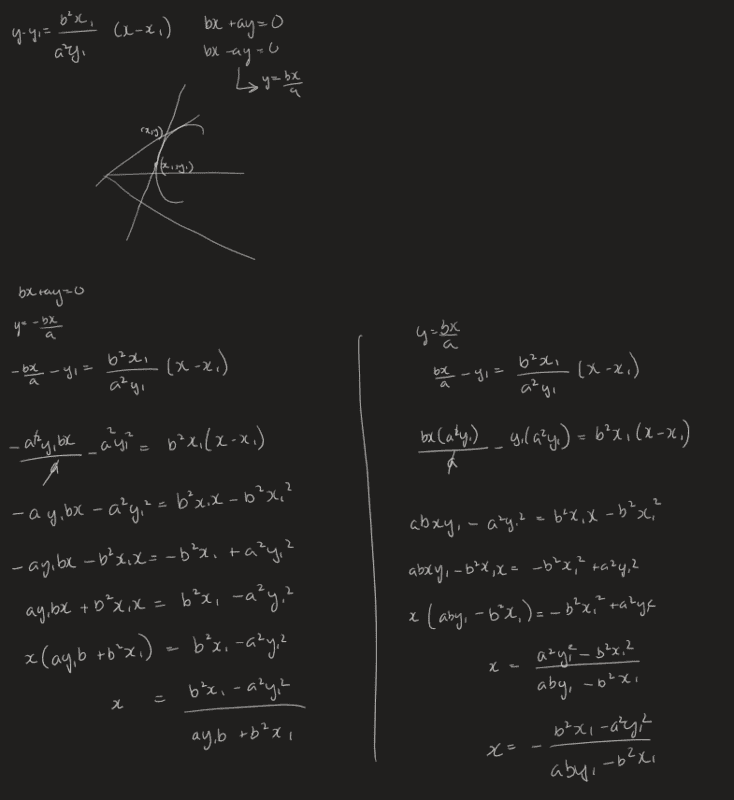
1593504334310.png

1593504395914.png

From what I understand of the solution, I should be getting two values of x for the intersection that should be equivalent but with different signs. However, I get

$$x=\frac{b^{2} x_{1}-a^{2} y_{1}^{2}}{a y_{1} b+b^{2} x_{1}}$$ and $$x=-\frac{b^{2} x_{1}-a^{2} y_{1}^{2}}{a b y_{1}-b^{2} x_{1}}$$
as the x-coordinates of the intersects with the two asymptotes. But these are not equivalent, am I making a mistake somewhere?
 
  • Like
Likes   Reactions: Charles Link
Physics news on Phys.org
I don't understand your approach. Did you just revert the slope on one side?

The x-values don't need to be equal in magnitude with opposite sign, but their average should be the x-value of the tangent point.
 
  • Like
Likes   Reactions: ElectronicTeaCup
I am simultaneously solving

1) The equation of the hyperbola ##y-y_{1}=\frac{b^{2} x_{1}}{a^{2} y_{1}}\left(x-x_{1}\right)## with the equation of the top asymptote ## bx + ay = 0##

2) The equation of the hyperbola ##y-y_{1}=\frac{b^{2} x_{1}}{a^{2} y_{1}}\left(x-x_{1}\right)## with the equation of the bottom asymptote ## bx - ay = 0##

Where ##(x_{1},y_{1})## are the coordinates of the tangent on the hyperbola.

So am I just missing the next step then? I.e to do the same with the y intercepts and plug them into the distance formula? I was assuming this would be too cumbersome—am I incorrect to think so?
 
ElectronicTeaCup said:
$$x=\frac{b^{2} x_{1}-a^{2} y_{1}^{2}}{a y_{1} b+b^{2} x_{1}}$$ and $$x=-\frac{b^{2} x_{1}-a^{2} y_{1}^{2}}{a b y_{1}-b^{2} x_{1}}$$
Those equations are not dimensionally consistent. Shoukd the x1 in the numerators be squared?
Having fixed that, as @mfb indicates, try taking the average of your two x values.
 
  • Like
Likes   Reactions: ElectronicTeaCup
Oh yes, the ##x_{1}## is supposed to be squared. I tried averaging them but it became very cumbersome
1593518456167.png
 
mfb said:
I'm not sure which step is wrong but the expressions for the two solutions should be much simpler. WolframAlpha (I replaced x1 by c).

Oh I see! Using the answers from WolframAlpha gives me the right results. Now to find that mistake! Thank you all!
 
There wasn't a mistake, just one more step was needed:

1593533166445.png

Is there a method to do this division, and how do you get the intuition to divide it anyway? o_O
 
Ah, with the numerator fixed it's better to see. If you have a difference of squares it's often a good idea to write that as product. ##a^2 y^2 - b^2 c^2 = (ay-bc)(ay+bc)## and now the first factor is clearly in the denominator (just with an additional b).
 
  • Like
Likes   Reactions: Charles Link and ElectronicTeaCup
ElectronicTeaCup said:
it became very cumbersome
Only because you failed to spot that the numerators are the same, just with opposite signs.
 
  • Like
Likes   Reactions: ElectronicTeaCup