Interview with Astronomer Pamela Gay - Comments

  • Context: Insights 
  • Thread starter Thread starter Greg Bernhardt
  • Start date Start date
  • Tags Tags
    astronomer interview
Click For Summary
SUMMARY

The forum discussion centers on an interview with astronomer Pamela Gay, focusing on the challenges of combating misinformation in science education. Gay emphasizes the importance of teaching students to critically evaluate sources and evidence, highlighting that misinformation extends beyond science to various topics. Participants express concerns about the effectiveness of critical thinking education in U.S. high schools and discuss the implementation of physics-first curricula, noting that many students struggle with the mathematical demands of such courses. Overall, the conversation underscores the need for improved educational strategies to foster critical thinking and scientific literacy.

PREREQUISITES
  • Understanding of critical thinking principles
  • Familiarity with science education methodologies
  • Knowledge of physics curricula in high schools
  • Awareness of misinformation and its impact on public perception
NEXT STEPS
  • Research effective methods for teaching critical thinking in education
  • Explore the implementation of physics-first curricula in high schools
  • Investigate strategies for combating misinformation in science
  • Learn about the role of media literacy in education
USEFUL FOR

Educators, curriculum developers, science communicators, and anyone interested in improving science education and critical thinking skills among students.

Messages
19,910
Reaction score
10,919
TheAdmin submitted a new PF Insights post

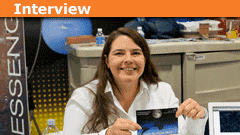
Interview with Astronomer Pamela Gay
pamelagay.png


Continue reading the Original PF Insights Post.
 
  • Like
Likes   Reactions: Charles Link, fresh_42, jim mcnamara and 3 others
Astronomy news on Phys.org
I enjoyed the interview; I don't follow cosmology or astronomy currently, but Gay's positive outlook is infectious.

Where she addresses topics other than astronomy, I especially liked this question and answer:

It seems that there is more anti-science and misinformation in the media, which probably trickles down to our students. How can we better train our students to be more resistive to this?

The problem goes beyond just misinformation about science, and extends to misinformation about just about any topic someone might what to read about. The most important thing I think we can teach is to get people – student’s and everyone else – to consistently ask; what are the sources, what is the evidence, and (if you can’t validate the source or evidence) is there a self-serving reason the author may be saying what they’re saying? Learning that click-bait means income, and that facts that have a negative economic impact may get suppressed are important lessons we all need to take to heart.

The first bolded sentence ("The problem goes beyond") is something I strongly agree with. Those of us who wish to improve upon science education must remember that science is just the tip of the misinformation/mistrust iceberg.

As for the remainder of the quote, including the bolded sentence at the end which alludes to motives for spreading misinformation, I agree with all of this as well; but how to carry out such good intentions? I think many of us have an impression that critical thinking, although supposedly taught in college and possibly in some high schools in the U.S., is still not widespread in the population. I'd be curious as to how it actually is taught; whether it is mandatory; the degree to which students discount the value of such courses based on their own preconceptions; etc.
 
Last edited:
  • Like
Likes   Reactions: vanhees71 and Greg Bernhardt
Thanks for the interesting interview. Pamela Gay seems like an excellent person for her job.

Advocating for physics first education is interesting. I really like the idea in principle, but am not sure how the implementation really works for typical high school freshman in the US. My elder daughter is in a physics first school, and it made for a very rough start in science for the majority of the students. Academic performance in physics was the single larges reason students had some school priviledges revoked. From what I could gather from my daughter it seems that most students did not have the mathematical skills to really understand a quantitative physics class (at least the one taught in her school). On the positive side, after understanding basic physics the sophomore chemistry class can use the understanding of electrostatic forces to help understand why some chemical reactions occur, but a qualitative understanding would probably be adequate for that. Knowing physics may also help teenagers understand wise driving habits, like not accellerating much or turning at high speed when the road is slick. So I'm all for freshman learning some physics at some level, but a full-year "highly" quantitative course may not be the best choice for every student.

jason
 

Similar threads

  • · Replies 4 ·
Replies
4
Views
2K
  • · Replies 17 ·
Replies
17
Views
3K
  • · Replies 8 ·
Replies
8
Views
3K
  • · Replies 5 ·
Replies
5
Views
2K
  • · Replies 9 ·
Replies
9
Views
3K
  • · Replies 14 ·
Replies
14
Views
5K
  • · Replies 15 ·
Replies
15
Views
5K
  • · Replies 2 ·
Replies
2
Views
4K
  • · Replies 4 ·
Replies
4
Views
3K
  • · Replies 132 ·
5
Replies
132
Views
15K