Insights Intro to Physically Reasonable Waves on a String

Click For Summary
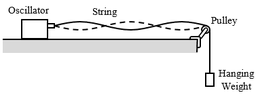
The discussion revolves around the concept of "physically reasonable waves on a string" and the challenges faced in teaching physics experiments. A participant shares an alternative experimental setup using electromagnetic force with a horseshoe magnet and a steel wire, allowing for precise wavelength measurement. There is a debate on how to guide students in selecting variable ranges for experiments, with some preferring structured limits while others advocate for student-led exploration. The conversation highlights the difficulty in fostering student confidence to design their own experiments and the importance of identifying when experimental results deviate from expected outcomes. Overall, the exchange emphasizes innovative teaching methods and the need for flexibility in experimental design.
Redbelly98
Staff Emeritus
Science Advisor
Homework Helper
Insights Author
Messages
12,178
Reaction score
186

Attachments

  • StandingWaveOnString_01.png
    StandingWaveOnString_01.png
    1.6 KB · Views: 248
  • StandingWaveOnString_01.png
    StandingWaveOnString_01.png
    1.6 KB · Views: 237
  • StandingWaveOnString_01.png
    StandingWaveOnString_01.png
    1.6 KB · Views: 240
  • StandingWaveOnString_01.png
    StandingWaveOnString_01.png
    1.6 KB · Views: 250
  • StandingWaveOnString_01.png
    StandingWaveOnString_01.png
    1.6 KB · Views: 249
  • StandingWaveOnString_01.png
    StandingWaveOnString_01.png
    1.6 KB · Views: 596
  • StandingWaveOnString_01.png
    StandingWaveOnString_01.png
    1.6 KB · Views: 201
  • StandingWaveOnString_01.png
    StandingWaveOnString_01.png
    1.6 KB · Views: 177
  • StandingWaveOnString_01.png
    StandingWaveOnString_01.png
    1.6 KB · Views: 238
  • StandingWaveOnString_01.png
    StandingWaveOnString_01.png
    1.6 KB · Views: 115
  • StandingWaveOnString_01.png
    StandingWaveOnString_01.png
    1.6 KB · Views: 219
  • StandingWaveOnString_01.png
    StandingWaveOnString_01.png
    1.6 KB · Views: 220
Last edited by a moderator:
  • Like
Likes Drakkith, berkeman, BvU and 5 others
Physics news on Phys.org
I'm particularly interested in hearing from physics teachers or students who have used these setups, especially if your setup was outside what I'm calling the "physically reasonable zone".
 
Redbelly98 said:
if your setup was outside what I'm calling the "physically reasonable zone".
I'm not sure what you mean by that expression, exactly but I have used an alternative method which might interest you. The method involves electromagnetic force. A nice beefy horseshoe magnet is placed with a stretched steel wire held between the poles. One end is fixed and the other is tensioned with a variable mass. A fairly powerful signal generator is connected across the ends of the wire. Not directly on the wire but to the fixing and pulley so that the excitation is 'clean' and can be applied at any point along the wire. I prefer this method because, unlike when the end of the string is moved, the precise wavelength can be measured because true Nodes can be seen at each end.
Good magnets are easily obtainable these days - much better ones than what I had available a few years ago and a standard School Oscillator will give you frequencies from a few Hz to a few tens of Hz.
Give it a go.
 
  • Like
Likes Redbelly98 and vanhees71
Oh, cool setup!
sophiecentaur said:
I'm not sure what you mean by that expression ...
I was referring to the two diagrams toward the of the article -- to see them, you'd need to click the "Continue reading" link. (Not sure if you didn't see the diagrams, or did see them and something still isn't clear about them.)
 
Redbelly98 said:
(Not sure if you didn't see the diagrams, or did see them and something still isn't clear about them
Ah yes - I see where you're coming from. now. Choosing suitable ranges of variables to present to students for practical exercises can be approached in two ways. you either tell them to look between specified limits or you tell them to find those limits. Personally, I always found it difficult to find students with enough confidence to do the latter. They always wanted guidance and we seldom had time to do any more than the basic experiment, followed by the customary graph and analysis. I sometimes wonder if it had anything to do with the religious basis on which the School was run - but that could be just me offloading some of my own guilt.
Afair, there were only one or two opportunities for extended investigations and there would only be the occasional student who would actually risk writing their own agenda. When that occurs, of course, it's great.
Spotting where the experiment breaks down - where the graph leaves the straight line, for instance is good for qualitative comments.

Earlier in life, as a Research Engineer, I was always coming across this sort of thing but I think experiments would have been run, using ranges of variables that were realistic, found during the experiment on an iterative basis (seat of pants, you could say).
 
  • Like
Likes vanhees71
Topic about reference frames, center of rotation, postion of origin etc Comoving ref. frame is frame that is attached to moving object, does that mean, in that frame translation and rotation of object is zero, because origin and axes(x,y,z) are fixed to object? Is it same if you place origin of frame at object center of mass or at object tail? What type of comoving frame exist? What is lab frame? If we talk about center of rotation do we always need to specified from what frame we observe?

Similar threads

  • · Replies 1 ·
Replies
1
Views
1K
  • · Replies 1 ·
Replies
1
Views
1K
  • · Replies 3 ·
Replies
3
Views
1K
  • · Replies 10 ·
Replies
10
Views
3K
  • · Replies 29 ·
Replies
29
Views
3K
  • · Replies 3 ·
Replies
3
Views
2K
  • · Replies 11 ·
Replies
11
Views
1K
  • · Replies 11 ·
Replies
11
Views
4K
  • · Replies 7 ·
Replies
7
Views
3K
  • · Replies 5 ·
Replies
5
Views
566