Finding the Inverse Fourier Transform for a Complex Function

Click For Summary

Homework Help Overview

The discussion revolves around finding the inverse Fourier transform of the function \(\frac{e^{i 6\omega}}{\omega}\). Participants are exploring the correct application of Fourier transform properties and the implications of using different conventions in mathematical software.

Discussion Character

  • Mixed

Approaches and Questions Raised

  • Participants discuss using tables of Fourier transforms and convolution properties. There are questions about the integral involved and the interpretation of results from different software tools like Mathematica and Maple. Some participants express uncertainty about the constants and conventions used in their calculations.

Discussion Status

The discussion is ongoing, with participants providing insights and questioning each other's reasoning. Some guidance about conventions in Fourier transforms has been offered, but there is no explicit consensus on the correct approach or the source of discrepancies in results.

Contextual Notes

Participants mention potential differences in definitions and conventions for Fourier transforms, which may affect their results. There is also a reference to the need for clarity on the use of the sign function and its relationship to the Heaviside function.

Telemachus
Messages
820
Reaction score
30
Hi there. I have some trouble with this. I have to find the inverse Fourier transform for: \frac{e^{i 6\omega}}{\omega}
So I'm using a table, then:
F^{-1}\left ( \frac{e^{i 6\omega}}{\omega}\right )=F^{-1}\left ( e^{i 6\omega}\right ) * F^{-1}\left ( \frac{1}{\omega}\right )=2\pi\left[ \delta (t+6)*\frac{i}{2}sg(t)\right] where (*) represents the convolution.

Well, everything fine till there, but when I tried to corroborate my result with mathematica I get:
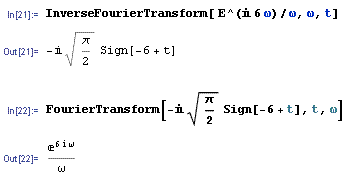
attachment.php?attachmentid=36378&stc=1&d=1307828102.gif


I don't know what's wrong.
 

Attachments

  • ft.GIF
    ft.GIF
    2 KB · Views: 792
Physics news on Phys.org
I don't know which integral you are referring. I'm using that F(sg(t))=\frac{2}{i \omega} and F(\delta(t-t_0))=e^{-i \omega t_0}

Then F^{-1}(e^{i6\omega})=\delta(t+6) and F^{-1}\left (\frac{1}{\omega}\right )=F^{-1}\left ( \frac{i}{2}\frac{2}{i \omega}\right )=\frac{i}{2}sg(t)
 
The convolution is given by:
<br /> f\star g(x)=\int_{-\infty}^{\infty}f(y)(g(x-y)dy<br />
Then the Fourier transform is just the product of the Fourier transforms of f and g. So in this case you have \hat{f}(\omega )=e^{6\omega i} and \hat{g}(\omega )=\omega^{-1} and so the founction you're tring to find is:
<br /> i\sqrt{\frac{\pi}{2}}\int_{\infty}^{\infty}\delta (y+6)\textrm{sign}(y-x)dy<br />
 
I follow your reasoning till here:
<br /> f\star g(x)=\int_{-\infty}^{\infty}f(y)(g(x-y)dy<br />

But I don't know how you get this from there:

<br /> i\sqrt{\frac{\pi}{2}}\int_{\infty}^{\infty}\delta (y+6)\textrm{sign}(y-x)dy<br />
Particularly this: i\sqrt{\frac{\pi}{2}}
I don't know where you get that from.

I get from here: 2\pi\left[ \delta (t+6)*\frac{i}{2}sg(t)\right]=i \pi \int_{\infty}^{\infty}\delta (t+6)\textrm{sign}(x-t)dy so I make x_0=-6, then:
i \pi \int_{\infty}^{\infty}\delta (x+6)\textrm{sign}(t-x)dx=i \pi \textrm{Sign}(t+6)
 
Last edited:
Edit: incorrect
 
Last edited:
I think it's fine. Look, I have the table right here.

F^{-1}(e^{-i\omega t_0})=\delta(t-t_0)
Then I have t_0=-6

Thats what I've used.
 
Yes, I think I made a mistake. I don't know how Mathematica arrives at that result.
 
Yes, I don't know neither. And actually the problem is I don't know where I have the mistake, I think that my solution is fine, maybe I'm not doing it well in mathematica, I'm thinking that there are different ways for defining a Fourier transform. You can use the frequencies or the angular frequency. Maybe I'm just not doing it well with mathematica, perhaps I have to define something else, that's a possibility.
 
  • #10
Telemachus said:
Hi there. I have some trouble with this. I have to find the inverse Fourier transform for: \frac{e^{i 6\omega}}{\omega}
So I'm using a table, then:
F^{-1}\left ( \frac{e^{i 6\omega}}{\omega}\right )=F^{-1}\left ( e^{i 6\omega}\right ) * F^{-1}\left ( \frac{1}{\omega}\right )=2\pi\left[ \delta (t+6)*\frac{i}{2}sg(t)\right] where (*) represents the convolution.

Well, everything fine till there, but when I tried to corroborate my result with mathematica I get:
attachment.php?attachmentid=36378&stc=1&d=1307828102.gif


I don't know what's wrong.

Here is what I get using Maple:


fw:=exp(I*6*w)/w;
exp(6 I w)
fw := ----------
w


> ft:=invfourier(fw,w,t);

ft := 1/2 I (2 Heaviside(6 + t) - 1)

> convert(%,piecewise);

{ -1/2 I t < -6
{
{ undefined I t = -6
{
{ 1/2 I -6 < t

RGV
 
  • #11
Thats even weirder.
 
  • #12
If you're just wondering about the constants out front, you have to remember there are various conventions of where to put the 2\pi. Mathematica has a parameter called, appropriately enough, FourierParameters that you can set depending on which convention you want to use.
 
  • #13
Thank you vela :) do you have any idea about how mathematica gets to that? I think I should read more carefully the help content on this topic, but I don't have to much time for this, so maybe if you know the underlying formalism for this I'll appreciate if you let me know :P

Does it have any sense the solution with the heaviside function that Ray found using Maple? that's not a constant difference, but I'm aware of the similarities between the unit step function and the sign function, they differ only for the negative real values (I have no idea about what happens on the complex field).
 
Last edited:
  • #14
By default, this is what Mathematica uses for the inverse Fourier transform:

f(t) = \frac{1}{\sqrt{2\pi}}\int_{-\infty}^\infty F(\omega)e^{-i\omega t}\,d\omega
So Mathematica would give you, for example,

F^{-1}[e^{i6\omega}] = \frac{1}{\sqrt{2\pi}}\int_{-\infty}^\infty e^{i6\omega}e^{-i\omega t}\,d\omega = \sqrt{2\pi}\left[\frac{1}{2\pi}\int_{-\infty}^\infty e^{i(6-t)\omega}\,d\omega\right]
where the quantity in the square brackets is the Dirac delta function \delta(t-6).

From looking at the results you found in the table, I think you're using the convention

f(t) = \int_{-\infty}^\infty F(\omega)e^{i\omega t}\,d\omega
If you look in the Mathematica documentation on integral transforms, there's a list of what you want to set FourierParameters to to follow the convention you're using in your class.

As to the unit step and sign functions, they're related by a vertical shift and vertical scaling. You should be able to figure that out pretty easily.
 
  • #15
The definition of the integral transform I am using is:
<br /> \hat{f}(\omega )=\int_{-\infty}^{\infty}f(x)e^{-i\omega x}dx<br />
All I did was take the information from the wikipedia page and use that. The coefficient i\sqrt{\pi /2} came from examining the Fourier transform of the sign function.
 
  • #16
Thank you vela.
hunt_mat, I think wikipedia uses the formalism that vela just mentioned. You used the Fourier transform for the sign that you found in wikipedia or the one I've posted?
 
  • #17
having said that now, I am a little unsure of the sign I used.
 
  • #18
That is also the definition that Maple uses. Of course, that means that the inverse FT has the form (1/(2*pi))* \int \hat{f}(w) exp(i*w*x) dw.

RGV
 
  • #19
Thank you all.
 

Similar threads

Replies
1
Views
2K
  • · Replies 1 ·
Replies
1
Views
2K
  • · Replies 5 ·
Replies
5
Views
2K
  • · Replies 6 ·
Replies
6
Views
3K
  • · Replies 3 ·
Replies
3
Views
2K
  • · Replies 3 ·
Replies
3
Views
3K
Replies
2
Views
2K
  • · Replies 1 ·
Replies
1
Views
1K
Replies
8
Views
2K
Replies
5
Views
2K