High School Correctness of Equations in Electromagnetism Textbook

Click For Summary
SUMMARY

The forum discussion centers on the correctness of equations presented in a Russian handbook for electricians related to electromagnetism. Participants express skepticism about the mathematical validity of the equations, particularly noting that after the third equal sign, the expression loses its dependence on time (t), which indicates a potential error. Additionally, there are concerns regarding the notation of amplitude, suggesting it should be represented with a subscript (A_m) for clarity. The discussion emphasizes the need for accurate transcription of equations from the source material.

PREREQUISITES
  • Understanding of Fourier transforms in electromagnetism
  • Familiarity with mathematical notation in physics
  • Knowledge of amplitude representation in equations
  • Basic principles of electromagnetism
NEXT STEPS
  • Research the Fourier transform and its applications in electromagnetism
  • Study the mathematical representation of amplitude in physics
  • Examine common errors in transcription of equations from textbooks
  • Explore the significance of time dependence in electromagnetic equations
USEFUL FOR

Students of physics, electrical engineers, and anyone involved in the study or application of electromagnetism who seeks to verify the accuracy of mathematical equations in technical literature.

DesertFox
Hello buddies!
Please, check out these equations...
Tell me, please, are they mathematically correct or not?

I need a simple YES/NO answer.
I have not sufficient knowledge to understand them. I just need to know whether they are correct...

Thank you!

P.S. Am is amplitude; I guess it is a form of Fourier's inverse transform applied in electromagnetism...
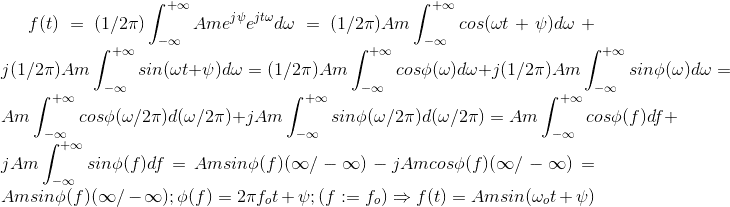
CodeCogsEqn (7).gif
 
Physics news on Phys.org
What is the source of these equations?
 
Dale said:
What is the source of these equations?
A russian handbook for electricians..
 
Is it this same book that we have discussed here previously?
 
Dale said:
Is it this same book that we have discussed here previously?
No. This one is from Russian source! Is it correct?
 
  • Like
Likes Dale
After the third equal sign the expression loses its dependence on t, so that seems wrong. The infinity/-infinity is not terribly meaningful either.
 
You can simplify by taking Ame^{j\psi} outside the integral sign.
The resultant integrand looks like the Fourier transform of the delta function.
 
Are you sure you're copying it from the textbook correctly? Shouldn't amplitude ##Am## be with ##m## as a subscript (like in ##A_m## or something)? Can you just screenshot the page with equations (I doubt it is an actual screenshot from the textbook) or make a photo of it?
What is the name of the source and where in the source (page, equation number) one can find these equations?

Dale said:
After the third equal sign the expression loses its dependence on t, so that seems wrong.
Because it got buried in the notation like ##\phi(f)=2\pi f_0 t + \psi## (you can spot it somewhere at the end of this... mess). Not sure if it would help fully decipher it.
 
Last edited:

Similar threads

  • · Replies 8 ·
Replies
8
Views
5K
  • · Replies 11 ·
Replies
11
Views
2K
  • · Replies 1 ·
Replies
1
Views
3K
Replies
5
Views
2K
  • · Replies 3 ·
Replies
3
Views
3K
  • · Replies 26 ·
Replies
26
Views
2K
Replies
4
Views
2K
  • · Replies 1 ·
Replies
1
Views
2K
Replies
1
Views
2K
Replies
8
Views
2K