Inverse Weyl quantization of the projection operator.

Click For Summary

Homework Help Overview

The discussion revolves around a problem from Quantum Mechanics concerning the inverse Weyl quantization of the projection operator, specifically focusing on the trace of an operator and its integral kernel.

Discussion Character

  • Exploratory, Mathematical reasoning, Assumption checking

Approaches and Questions Raised

  • Participants discuss the action of the operator in the trace and attempt to derive the integral kernel. There are attempts to evaluate integrals involving the trace expression and to manipulate the resulting equations. Questions arise regarding the correctness of numerical factors and the implications of taking limits, particularly in relation to the classical limit.

Discussion Status

Participants are actively engaging with the problem, sharing their attempts and questioning specific aspects of their calculations. Some guidance has been offered regarding the integration order and the treatment of prefactors, but no consensus has been reached on the correctness of certain factors or the implications of the classical limit.

Contextual Notes

There are ongoing discussions about the assumptions related to the behavior of the wave function as certain parameters approach limits, as well as the definitions of probability distributions in the context of the problem.

VoxCaelum
Messages
14
Reaction score
0
I am trying to solve the following problem on an old Quantum Mechanics exam as an exercise.
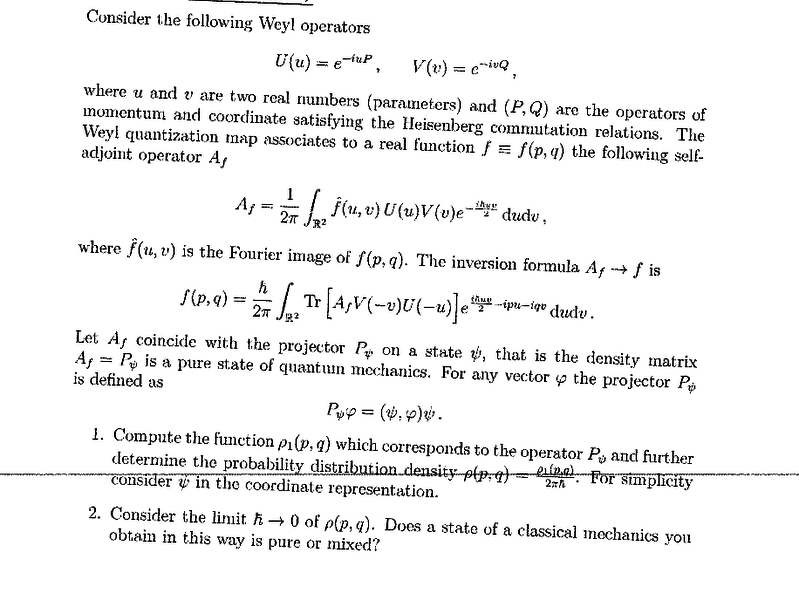
Homework Statement


attachment.php?attachmentid=56531&stc=1&d=1362850754.png


Homework Equations


I know that the trace of an operator is the integral of its kernel.
\begin{equation}
Tr[K(x,y)] = \int K(x,x) dx
\end{equation}


The Attempt at a Solution


I start out by finding the action of the operator in the trace:
\begin{equation}
(P_{\psi} V(-v) U(-u) \phi)(x) = \int \psi^{\star} e^{i v x} \phi(x+\hbar u) dx \psi(x)
\end{equation}
Which I think should, by sending $x\rightarrow y-\hbar u$, be equal to:
\begin{equation}
\int \psi^{\star}(y- \hbar u) e^{i v (y-\hbar u)} \phi(y) \psi(x) dy
\end{equation}
Which means that the integral kernel of this operator is:
\begin{equation}
K_{\psi}(x,y) = \psi^{\star}(y- \hbar u) e^{i v (y-\hbar u)} \psi(x)
\end{equation}
Which means that the trace is:
\begin{equation}
\int K_{\psi}(x,x) dx = \int \psi^{\star}(x- \hbar u) e^{i v (x-\hbar u)} \psi(x) dx
\end{equation}

So essentially I am stuck trying to solve this integral.
Any help would be greatly appreciated.
 

Attachments

  • weyl quantization.png
    weyl quantization.png
    53.3 KB · Views: 1,550
Physics news on Phys.org
VoxCaelum said:
Which means that the trace is:
\begin{equation}
\int K_{\psi}(x,x) dx = \int \psi^{\star}(x- \hbar u) e^{i v (x-\hbar u)} \psi(x) dx
\end{equation}

So essentially I am stuck trying to solve this integral.
Any help would be greatly appreciated.

Use this expression for the trace in the equation for ##f(q,p)## and see if you can do the ##v## integration next and then do the ##x## integration.
 
Thanks!
I gave that a try, and this is what I came up with:

\begin{equation}
f(p,q) = \frac{\hbar}{2 \pi} \int_{ℝ^{2}} \int_{ℝ} \psi^{\star}(x-\hbar u) e^{ev(x-\hbar u)} \psi(x) e^{i \hbar u v/2 -ipu -iqv/} du dv dx
\end{equation}

Which I think should be combined as follows so I get an expression for the dirac-delta distribution:

\begin{equation}
\frac{\hbar}{2 \pi} \int_{ℝ^{2}} \int_{ℝ} \psi^{\star}(x - \hbar u) \psi(x) e^{-ipu} e^{iv(-\hbar u/2 + x -q)} du dv dx
\end{equation}

Where the v integration gives the delta distribution:
\begin{equation}
f(p,q) = \frac{\hbar}{\sqrt{2 \pi}} \int_{ℝ} \int_{ℝ} \psi^{\star}(x-\hbar u) \psi(x) e^{-ipu} \delta(\frac{-\hbar u}{2} + x -q) dudx
\end{equation}
I figure you could do either the x or the u integration here, but since you said I should start with the x integration:
\begin{equation}
f(p,q) = \frac{\hbar}{\sqrt{2 \pi}} \int_{ℝ} \psi^{\star}(\frac{-\hbar u}{2} + q) \psi(\frac{\hbar u}{2} + q) e^{-ipu} du
\end{equation}

I don't think the last integration can be taken any further without knowing what psi is...

As for part b, in the limit that hbar approaches zero, does this function not becomes simply identically zero?
 
Yes, you could do the u integration before the x integration. I think you should get the same result.

I don't think the factor of ##1/\sqrt{2\pi}## should be in the result. (Check the numerical factors in getting the delta function from the integration of the exponential.)

Note that the probability distribution is defined as ##f(p,q)/(2\pi\hbar)##, so the ##\hbar## in front of the integral in ##f(p,q)## will disappear. You can then try to get the classical limit.
 
Thanks again.
I believe the current prefactor \frac{1}{\sqrt{2 \pi}} is still correct, but it will be taken care of once you divide by 2 \pi \hbar and compute the last integral, which is the Fourier transform of |\psi|^{2}.
 
VoxCaelum said:
Thanks again.
I believe the current prefactor \frac{1}{\sqrt{2 \pi}} is still correct, but it will be taken care of once you divide by 2 \pi \hbar and compute the last integral, which is the Fourier transform of |\psi|^{2}.

Maybe I'm overlooking a factor of ##\sqrt{2\pi}## somewhere. When integrating over ##v## to get the dirac delta function, did you use the integral representation of the delta function as given in equation 1.17.12 here ?

The last integral is not quite the Fourier transform of ##|\psi^2|## due to the difference in signs occurring inside the arguments of ##\psi## and ##\psi^*##.
 
I meant it would be the Fourier transform in the classical limit. And you're right about me getting that factor wrong. I misremembered there being a square root.
 
VoxCaelum said:
I meant it would be the Fourier transform in the classical limit.

I'm not sure about the classical limit. It seems to me that if you let h \rightarrow 0, then the arguments of ψ and ψ* no longer depend on the integration variable u. Thus you can pull ψ and ψ* out of the integral.
 

Similar threads

  • · Replies 10 ·
Replies
10
Views
3K
  • · Replies 1 ·
Replies
1
Views
3K
Replies
7
Views
2K
Replies
7
Views
3K
  • · Replies 2 ·
Replies
2
Views
3K
  • · Replies 3 ·
Replies
3
Views
2K
Replies
4
Views
5K
Replies
1
Views
2K
  • · Replies 3 ·
Replies
3
Views
2K
  • · Replies 20 ·
Replies
20
Views
3K