Is a function better approximated by a line in some regions?

Click For Summary

Discussion Overview

The discussion revolves around the approximation of the function ##f(x) = e^{-x}## by a linear function in different regions of its graph. Participants explore the conditions under which the linear approximation is more accurate and the implications of the function's curvature, particularly focusing on regions labeled ##A## and ##B##.

Discussion Character

  • Exploratory
  • Technical explanation
  • Mathematical reasoning

Main Points Raised

  • One participant questions to what extent ##f(x)## can be said to be better approximated by a line in region ##B## compared to region ##A##, suggesting that the sharpness of the curve may influence the approximation quality.
  • Another participant explains the Taylor series expansion and emphasizes the importance of the remainder term ##R(x,x_0)## in assessing the accuracy of the linear approximation.
  • A further remark highlights the limitations of the remainder formulation for numerical calculations and suggests that multiple derivatives can be considered for improved approximations.
  • One participant expresses uncertainty about the validity of statements regarding approximation accuracy, noting that the second derivative's behavior affects the remainder and thus the approximation's quality.
  • A clarification is provided regarding the choice of points ##B## and ##-ln A## for comparison, indicating that they correspond to different axes in the graph of the function.

Areas of Agreement / Disagreement

Participants express differing views on the criteria for determining where the second derivative is larger between regions ##A## and ##B##, indicating that the discussion remains unresolved regarding the specific conditions affecting approximation accuracy.

Contextual Notes

Participants note that the second derivative's positivity in both regions does not clarify which region has a larger second derivative, leaving the criteria for comparison ambiguous.

Soren4
Messages
127
Reaction score
2
I studied Taylor series but I would like to have an answer to a doubt that I have. Suppose I have ##f(x)=e^{-x}##. Sometimes I've heard things like: "the exponential curve can be locally approximated by a line, furthermore in this particular region it is not very sharp so the approximation is even more good.."

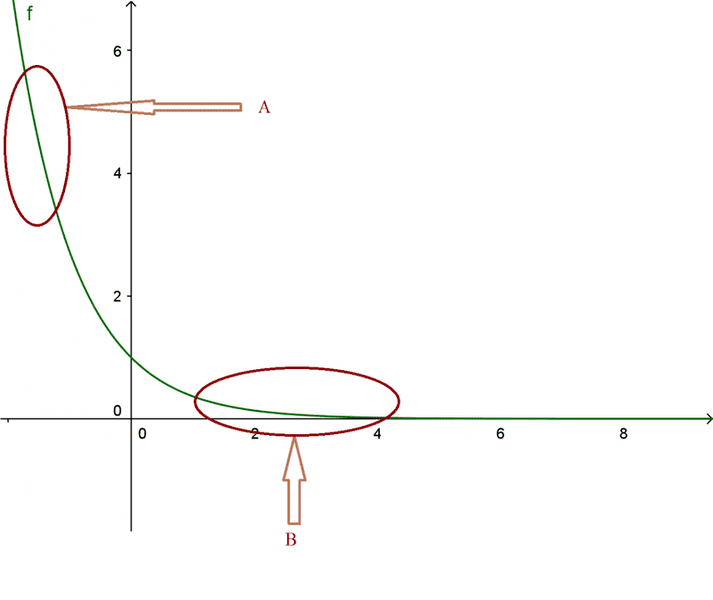
Now I'm aware of the fact that any function (differentiable and so on) can be approximated by a line and further polynomial, but consider this graph of ##f(x)## and the regions ##A## and ##B##.
ggg.png

My question is : to what extent I can say "##f(x)## is better approximated by a line in ##B## than in ##A##"? And, if I could do this, why is that ? Is that because in region ##B## ##f(x)## is less sharp than in ##A##, or is there other reason behind this?
 

Attachments

  • ggg.png
    ggg.png
    65.4 KB · Views: 498
Physics news on Phys.org
If you consider a linear approximation, i.e. by the first derivative, then you have the Taylor series (expanded at a point ##x_0##) written as
##f(x) = f(x_0) + (x-x_0) f'(x_0) + R(x,x_0)## where the term ##R(x,x_0)## is the remainder, that makes the difference. So we have to consider this term. One way to write it, is ##R(x,x_0) = \frac{1}{2} (x-x_0)^2 f''(\zeta)## for a point ##\zeta \in ]x,x_0[##.

Now you can choose a small interval around your points ##x_0 = B## and ##x_0 = - \ln A## and calculate the deviation ##|R(x,x_0)|## from linearity.
 
  • Like
Likes   Reactions: Soren4
Another remark.
The formulation above isn't really good for numeric calculations, since it only states "there exists a certain ##x < \zeta < x_0## such that ..." and is of little use, if one actually needs to sharply calculate proper estimations. Here is where the work starts. If I remember correctly, there are several ways to get the hands on the remainders. Plural, because one can of course take more derivations into account than just one and get closer and closer towards ##f## and thus have according remainders ##R##. (I would have searched the internet, if I knew the correct English term for ##R##.)

However, the formulation above has a few advantages:
- it is easy to remember
- it can be used if one is interested in only a rough approximation
- it is sufficient for most physical applications (I think)

And finally it holds true for more than one term of the Taylor series, i.e.
$$f(x) = f(x_0) + (x-x_0)f'(x_0) + \frac{1}{2!}(x-x_0)^2f''(x_0) + \frac{1}{3!}(x-x_0)^3f^{(3)}(x_0) + \; \dots \; + \frac{1}{n!}(x-x_0)^nf^{(n)}(x_0) + R_n(x,x_0)$$
with now ##R_n(x,x_0) = \frac{1}{(n+1)!}(x-x_0)^{n+1}f^{(n+1)}(\zeta)##
 
  • Like
Likes   Reactions: Soren4
Thanks a lot for your answers and your help!

I still do not really get if statements like the one in my question are somehow true or not... The remainder is bigger where ##f''(\zeta)## (the second derivative) is bigger, and there the approximation is worse. But here for istance, I understand that in both in regions ##A## and ##B## ##f''## is positive (by the way, why did you say to consider ##B## and ##-lnA##? why the logarithm?) but I fail to understand where between ##A## and ##B## the second derivative is bigger, what could be the criteria to see where ##f''## is bigger in this case?
 
Soren4 said:
(by the way, why did you say to consider ##B## and ##−lnA##? why the logarithm?)
Because you labeled ##A## on the ##y-##axis and ##B## on the ##x-##axis. For comparison you need some comparable ranges on the ##x-##axis. The smaller you chose the interval ##[x,x_0]## the smaller is the deviation and it won't matter a lot whether ##\zeta## is closer at ##x## or at ##x_0## which we cannot know, since we only have the existence of such a ##\zeta## and not its position.
 

Similar threads

  • · Replies 3 ·
Replies
3
Views
2K
  • · Replies 9 ·
Replies
9
Views
3K
Replies
23
Views
4K
  • · Replies 2 ·
Replies
2
Views
2K
  • · Replies 3 ·
Replies
3
Views
2K
  • · Replies 9 ·
Replies
9
Views
2K
  • · Replies 12 ·
Replies
12
Views
1K
  • · Replies 3 ·
Replies
3
Views
2K
  • · Replies 24 ·
Replies
24
Views
4K
  • · Replies 2 ·
Replies
2
Views
2K