A1337STI
- 4
- 0
So I was trying to understand some Mu charts of Brake pads for cars.
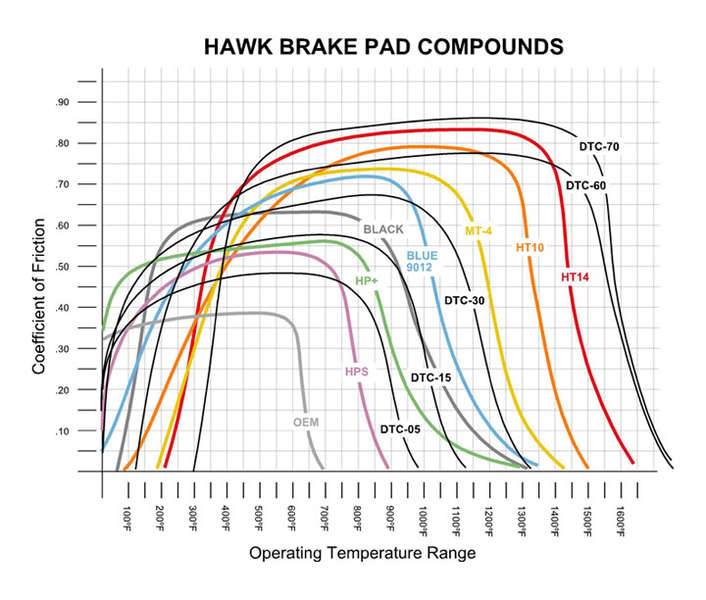
I thought that Mu was basically a "calculated, or measured constant " which could be used to compare friction between 2 materials. like a solid iron Rotor, and a brake pad. I was thinking that a simple chart that shows Mu throughout the operating temperature range was sufficient.
My assumptions are that 1) Mu does not change with speed. whether a car is going 100 mph or 10 mph is irrelevant (rotor speed of 1333 RPM or 133 RPM) the Mu is the Mu .. Or am i wrong?
total friction generated per minute would obviously go up, and heat would go up as a result which might push the pad/rotor combination into a hotter part of the chart, but the Mu would fall in line with its established value .
Or does the mu change with speed ?
2) assumption , Clamping force doesn't change Mu, as you clamp down harder, the total friction would go up, but not the actual Mu .
If those assumptions are both correct, then someone Could look at a chart that shows Mu vs temperature and get a good idea of if brake pad A would perform better than brake pad B
something that looks like this :
Hopefully I'm not completely ignorant on this. i never took physics past high school, despite having a strong interest in it.
But I want to know the correct answer. thanks in advance. :)
I thought that Mu was basically a "calculated, or measured constant " which could be used to compare friction between 2 materials. like a solid iron Rotor, and a brake pad. I was thinking that a simple chart that shows Mu throughout the operating temperature range was sufficient.
My assumptions are that 1) Mu does not change with speed. whether a car is going 100 mph or 10 mph is irrelevant (rotor speed of 1333 RPM or 133 RPM) the Mu is the Mu .. Or am i wrong?
total friction generated per minute would obviously go up, and heat would go up as a result which might push the pad/rotor combination into a hotter part of the chart, but the Mu would fall in line with its established value .
Or does the mu change with speed ?
2) assumption , Clamping force doesn't change Mu, as you clamp down harder, the total friction would go up, but not the actual Mu .
If those assumptions are both correct, then someone Could look at a chart that shows Mu vs temperature and get a good idea of if brake pad A would perform better than brake pad B
something that looks like this :
Hopefully I'm not completely ignorant on this. i never took physics past high school, despite having a strong interest in it.
But I want to know the correct answer. thanks in advance. :)