Discussion Overview
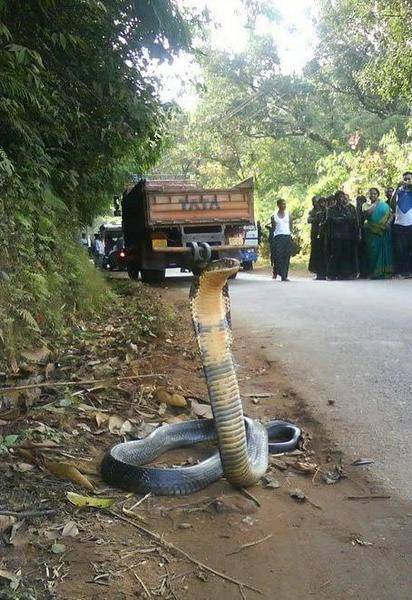
The discussion centers around a photograph of a three-headed snake, exploring whether it is a rare genetic mutation or if it holds significance as a revered figure in Hindu culture. Participants examine the rarity of polycephalic animals, the authenticity of the photograph, and the biological implications of such mutations.
Discussion Character
- Exploratory
- Debate/contested
- Technical explanation
- Meta-discussion
Main Points Raised
- Some participants suggest that three-headed snakes are extremely rare, with reports primarily of two-headed snakes.
- Questions arise about how a three-headed snake would coordinate its movements and survive, with speculation on whether one head controls the body or if all three share control.
- Concerns about the authenticity of the photograph are raised, with some participants claiming it may be photoshopped due to visual anomalies.
- Others argue that identical genetic structures could lead to similar markings on each head, challenging the assertion of the image being manipulated.
- Some participants express skepticism about the original poster's claims of taking the photograph, suggesting it could be a hoax.
- There are discussions about the implications of polycephaly in animals, including the potential for such creatures to survive to adulthood despite the challenges posed by having multiple heads.
- Participants note that the original poster seems more interested in sharing excitement than proving the photograph's authenticity.
Areas of Agreement / Disagreement
Participants do not reach a consensus on the authenticity of the photograph or the nature of the three-headed snake. Multiple competing views exist regarding its rarity, the biological implications of polycephaly, and the validity of the original poster's claims.
Contextual Notes
Some participants express uncertainty about the conditions under which polycephalic animals can survive, and there are unresolved questions about the photographic evidence presented.