Is caustic surface of an astrophysical black hole one event?

Click For Summary

Discussion Overview

The discussion centers on the nature of caustics in the context of astrophysical black holes, specifically whether a caustic surface constitutes a single event or a two-dimensional surface. Participants explore the implications of caustics in relation to the event horizon and the formation of black holes, engaging with concepts from general relativity and Penrose diagrams.

Discussion Character

  • Exploratory
  • Technical explanation
  • Debate/contested

Main Points Raised

  • One participant references MTW's definition of a caustic and the theorem by Penrose regarding generators of the horizon, questioning whether a caustic is a single event or a surface.
  • Another participant describes the formation of the event horizon and the role of light rays emitted from the center of a collapsing region, suggesting that these light rays represent the generators of the horizon.
  • There is a discussion about the nature of the event at which matter crosses the horizon, with some arguing that it is not infalling since it remains at r = 0, while others contend that it still has proper time before reaching the singularity.
  • Participants debate the appropriateness of using Schwarzschild coordinates versus other coordinate systems, noting that the singularity is spacelike and not present at all times in the discussed spacetime.
  • Terminology around "infalling" is contested, with some suggesting it is misleading in the context of matter at r = 0, while others argue for its use based on the proper time before reaching the singularity.

Areas of Agreement / Disagreement

Participants express differing views on the nature of caustics, the terminology used to describe the behavior of matter crossing the horizon, and the implications of coordinate systems. No consensus is reached on these points, indicating ongoing debate and exploration of the concepts involved.

Contextual Notes

Participants highlight the limitations of using different coordinate systems and the implications for understanding the relationship between caustics, event horizons, and singularities. There is also mention of the dependence on definitions and the complexity of the spacetime being discussed.

bcrowell
Staff Emeritus
Science Advisor
Insights Author
Messages
6,723
Reaction score
431
MTW, p. 924, defines a caustic as a point where a null geodesic originating from the external universe enters a black hole's event horizon, remaining in the horizon afterward for some finite affine interval. (A null geodesic of this type is called a generator of the horizon.) They introduce this as a preliminary to stating and proving a theorem by Penrose, 1968. The theorem says that: (1) after a generator enters the horizon, it stays there forever, and never intersects another generator except at a caustic; (2) any point on the horizon (if not a caustic point) lies on exactly one generator.

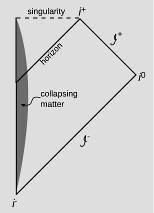
In the case of a black hole that forms by gravitational collapse, is there a single event in all of spacetime that is a caustic, or does the set of caustics form a two-dimensional caustic surface?
penrose_black_hole.jpg


If I look at the Penrose diagram for an astrophysical black hole, it looks to me like there is one point on the diagram that represents a caustic, and this point lies on the axis of symmetry, so it really is a single point, not a 2-sphere. (To see this on my diagram, you need to imagine the diagram as being rotated about the symmetry axis at its left edge.)

However, this seems odd, because I would then imagine this event as the one at which the black hole first formed, i.e., the earliest moment at which any infalling matter crossed the newly formed horizon. ("Earliest" would mean that it's in the causal past of all other events at which infalling matter crossed the horizon.) So it's trapped behind a horizon that is going to be formed by other matter that isn't there yet.

Based on Newtonian intuition, it's also tempting to imagine this as the event at which the singularity formed, but on the Penrose diagram I think it's clear that the caustic is separated from the singularity by some finite proper time, which I guess equals the mass of the hole.

If the caustic was going to be associated with a surface rather than a point, I guess it would have to be the first trapped null surface...? But where does that lie on the Penrose diagram?
 
Physics news on Phys.org
bcrowell said:
I would then imagine this event as the one at which the black hole first formed, i.e., the earliest moment at which any infalling matter crossed the newly formed horizon.

The matter that crosses the horizon at this point isn't "infalling". It's at ##r = 0##, and it stays at ##r = 0## after the horizon forms there.

The way I usually imagine the horizon formation is this: we have a spherically symmetric region of collapsing matter that is forming a black hole. Imagine a series of radially outgoing light rays emitted from the piece of matter at the exact center of the region (i.e., at ##r = 0##) in some particular direction (i.e., with constant angular coordinates ##\theta##, ##\phi##). These light rays will travel outward and reach the surface of the region of collapsing matter at some series of events.

Now consider one of these radially outgoing light rays, that happens to reach the surface of the collapsing matter at the exact instant that that surface is at ##r = 2M##, i.e., at the Schwarzschild radius. That light ray will stay at ##r = 2M## forever, since once we are in the vacuum region exterior to the collapsing matter, ##r = 2M## is the horizon. So that light ray is actually one of the generators of the horizon. The family of all such light rays, emitted from ##r = 0## at the exact same instant, in all possible directions (a 2-sphere's worth), is the complete family of generators of the horizon; and obviously they all intersect at the event at ##r = 0## where they were all emitted (this is the caustic).

bcrowell said:
So it's trapped behind a horizon that is going to be formed by other matter that isn't there yet.

Yes. The event horizon's location depends on the entire future of the spacetime; in particular, it depends on the intersection of radially outgoing light rays with the surface of the collapsing matter, in the causal future of the original emission event at ##r = 0##.

bcrowell said:
on the Penrose diagram I think it's clear that the caustic is separated from the singularity by some finite proper time

Yes, it is. The singularity forms when the surface of the collapsing matter reaches ##r = 0##. Along the worldline of a piece of matter at the surface, the proper time from crossing the horizon (at ##r = 2M##) to reaching the singularity is of the order of the mass of the hole (it's the same formula as for the proper time from horizon to singularity of a test object free-falling in after the hole has formed). I haven't calculated what the proper time along the worldline of the piece of matter at ##r = 0## would be between the horizon (the event where all the outgoing light rays that generate the horizon are emitted) and the singularity, but I would guess it would also be of the same order as the mass of the hole; however, the coefficient would have to be larger since the event where the surface of the collapsing matter crosses ##r = 2M## is in the causal future of the event where the generators are emitted from ##r = 0##.
 
Last edited:
PeterDonis said:
The matter that crosses the horizon at this point isn't "infalling". It's at ##r = 0##, and it stays at ##r = 0## after the horizon forms there.

Thanks for the helpful answer! On this point, though, I'm not sure I agree -- or maybe this is a purely verbal issue. This is not the Schwarzschild spacetime, so we don't have a singularity at all times. When this material particle crosses the event horizon, it still has some proper time to go before it hits the singularity, so I think it's still infalling.

You can make statements about coordinates, like stating that r=0, but I don't think that's conclusive. This is not the Schwarzschild spacetime, and we don't have Schwarzschild coordinates. The triangle on the Penrose diagram representing the interior region does look the same on this Penrose diagram as it does on the Penrose diagram for the Schwarzschild spacetime (supplying the reflection across the left edge), so I guess there is some fairly natural way of assigning pseudo-Schwarzschild coordinates to the triangle -- just invert the same map that you would have used to make the diagram in the Schwarzschild case. If we do that, then the matter that crosses the horizon at this event is not at r=0, it's at r=2M. On the other hand, if you look at the Penrose diagram for the astrophysical black hole, clearly it would be more appropriate at the times before the horizon forms to assign r=0 to the axis of spherical symmetry. So not surprisingly, if we pick one coordinate patch we like for one region and another coordinate patch we like for another region, they don't match up nicely at the boundary between the regions.
 
bcrowell said:
This is not the Schwarzschild spacetime, so we don't have a singularity at all times.

You don't have that even in Schwarzschild spacetime; the singularity is spacelike, not timelike. I agree that the spacetime we are discussing does not have Schwarzschild geometry everywhere, but the singularity is still spacelike; it's basically the portion of the singularity of maximally extended Schwarzschild spacetime that is not "replaced" by the non-vacuum region containing the collapsing matter.

bcrowell said:
When this material particle crosses the event horizon, it still has some proper time to go before it hits the singularity, so I think it's still infalling.

It hasn't reached the singularity yet, yes; but it's at ##r = 0## the whole time, so it isn't "infalling" in the usual sense of that term, which implies that the worldline is passing through smaller and smaller ##r## coordinates with increasing proper time. This is a matter of terminology, not physics, but I think the term "infalling" is misleading in this connection. I think a better description would be that the piece of matter at ##r = 0## emits the generators of the horizon at some instant of its proper time, and then at some later instant of its proper time, the rest of the collapsing matter hits it and the singularity forms.
 
  • Like
Likes   Reactions: bcrowell

Similar threads

  • · Replies 22 ·
Replies
22
Views
1K
  • · Replies 20 ·
Replies
20
Views
3K
  • · Replies 7 ·
Replies
7
Views
2K
  • · Replies 51 ·
2
Replies
51
Views
5K
  • · Replies 1 ·
Replies
1
Views
1K
  • · Replies 24 ·
Replies
24
Views
3K
  • · Replies 11 ·
Replies
11
Views
2K
  • · Replies 43 ·
2
Replies
43
Views
6K
  • · Replies 62 ·
3
Replies
62
Views
8K
  • · Replies 4 ·
Replies
4
Views
2K