Is $D_4$ a bounded region in 3-dimensional space?

  • Topic:
  • Thread starter mathmari
  • Start date
10 replies · 3K views · last reply
mathmari
Gold Member
MHB
Messages
4,984
Reaction score
7
Hey! :o

I want to draw the following spaces:

  1. $D_1=\{(x,y,z)\mid 0\leq x\leq 1, \ 1-x\leq y\leq 1, \ x\leq z\leq 1\}$

    By the inequalities $0\leq x\leq 1, \ 1-x\leq y\leq 1$ we get a triangle on the $xy$-plane with vertices $(0,1)$, $(1,0)$ and $(1,1)$.

    So, we have that triangle at the plane $z=0$. Do we shift that triangle to the plane $z=1$ because of the inequality $x\leq z\leq 1$, and so we get all the points between the triangle at $z=0$ till the triangle at $z=1$ ?

    $$$$
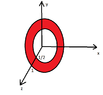
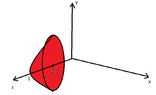
  2. $D_2=\left \{(x,y,z)\mid \frac{1}{2}\leq z\leq 1, \ x^2+y^2+z^2\leq 1\right \}$

    $x^2+y^2+z^2\leq 1$ is a sphere. From the inequality $\frac{1}{2}\leq z\leq 1$ we take only one part of the sphere, or not?

    $$$$
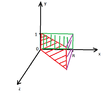
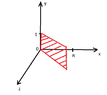
  3. $D_3=\{(x,y,z)\mid 0\leq x\leq \pi , \ 0\leq y \leq 1, \ 0\leq z\leq x\}$

    We draw the line $z=x$ on the $xz$-plane for $0\leq x\leq \pi$. Since $0\leq y\leq 1$, we get the following parallelogramm:

    View attachment 7396

    Is this correct?

    $$$$
  4. $D_4$ is defined by the paraboloid with equation $z=2x^2+y^2$ and the cylinder with the equation $z=8-y^2$.

    The paraboloid and the cylinder intersect at $2x^2+y^2=8-y^2 \Rightarrow x^2=4-y^2 \Rightarrow x=\pm \sqrt{4-y^2}$, therefore we get $-\sqrt{4-y^2}\leq x\leq \sqrt{4-y^2}$.
    It must hold that $4-y^2\geq 0 \Rightarrow y^2\leq 4 \Rightarrow -2\leq y \leq 2$.
    We have that $2x^2+y^2\leq 2\sqrt{4-y^2}^2+y^2=8-y^2 \Rightarrow 2x^2+y^2\leq z\leq 8-y^2$.

    Therefore the space $D_4$ is the set $\{(x,y,z)\mid -\sqrt{4-y^2}\leq x\leq \sqrt{4-y^2}, \ -2\leq y \leq 2, \ 2x^2+y^2\leq z\leq 8-y^2\}$, or not?
 
Attachments
  • Hand-drawn 3D axes with x, y, z labelled, tick marks at 1 on y and pi on x, and a red hatched triangle lying in the xy-plane with vertices at the origin, (pi, 0) and (pi, 1)
    paral.png
    2.9 KB · Views: 172
Hey mathmari! (Smile)

Picking 2 of them for now.

mathmari said:
2. $D_2=\left \{(x,y,z)\mid \frac{1}{2}\leq z\leq 1, \ x^2+y^2+z^2\leq 1\right \}$

$x^2+y^2+z^2\leq 1$ is a sphere. From the inequality $\frac{1}{2}\leq z\leq 1$ we take only one part of the sphere, or not?

Yep. The top part where $z\ge \frac 12$. (Nod)

mathmari said:
3. $D_3=\{(x,y,z)\mid 0\leq x\leq \pi , \ 0\leq y \leq 1, \ 0\leq z\leq x\}$

We draw the line $z=x$ on the $xz$-plane for $0\leq x\leq \pi$. Since $0\leq y\leq 1$, we get the following parallelogramm:

Is this correct?

Wouldn't $(\pi, 0, 0)$ be in $D_3$ as well? (Wondering)
 
I like Serena said:
Yep. The top part where $z\ge \frac 12$. (Nod)
So, will it be in the following form?

View attachment 7399
I like Serena said:
Wouldn't $(\pi, 0, 0)$ be in $D_3$ as well? (Wondering)

So, is $D_3$ the space between these three planes (red, green, purple) :

View attachment 7398

?
 
Attachments
  • 3D coordinate axes x, y and z with y-axis marked 1 and x-axis marked π, showing a region bounded by a green plane above a red hatched plane and a purple plane at the x = π end.
    paral.png
    3.8 KB · Views: 153
  • Diagram of a red elliptical annulus lying in the xy-plane-like orientation with x, y, z axes drawn from the origin; the z-axis is labelled 1/2 at the inner edge and 1 at the outer edge.
    sphere.png
    3.5 KB · Views: 162
mathmari said:
So, will it be in the following form?

Erm... I don't recognize part of a sphere in there. :confused:
It should have a circle at $z=\frac 12$, and it should curve into the z-direction to the point (0,0,1), where it is closed.

mathmari said:
So, is $D_3$ the space between these three planes (red, green, purple)?

Yep. (Nod)
 
I like Serena said:
Erm... I don't recognize part of a sphere in there. :confused:
It should have a circle at $z=\frac 12$, and it should curve into the z-direction to the point (0,0,1), where it is closed.

Ah, so should it be as follows?

View attachment 7400
 
Attachments
  • 3D coordinate axes with x, y and z labelled, and a red solid of revolution along the z-axis, with tick marks at 1/2 and 1 on the z-axis.
    sphere.png
    3.6 KB · Views: 172
mathmari said:
Ah, so should it be as follows?

That looks more like it. (Nod)

Although it looks more paraboloidical then spherical. (Nerd)
 
I like Serena said:
That looks more like it. (Nod)

Although it looks more paraboloidical then spherical. (Nerd)

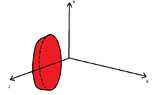
Oh yes (Blush)

It should be more like that

View attachment 7401

right? Do you have also an idea about the spaces $D_1$ and $D_4$ ?
 
Attachments
  • Hand-drawn 3D coordinate axes labelled x, y and z, with a red solid disc-like region sitting to the left of the origin along the z-axis direction, drawn with a dashed curve on its interior.
    sphere.png
    3.3 KB · Views: 166
mathmari said:
Oh yes (Blush)
It should be more like that
right?
Yep.

mathmari said:
1. $D_1=\{(x,y,z)\mid 0\leq x\leq 1, \ 1-x\leq y\leq 1, \ x\leq z\leq 1\}$

By the inequalities $0\leq x\leq 1, \ 1-x\leq y\leq 1$ we get a triangle on the $xy$-plane with vertices $(0,1)$, $(1,0)$ and $(1,1)$.

So, we have that triangle at the plane $z=0$. Do we shift that triangle to the plane $z=1$ because of the inequality $x\leq z\leq 1$, and so we get all the points between the triangle at $z=0$ till the triangle at $z=1$ ?

Suppose we pick (1,0) in the xy-plane, then z cannot be 0 can it? (Wondering)
 
I like Serena said:
Suppose we pick (1,0) in the xy-plane, then z cannot be 0 can it? (Wondering)

At the $xy$-plane ($z=0$) we have that $x=0$ and $y=1$. So, we get only the point $(0,1,0)$.

At the plane $z=1$ we get the following points:
for $x=0$ : $y=1$ and so $(0,1,1)$
for $x=1$: $y=0$ or $y=1$ and so $(1,0,1)$ and $(1,1,1)$

Do we connect all these points? The result is a pyramid with base the triangle on the plane $z=1$ defined by the points $(0,1,1)$, $(1,0,1)$, $(1,1,1)$ and the top of the pyramid is $(0,1,0)$.

Is this correct? (Wondering)
 
mathmari said:
At the $xy$-plane ($z=0$) we have that $x=0$ and $y=1$. So, we get only the point $(0,1,0)$.

At the plane $z=1$ we get the following points:
for $x=0$ : $y=1$ and so $(0,1,1)$
for $x=1$: $y=0$ or $y=1$ and so $(1,0,1)$ and $(1,1,1)$

Do we connect all these points? The result is a pyramid with base the triangle on the plane $z=1$ defined by the points $(0,1,1)$, $(1,0,1)$, $(1,1,1)$ and the top of the pyramid is $(0,1,0)$.

Is this correct? (Wondering)

When solving for each of the boundary conditions x=0, y=0, z=0, x=1, y=1, and z=1, I find the same points.
Since the remaining inequalities are linear equations, I believe our space $D_1$ is indeed that pyramid. (Nod)
 
mathmari said:
4. $D_4$ is defined by the paraboloid with equation $z=2x^2+y^2$ and the cylinder with the equation $z=8-y^2$.

The paraboloid and the cylinder intersect at $2x^2+y^2=8-y^2 \Rightarrow x^2=4-y^2 \Rightarrow x=\pm \sqrt{4-y^2}$, therefore we get $-\sqrt{4-y^2}\leq x\leq \sqrt{4-y^2}$.
It must hold that $4-y^2\geq 0 \Rightarrow y^2\leq 4 \Rightarrow -2\leq y \leq 2$.
We have that $2x^2+y^2\leq 2\sqrt{4-y^2}^2+y^2=8-y^2 \Rightarrow 2x^2+y^2\leq z\leq 8-y^2$.

Therefore the space $D_4$ is the set $\{(x,y,z)\mid -\sqrt{4-y^2}\leq x\leq \sqrt{4-y^2}, \ -2\leq y \leq 2, \ 2x^2+y^2\leq z\leq 8-y^2\}$, or not?
Can we draw this?
Preferably including the curves that follow from the intersections with the coordinate planes?
Then it becomes a bit easier to see if it matches and if it's all correct. (Thinking)