Is ##f(x)=2^{x}-1## considered an exponential function?

Join the discussion
Ask a follow-up here, or get your own question answered by working scientists, mathematicians and engineers — people, not an autocomplete.
Real named experts · corrections over time · the nuance an AI answer skips
12 replies · 3K views
Callmelucky
Messages
144
Reaction score
30
Homework Statement
I wonder if it's ##f(x)=2^{x}-1## considered an exponential function?
Relevant Equations
##f(x)=a^{x}##
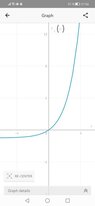
I wonder if it's ##f(x)=2^{x}-1## considered an exponential function because in my textbook it's stated that the set of values of an exponential function is a set of positive real numbers, while when graphing this function I get values(y line) that are not positive(graph in attachments), so I am not sure if the statement "the set of values of an exponential function is a set of positive real numbers" applies only to this type of function ##f(x)=a^{x}## or does it include all types of functions, like this one ##f(x)=2^{x}-1##?

Thank you
 

Attachments

  • WhatsApp Image 2023-03-27 at 22.09.15.jpeg
    WhatsApp Image 2023-03-27 at 22.09.15.jpeg
    8.7 KB · Views: 185
Last edited:
Reply
  • Like
Likes   Reactions: DeBangis21
Physics news on Phys.org
Callmelucky said:
Homework Statement:: I wonder if it's ##f(x)=2^{x}-1## considered an exponential function?
Relevant Equations:: ##f(x)=a^{x}##

I wonder if it's ##f(x)=2^{x}-1## considered an exponential function because in my textbook it's stated that the set of values of an exponential function is a set of positive real numbers, while when graphing this function I get values(y line) that are not positive(graph in attachments), so I am not sure if the statement "the set of values of an exponential function is a set of positive real numbers" applies only to this type of function ##f(x)=a^{x}## or does it include all types of functions, like this one ##f(x)=2^{x}-1##?

Thank you
Yes, this is an exponential function. Your textbook is considering only functions of the form ##f(x) = a^x##, which would have only positive values. The one you asked about is the translation down by 1 unit of ##y = 2^x##, so the translated version will have negative values when x < 0.
 
Reply
  • Like
Likes   Reactions: MatinSAR, DeBangis21 and Callmelucky
Callmelucky said:
Homework Statement:: I wonder if it's ##f(x)=2^{x}-1## considered an exponential function?
Relevant Equations:: ##f(x)=a^{x}##

I wonder if it's ##f(x)=2^{x}-1## considered an exponential function because in my textbook it's stated that the set of values of an exponential function is a set of positive real numbers, while when graphing this function I get values(y line) that are not positive(graph in attachments), so I am not sure if the statement "the set of values of an exponential function is a set of positive real numbers" applies only to this type of function ##f(x)=a^{x}## or does it include all types of functions, like this one ##f(x)=2^{x}-1##?

Thank you
This depends more on the context than on a precise definition.

as an algebraic object:
a linear combination of an exponential (##x\mapsto 2^x##) and a constant (##x\mapsto 1##) function

as an algorithmic runtime:
an exponential function, the shift by ##-1## is irrelevant

as an analytical function:
a shifted (by ##c##) exponential function (##x\mapsto a^x+c##)

It is not purely an exponential function, but the effect of minus one is in almost all cases negligible so people might call it exponential despite of it.
 
Reply
  • Like
Likes   Reactions: DaveE, MatinSAR, DeBangis21 and 2 others
Mark44 said:
Yes, this is an exponential function. Your textbook is considering only functions of the form ##f(x) = a^x##, which would have only positive values. The one you asked about is the translation down by 1 unit of ##y = 2^x##, so the translated version will have negative values when x < 0.
thank you
 
fresh_42 said:
This depends more on the context than on a precise definition.

as an algebraic object:
a linear combination of an exponential (##x\mapsto 2^x##) and a constant (##x\mapsto 1##) function

as an algorithmic runtime:
an exponential function, the shift by ##-1## is irrelevant

as an analytical function:
a shifted (by ##c##) exponential function (##x\mapsto a^x+c##)

It is not purely an exponential function, but the effect of minus one is in almost all cases negligible so people might call it exponential despite of it.
thank you
 
When considering the growth of the function for large x, I would call it exponential growth. But IMO, to call it an exponential function is a mistake. There are too many situations where you would have to continually mention the added constant.
 
Reply
  • Like
Likes   Reactions: mathwonk
FactChecker said:
When considering the growth of the function for large x, I would call it exponential growth. But IMO, to call it an exponential function is a mistake. There are too many situations where you would have to continually mention the added constant.
Still, as ##a ## grows, the value of the function and it's translate will become very close, even if the ln slows the growth of the ## a##
 
Similar question: is ##f(x) = kx + m ##, ##(m \neq 0 )## considered to be a linear function? :wink:

It depends on your definition.
Some say "yes" (usually in calculus) because the graph is a straight line.
Some say "no" (usually in linear algebra) because it does not fulfill ##f(x_1 + x_2) = f(x_1) + f(x_2)## and ##f(ax) = af(x)##.
 
Reply
  • Like
Likes   Reactions: dextercioby, FactChecker, fresh_42 and 1 other person
Mark44 said:
Maybe not an exponential function per se, but definitely a simple transformation of one.
Agreed. The only reason I can think of to not call it officially an exponential function is this. If there are theorems about exponential functions, they might not apply to this function.
 
Mark44 said:
Maybe not an exponential function per se, but definitely a simple transformation of one.
It depends on what we consider the essential information and it therewith depends on context. I am used to complexity considerations so ##f(x)=O(2^x).## Others may consider them as linear independent functions in some algebra, ##2^x## and ##-1.## Again others may see its asymptotic behavior, i.e. the exponential part.

The question becomes more interesting if we consider examples like ##f(x)=2^x+x^2+x \log x +c.## Would we still call it exponential? Probably not, although it is still ##f(x)=O(2^x).## So that would be a non-exponential function with an exponential behavior.
 
Reply
  • Like
Likes   Reactions: dextercioby and DaveE
malawi_glenn said:
Similar question: is ##f(x) = kx + m ##, ##(m \neq 0 )## considered to be a linear function? :wink:

It depends on your definition.
Some say "yes" (usually in calculus) because the graph is a straight line.
Some say "no" (usually in linear algebra) because it does not fulfill ##f(x_1 + x_2) = f(x_1) + f(x_2)## and ##f(ax) = af(x)##.
That's a(ffine) example you used.
 
Reply
  • Like
Likes   Reactions: fresh_42