Is General Relativity More Accurate for Planetary Calculations?

  • Context: Undergrad 
  • Thread starter Thread starter avery
  • Start date Start date
  • Tags Tags
    Gravity Law
Click For Summary

Discussion Overview

The discussion centers on the accuracy of general relativity compared to Newtonian mechanics in the context of planetary calculations, particularly in light of lunar laser ranging experiments. Participants explore the implications of these experiments for gravitational equations and the precision of astronomical models.

Discussion Character

  • Debate/contested
  • Technical explanation
  • Exploratory

Main Points Raised

  • Some participants inquire about the existence of a precise equation in general relativity that links the masses of the Moon and Earth with the gravitational force and distance between them.
  • Others note that Newton's law of gravitation remains highly accurate even when accounting for the non-spherical nature of celestial bodies.
  • A participant mentions that the lunar laser ranging experiments test the equivalence principle, highlighting the Moon's irregular geometry as a factor in measurement accuracy.
  • There is a discussion about the Einstein-Infeld-Hoffmann (EIH) equations of motion as approximate corrections to Newtonian gravity, with some arguing that these corrections are necessary due to improved observational capabilities.
  • One participant emphasizes that general relativity does not falsify Newtonian mechanics but rather shows it to be an approximation of reality, with both theories having limitations.
  • Another participant points out that the latest editions of the Astronomical Almanac utilize EIH for planetary calculations, indicating a shift towards incorporating relativistic corrections in light of precise observations.
  • Some participants agree on the profound conceptual shift that relativity brings to our understanding of space and time compared to Newtonian mechanics.

Areas of Agreement / Disagreement

Participants express both agreement and disagreement on various points, particularly regarding the accuracy of Newtonian mechanics versus general relativity. Multiple competing views remain on the necessity and implications of using relativistic corrections in astronomical calculations.

Contextual Notes

There are unresolved assumptions regarding the applicability of Newtonian mechanics in different contexts and the extent to which general relativity provides necessary corrections. The discussion also reflects on the historical context of astronomical observations and their impact on current models.

avery
Messages
24
Reaction score
0
hi
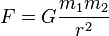
I head that the laser moon mirror experiment showed that the following equation is not so accurate. is there in general relativity a precise equation that links the mass of the moon and the mass of the Earth and the force and the distance between them ?
0f36df929ac9d711a8ba8c5658c3bfee.png

thx
 
Physics news on Phys.org
hi avery! :smile:

that's the equation for two uniform spheres …

it doesn't apply if your moon is lumpy! :wink:
 
avery said:
hi
I head that the laser moon mirror experiment showed that the following equation is not so accurate. is there in general relativity a precise equation that links the mass of the moon and the mass of the Earth and the force and the distance between them ?
0f36df929ac9d711a8ba8c5658c3bfee.png

thx

Precise, no (two body problem - even for ideal bodies - involves loss of energy due to gravitational waves and cannot be expressed in closed form).

The simplest approximate corrections to the Newtonian formula is the Einstein-Infeld-Hoffman equations of motion. The first term, below, is the Newtonian formula:

http://en.wikipedia.org/wiki/Einstein–Infeld–Hoffmann_equations
 
tiny-tim said:
hi avery! :smile:

that's the equation for two uniform spheres …

it doesn't apply if your moon is lumpy! :wink:
hi tiny-tim
well I guess they take that in consideration when they measure the distance between the mirror on the moon and their location on earth.
 
avery said:
hi
I head that the laser moon mirror experiment showed that the following equation is not so accurate. is there in general relativity a precise equation that links the mass of the moon and the mass of the Earth and the force and the distance between them ?
0f36df929ac9d711a8ba8c5658c3bfee.png

thx
You've misread, or the author misstated. Newton's law of gravitation, after accounting for the non-spherical nature of the planets, is incredibly accurate. NASA and other space agencies still use Newtonian gravity to plan, monitor, and control their space missions.

What the lunar laser ranging experiments did do was to test one of the key tenets of general relativity, the equivalence principle. The Moon has a rather weird geometry. The far side of the Moon has a much thicker crust than the near side. This results in about a two kilometer offset between the Moon's center of mass and its geometric center. It is this offset that gives the laser ranging experiments the ability to test the equivalence principle to an amazing degree of precision.The best place in the solar system to look to to see the difference between Newtonian mechanics and general relativity is not the Moon. It is the orbit of Mercury. Suppose Mercury was the only planet in the solar system. Newtonian mechanics would indicate that Mercury would return to exactly the same spot in space after one orbit. General relativity says otherwise. It says that Mercury's orbit would like something like this:
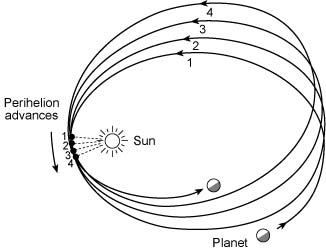
Fig6_19.jpg


The orbit is still more or less elliptical, but the perihelion (the point of the closest approach to the Sun) advances with each orbit. The portrayal in the above image is greatly exaggerated. Imagine a slightly larger scale model of Mercury's orbit such that the perihelion distance is one meter. Instead of four orbits as depicted above, imagine the precession over 415 or so orbits (100 years). Imagine placing a meter stick that goes from the center of the Sun to Mercury's perihelion at the start of this 100 year period, another meter stick that goes from the center of the Sun to Mercury's perihelion at the end of this 100 year period. Per general relativity, the angle subtended by those two meter sticks will be about 43 arcseconds (and this agrees with observations). That 43 seconds of arc: That is the thickness of a postcard between the tips those two meter sticks. Tiny!

Bottom line: Even for the orbit of Mercury, Newtonian mechanics misses the mark by a tiny, tiny bit over the course of a century. One has to look at the solar system for a very long time, or look outside the solar system at huge masses orbiting very closely to one another, before you can say that Newtonian mechanics "is not so accurate".Those who claim that general relativity falsifies Newtonian mechanics have missed the mark. It doesn't. What general relativity did do was to show that Newtonian mechanics is not universally true. Newtonian mechanics is instead merely an approximation of reality. Then again, this is most likely the case for general relativity as well. Physicists have yet to reconcile general relativity with quantum mechanics, and when they do, the combined theory will have to differ from both in some subtle regard.

To me, the most profound difference between Newtonian mechanics and relativity is how the two look at space and time. Newtonian mechanics postulates that space and time are rigid, absolute, universal, and disconnected from one another. Relativity theory says otherwise. It is this "otherwise" that forces us to look at the universe in a very different regard. The accuracy (or lack thereof) of Newtonian mechanics with regard to lunar laser ranging experiments, or even the orbit of Mercury, is very much secondary to this huge mental shift in the nature of space nd time.
 
The accuracy (or lack thereof) of Newtonian mechanics with regard to lunar laser ranging experiments, or even the orbit of Mercury, is very much secondary to this huge mental shift in the nature of space and time.

Hear, hear.
 
While I completely agree with the last two points, in the process of looking for a place to link to the EIH equations of motion, I was surprised to discover that In the most recent editions of Astronomic Almanac, all planetary calculations now use EIH, and this proved necessary with increasingly precise observational capabilities. All those terms after the primary Newtonian term are very small, but they are now observable for the solar system.

See section 8.3 of:

http://iau-comm4.jpl.nasa.gov/XSChap8.pdf
 
Last edited by a moderator:
PAllen said:
While I completely agree with the last two points, in the process of looking for a place to link to the EIH equations of motion, I was surprised to discover that In the most recent editions of Astronomic Almanac, all planetary calculations now use EIH, and this proved necessary with increasingly precise observational capabilities.
That's correct. The Astronomical Almanac is jointly published by the US and UK, and is based on the Development Ephemeris models from the Jet Propulsion Laboratory. All three of the leading ephemerides (the other two are the Russian Institute of Applied Astronomy's Ephemerides of the Planets and the Moon and the Paris Observatory's INPOP) use a first-order general relativistic correction to Newtonian gravity. They also use a relativistic time scale; Earthly clocks change slightly as the Earth goes from perihelion to aphelion and back.

Some of the observations used to generate those ephemerides are very, very old. Thousands of years old. The ancients recorded eclipses and transits, and those old records, while scanty, are a part of what give the ephemeris models a long term basis.
 

Similar threads

  • · Replies 0 ·
Replies
0
Views
1K
  • · Replies 10 ·
Replies
10
Views
4K
  • · Replies 27 ·
Replies
27
Views
3K
  • · Replies 15 ·
Replies
15
Views
2K
  • · Replies 18 ·
Replies
18
Views
3K
  • · Replies 23 ·
Replies
23
Views
2K
  • · Replies 6 ·
Replies
6
Views
3K
  • · Replies 2 ·
Replies
2
Views
2K
  • · Replies 20 ·
Replies
20
Views
2K
  • · Replies 52 ·
2
Replies
52
Views
6K