Is it possible to have a breathable atmosphere at 6 atm

  • Context: Undergrad 
  • Thread starter Thread starter caters
  • Start date Start date
  • Tags Tags
    Atmosphere
Click For Summary
SUMMARY

It is not feasible to have a breathable atmosphere at a sea level pressure of 6 atm using Earth's atmospheric gases due to the risks of oxygen toxicity and nitrogen narcosis. While divers can utilize trimix (helium, nitrogen, and oxygen) to survive at high pressures, the partial pressure of CO2 becomes dangerously high at this level, leading to toxicity. Liquid CO2 can exist at 6 atm between -56.4 and -53 degrees Celsius, potentially allowing for temporary CO2 lakes in polar regions, but this does not create a breathable environment for humans.

PREREQUISITES
  • Understanding of gas laws and partial pressure
  • Knowledge of scuba diving principles and trimix usage
  • Familiarity with the phase diagram of CO2
  • Basic concepts of atmospheric pressure and its effects on gases
NEXT STEPS
  • Research the effects of oxygen toxicity at high pressures
  • Study the principles of trimix diving and its applications
  • Examine the phase behavior of CO2 under varying temperature and pressure conditions
  • Explore the ecological implications of CO2 lakes and their potential role in climate regulation
USEFUL FOR

This discussion is beneficial for atmospheric scientists, scuba diving professionals, and environmental researchers interested in the effects of high-pressure environments on gas behavior and potential ecological impacts.

caters
Messages
229
Reaction score
10
I was wondering if it is possible to have a breathable atmosphere at a sea level pressure of 6 atm(in other words, 6 times Earth's sea level atmospheric pressure).

Why am I asking this?

Well I know that above 5.11 atm, CO2 is past its triple point and thus it will become a liquid instead of going straight into a gas. Since at the critical point, the temperature is 31.1 degrees C and the pressure is 73 atm, this gives a wide range of temperatures and pressures for liquid CO2. Here is the phase diagram:
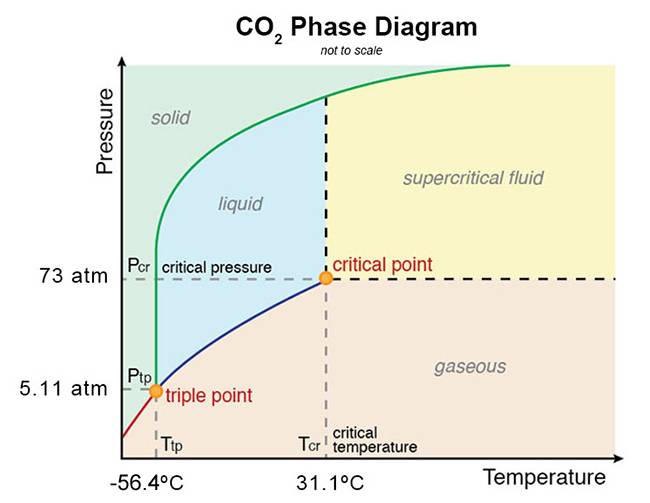
phase_diagram_CO2.jpg


At 6 atmospheres the CO2 will be liquid between -56.4 and -53 degrees C. So during the winter at the poles, there could be temporary CO2 lakes as the CO2 rains out of the sky. I see no problem with bacteria evolving to thrive in CO2 lakes and become spores when there either is too little CO2 or the temperature gets too hot or too cold for liquid CO2. After all, bacteria on our planet have evolved to thrive at extremes of hot and cold, extremely anaerobic environments, etc.

This could be a natural process against global warming because then you have less CO2 each year than would be predicted simply by adding emitted CO2 to pre-existing CO2 because that extra CO2 would be sequestered by the bacteria in CO2 lakes at the poles and also by plants and photosynthetic bacteria in temperate and tropical climates

But back to my question. Is it possible to have a breathable atmosphere at a sea level pressure of 6 atm or is that air pressure simply too high to be breathable, even with an Earth life compatible percentage range of gases?
 

Attachments

  • phase_diagram_CO2.jpg
    phase_diagram_CO2.jpg
    24.8 KB · Views: 3,904
Physics news on Phys.org
Google "SCUBA."
 
  • Like
Likes   Reactions: russ_watters
caters said:
Is it possible to have a breathable atmosphere at a sea level pressure of 6 atm or is that air pressure simply too high to be breathable, even with an Earth life compatible percentage range of gases?
Certainly, that would be breathable for a short amount of time, and the CO2 would be almost irrelevant. For prolonged exposure, oxygen toxicity would be a problem for a large portion of the population, and nitrogen narcosis would be a problem for another segment of the population. But I think that the CO2 exposure would be below the danger threshold for anyone.
 
I can't answer the question of a breathable atmosphere, but I can tell you that, at ground level, the partial pressure of CO2 is only 0.0004 bars. If you compressed the air 6 x, the partial pressure would "soar" to 0.0024 bars.
 
  • Like
Likes   Reactions: russ_watters, sophiecentaur and Merlin3189
With dinitrogen, a man would tend to get inert gas narcosis. Not sure how to quantify its level of seriousness at around 5,5 bar, but it is appreciable.

The less narcotic inert gases are He and Ne. At 11 km/s escape speeds, He tends to escape in timescale of millions of years. Ne does not.
 
Bystander said:
Google "SCUBA."
Or "saturation diving"
 
To get stable CO2 lakes your CO2 partial pressure has to be at least 5 times the atmospheric pressure. It is not sufficient to have a total pressure higher than 5 times the atmospheric pressure. The CO2 would be toxic within minutes - basically as long as you can hold your breath because breathing would just kill you faster.

It is possible to have a breathable atmosphere at 6 times the atmospheric pressure. Trimix is a common choice, helium together with nitrogen and oxygen to keep the partial pressures of nitrogen and oxygen low. Divers can live for weeks under these conditions, and probably longer if necessary. More than 60 bar have been tested, but they don't look safe for longer periods of time.
 
  • Like
Likes   Reactions: Dale
I thought it was simply air pressure along with temperature that determined whether a certain gas goes into its liquid state or not. And like I said, at 6 atm, CO2 would only be liquid between -56.4 degrees C and -53 degrees C. So wouldn't simply compressing air that has a small amount of CO2 in it to 6 atm cause the CO2 to rain out as it condenses into liquid CO2 as long as you kept the temperature of the air between -56.4 degrees C and -53 degrees C? And well a CO2 lake at an air pressure of 6 atm, could only be stable in the polar regions. In fact, I don't think CO2 would rain out outside of the polar regions unless the clouds were so high up and even then, it would quickly evaporate back into the atmosphere. I don't know what the vapour pressure of CO2 is according to temperature and air pressure.
 
caters said:
I thought it was simply air pressure along with temperature that determined whether a certain gas goes into its liquid state or not.

As you have been told, it's not. It's the partial pressure.
 
  • Like
Likes   Reactions: sophiecentaur
  • #10
Partial pressure can be a hard idea to get hold of but it's all about the sum of all the gas molecules of each gas with it's own 'contributing' (= partial) pressure bashing into the walls of its container. All the momentum changes add up. If you condense most of the water vapour in a steam engine cylinder, all that you are left with is the partial pressures of the water at room temperature and of any gases that happen to be left in there - which could be very low. Mr Newcomen got it right.
 
  • #11
As an everyday example: Temperatures on Earth are (basically) always below the boiling point of water at atmospheric pressure, but you don't see the humidity condensing everywhere. It can happen, but only at low temperatures when the partial pressure is above the equilibrium pressure at this low temperature.
 
  • #12
caters said:
I was wondering if it is possible to have a breathable atmosphere at a sea level pressure of 6 atm(in other words, 6 times Earth's sea level atmospheric pressure).

Why am I asking this?

Well I know that above 5.11 atm, CO2 is past its triple point and thus it will become a liquid instead of going straight into a gas. Since at the critical point, the temperature is 31.1 degrees C and the pressure is 73 atm, this gives a wide range of temperatures and pressures for liquid CO2. Here is the phase diagram:

View attachment 226111

At 6 atmospheres the CO2 will be liquid between -56.4 and -53 degrees C. So during the winter at the poles, there could be temporary CO2 lakes as the CO2 rains out of the sky. I see no problem with bacteria evolving to thrive in CO2 lakes and become spores when there either is too little CO2 or the temperature gets too hot or too cold for liquid CO2. After all, bacteria on our planet have evolved to thrive at extremes of hot and cold, extremely anaerobic environments, etc.

This could be a natural process against global warming because then you have less CO2 each year than would be predicted simply by adding emitted CO2 to pre-existing CO2 because that extra CO2 would be sequestered by the bacteria in CO2 lakes at the poles and also by plants and photosynthetic bacteria in temperate and tropical climates

But back to my question. Is it possible to have a breathable atmosphere at a sea level pressure of 6 atm or is that air pressure simply too high to be breathable, even with an Earth life compatible percentage range of gases?

Is it possible to have A breathable atmosphere at 6 Bar? Yes, but not composed of Earth's atmospheric gases compressed to that level.
 

Similar threads

  • · Replies 8 ·
Replies
8
Views
2K
Replies
6
Views
7K
  • · Replies 6 ·
Replies
6
Views
3K
  • · Replies 28 ·
Replies
28
Views
4K
Replies
17
Views
7K
  • · Replies 8 ·
Replies
8
Views
8K
  • · Replies 12 ·
Replies
12
Views
5K
  • · Replies 21 ·
Replies
21
Views
5K
  • · Replies 65 ·
3
Replies
65
Views
26K
  • · Replies 6 ·
Replies
6
Views
3K