Is Negative Acceleration Always Indicative of Slowing Down?

Click For Summary
SUMMARY

The discussion centers on the relationship between negative acceleration and the motion of an object, specifically addressing misconceptions about acceleration and velocity. It is established that acceleration can be zero at specific time intervals (0.5 min and 4.2 min) when the position function x(t) is constant. The participants confirm that negative acceleration indicates slowing down only when the velocity is positive, emphasizing that the signs of velocity and acceleration must be opposite for an object to decelerate. The conclusion is that only one statement regarding acceleration is true in the context provided.

PREREQUISITES
  • Understanding of kinematics, specifically position, velocity, and acceleration.
  • Familiarity with linear motion equations, such as x(t) = mx + p.
  • Knowledge of the relationship between velocity and acceleration signs.
  • Basic grasp of calculus concepts related to motion analysis.
NEXT STEPS
  • Study the implications of acceleration in different motion scenarios.
  • Learn about the graphical representation of velocity and acceleration over time.
  • Explore the concept of jerk and its impact on motion dynamics.
  • Investigate real-world applications of kinematic equations in physics problems.
USEFUL FOR

Students of physics, educators teaching kinematics, and anyone interested in understanding the principles of motion and acceleration dynamics.

mncyapntsi
Messages
38
Reaction score
4
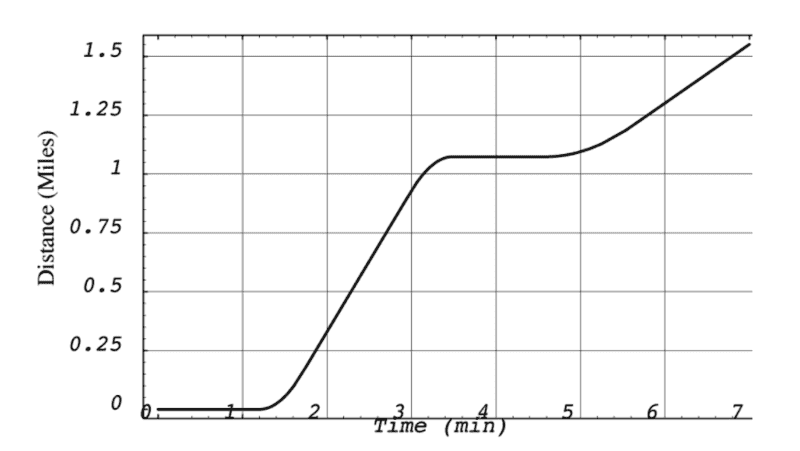
Homework Statement
Which of the following statements are false:

The speed at 2.1 min is less than at 2.6 min.
The acceleration is zero at 0.5 min and 4.2 min.
The acceleration is non-zero at 6.2 min.
The acceleration is never negative.
The acceleration is non-zero at 2.3 min.

IMAGE BELOW
Relevant Equations
a(t) = dv/dt; v(t) = dx/dt; ...
I've written in that only the first statement was False, however my classmates aren't getting the same answer?
Please help clarify...

Screen Shot 2021-09-14 at 4.50.38 PM.png
 
Physics news on Phys.org
Can you explain why you think the rest are true?
 
PeroK said:
Can you explain why you think the rest are true?
Here is my reasoning:

The acceleration is zero at 0.5 min and 4.2 min: true because x(t)=constant so v(t)=0 so a(t)=0

i just rethought this one - false right?: The acceleration is non-zero at 6.2 min: false because x(t)=mx+p so v(t)=constant so a(t)=0

The acceleration is never negative: true bc nowhere is v(t)<0

i just rethought this one - false? The acceleration is non-zero at 2.3 min: false because x(t)=mx+p so v(t)=constant so a(t)=0
 
  • Like
Likes PeroK
mncyapntsi said:
The acceleration is never negative: true bc nowhere is v(t)<0
Negative acceleration means that the object is slowing down. Not that the velocity is negative.
 
  • Like
Likes mncyapntsi
Right! So only one of them is true - the second one?
 
mncyapntsi said:
Right! So only one of them is true - the second one?
That's what I think.
 
  • Like
Likes mncyapntsi
Thanks for helping me think through that, and clearing it up!:smile:
 
  • Like
Likes PeroK
PeroK said:
Negative acceleration means that the object is slowing down. Not that the velocity is negative.
Just to clarify, that is in the present context where the velocity is positive. More generally, slowing down means the velocity and acceleration have opposite sign.
 
  • Like
Likes mncyapntsi and PeroK

Similar threads

Replies
7
Views
2K
  • · Replies 10 ·
Replies
10
Views
2K
  • · Replies 1 ·
Replies
1
Views
2K
Replies
20
Views
2K
Replies
2
Views
4K
Replies
5
Views
2K
  • · Replies 7 ·
Replies
7
Views
4K
  • · Replies 2 ·
Replies
2
Views
3K
Replies
13
Views
5K
  • · Replies 1 ·
Replies
1
Views
3K