WarshipNuran
- 1
- 0
Hello, I’m going to start writing a book about multiverses and more. The first part is about the existence of other universes (sequential). Please write what you think and rate this part.
Part 1. Is Our Universe Unique?
Before we begin this topic, I’d like to define a few terms that I’ll be using. A universe is a coherent space-time continuum born of the Big Bang, filled with matter and radiation, and governed by specific physical laws and constants. For the purposes of this discussion, I will assume that the universe emerged from a single infinitesimally small point—that is, it is finite. A sequential universe is a universe that is not the first (the one that emerged from the Big Bang), but rather one that emerged as a branch of events from a previous sequential universe (traceable all the way back to the first). It is one of the possible states of the first universe over time, and it is a connected spacetime just like the ordinary universe, differing only in its origin.
Later, when I use the word “universe,” it may refer to either the first universe or a sequential universe for a certain branch, depending on the context.
So, I’d like to talk about the uniqueness of our universe. More precisely, if we illustrate this with a diagram (No. 1), I’d like to discuss the fact that there are an infinite number of such sequential universes—or, at the very least, more than one.
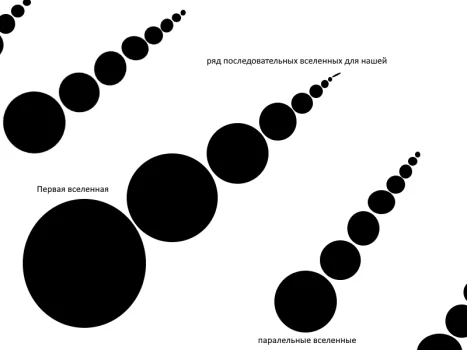
Figure No. 1 – The most basic representation of the multiverse
To begin with, let’s imagine that our universe is unique; it follows that it is, so to speak, “predictable everywhere.” By this term, I mean a property of spaces in which, for any body, point, or part of space, knowing its exact position or the positions of all its particles, there exists input data at the initial moment in time that allows us to determine the unique position of that body in space at the next required moment in time (all this knowledge of the initial data occurs within some space or universe).
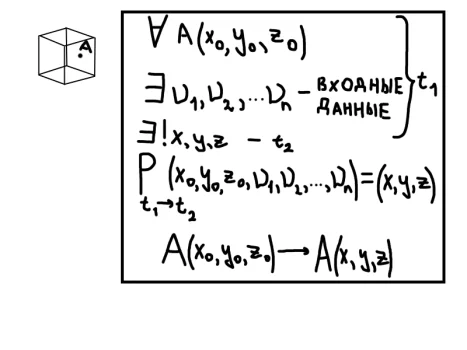
Figure 2 – illustrates a more mathematical definition of universality of predictability using a certain predictability function (this function is a computational algorithm—and, consequently, a modeling method—that leads us to a result) – P()
To prove this consequence, we will use the method of proof by contradiction. Suppose our universe is unique and is not universally predictable. This means that there exists a certain point, and for any input data and the exact position of this point, we will obtain two or more locations of this point in space at some subsequent moment in time (let’s assume two positions; for more than two, the reasoning is analogous).
Image from the question
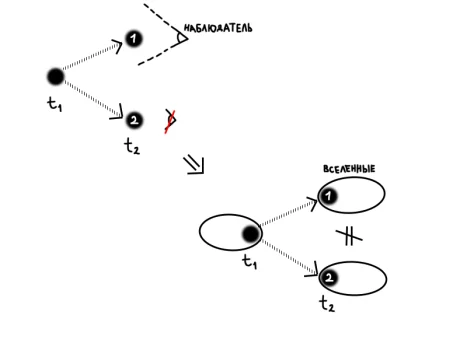
Figure 3 – Proof process
We then found that a specific point in the future could have two spatial positions at the same time. In quantum mechanics, this is described by the principle of superposition, but we’ll use that term a little later. Let’s say we traveled to that time and decided to find out which position the point had taken. We could observe either of the two positions—both are equally probable—but when we actually observe the point, it will be in only one specific position (let’s say the first one); the second probable position will be empty. In other words, after a period of uncertainty in space, it has settled into a single position, which is the one we observe. But we predicted two positions. They cannot vanish, disappear, or change; they are already defined as probable positions of the particle, and this follows from the fact that information in this system (the multiverse) cannot disappear (due to Schrödinger’s equations, probability is conserved). This means that the second position (or the point itself in that position) has not disappeared: it exists somewhere, but we observe only one; therefore, the second one is located somewhere other than here. But where else could it be—at the predicted second location (relative to our fixed universe), at the same time—yet it is not there? So where is it? That’s right—in another universe, relative to which the point’s position (the point itself) will be at the predicted location and at the same time; therefore, such a universe does indeed exist. This violates the assumption that our universe is the only one, since we have found a second universe in which the point has assumed a different position.
Now, to complete the proof, we need only present cases—possible in our universe—that violate its universal predictability. And such cases do exist—namely, when particles are in a superposition. For example, an electron: before its spin is measured, it can be in a superposition, or the famous Young’s double-slit experiment with an electron gun, in which particles without an observer occupy multiple positions simultaneously. This refutes the universality of predictability in our universe, since such particles can occupy multiple positions at some subsequent moment in time.
Conclusion/line of reasoning: If our universe is unique, then it is universally predictable; however, this leads to a contradiction, since there are counterexamples within our universe that refute its predictability. The initial assumption led to a contradiction, so it must be false, which means our universe is not the only one (there exists at least a finite number of consecutive universes).
Part 1. Is Our Universe Unique?
Before we begin this topic, I’d like to define a few terms that I’ll be using. A universe is a coherent space-time continuum born of the Big Bang, filled with matter and radiation, and governed by specific physical laws and constants. For the purposes of this discussion, I will assume that the universe emerged from a single infinitesimally small point—that is, it is finite. A sequential universe is a universe that is not the first (the one that emerged from the Big Bang), but rather one that emerged as a branch of events from a previous sequential universe (traceable all the way back to the first). It is one of the possible states of the first universe over time, and it is a connected spacetime just like the ordinary universe, differing only in its origin.
Later, when I use the word “universe,” it may refer to either the first universe or a sequential universe for a certain branch, depending on the context.
So, I’d like to talk about the uniqueness of our universe. More precisely, if we illustrate this with a diagram (No. 1), I’d like to discuss the fact that there are an infinite number of such sequential universes—or, at the very least, more than one.
Figure No. 1 – The most basic representation of the multiverse
To begin with, let’s imagine that our universe is unique; it follows that it is, so to speak, “predictable everywhere.” By this term, I mean a property of spaces in which, for any body, point, or part of space, knowing its exact position or the positions of all its particles, there exists input data at the initial moment in time that allows us to determine the unique position of that body in space at the next required moment in time (all this knowledge of the initial data occurs within some space or universe).
Figure 2 – illustrates a more mathematical definition of universality of predictability using a certain predictability function (this function is a computational algorithm—and, consequently, a modeling method—that leads us to a result) – P()
To prove this consequence, we will use the method of proof by contradiction. Suppose our universe is unique and is not universally predictable. This means that there exists a certain point, and for any input data and the exact position of this point, we will obtain two or more locations of this point in space at some subsequent moment in time (let’s assume two positions; for more than two, the reasoning is analogous).
Image from the question
Figure 3 – Proof process
We then found that a specific point in the future could have two spatial positions at the same time. In quantum mechanics, this is described by the principle of superposition, but we’ll use that term a little later. Let’s say we traveled to that time and decided to find out which position the point had taken. We could observe either of the two positions—both are equally probable—but when we actually observe the point, it will be in only one specific position (let’s say the first one); the second probable position will be empty. In other words, after a period of uncertainty in space, it has settled into a single position, which is the one we observe. But we predicted two positions. They cannot vanish, disappear, or change; they are already defined as probable positions of the particle, and this follows from the fact that information in this system (the multiverse) cannot disappear (due to Schrödinger’s equations, probability is conserved). This means that the second position (or the point itself in that position) has not disappeared: it exists somewhere, but we observe only one; therefore, the second one is located somewhere other than here. But where else could it be—at the predicted second location (relative to our fixed universe), at the same time—yet it is not there? So where is it? That’s right—in another universe, relative to which the point’s position (the point itself) will be at the predicted location and at the same time; therefore, such a universe does indeed exist. This violates the assumption that our universe is the only one, since we have found a second universe in which the point has assumed a different position.
Now, to complete the proof, we need only present cases—possible in our universe—that violate its universal predictability. And such cases do exist—namely, when particles are in a superposition. For example, an electron: before its spin is measured, it can be in a superposition, or the famous Young’s double-slit experiment with an electron gun, in which particles without an observer occupy multiple positions simultaneously. This refutes the universality of predictability in our universe, since such particles can occupy multiple positions at some subsequent moment in time.
Conclusion/line of reasoning: If our universe is unique, then it is universally predictable; however, this leads to a contradiction, since there are counterexamples within our universe that refute its predictability. The initial assumption led to a contradiction, so it must be false, which means our universe is not the only one (there exists at least a finite number of consecutive universes).