Is Shear Force Zero at the Point of a Nail Holding a Cross Section Together?

  • Thread starter Thread starter Dell
  • Start date Start date
  • Tags Tags
    Shearing
Click For Summary

Discussion Overview

The discussion revolves around the calculation of shear force in a nail that holds a cross section together, specifically examining whether the shear force at the point of the nail can be zero. Participants explore the implications of their calculations and the physical interpretations of shear flow in structural elements.

Discussion Character

  • Technical explanation
  • Mathematical reasoning
  • Debate/contested

Main Points Raised

  • One participant calculates the shear flow at the nail to be zero based on the centroids of the cross sections being aligned, leading to Q=0.
  • Another participant questions the clarity of the calculations and requests detailed workings to provide better feedback.
  • A different participant acknowledges that the channel section without the attached block would have zero shear flow at the center, suggesting that the result makes sense in context.
  • One participant discusses the practical implications of having zero shear flow at the nail, noting that while calculations suggest no need for fasteners, they are still necessary for structural integrity under varying loads.
  • Another participant emphasizes the importance of calculating Q correctly, indicating that it should be based on the total areas below the horizontal axis where the two sections meet.
  • There is a discussion about how to find the correct Q value and the significance of nail spacing and vertical shear in determining shear flow.
  • Participants explore the calculation of Q using different sections and the implications of centroids aligning, leading to zero shear stress at the nail.
  • One participant reflects on the implications of having no force in the nail, suggesting that it indicates no slippage between the sections under bending loads.

Areas of Agreement / Disagreement

Participants express differing views on the calculations and interpretations of shear flow, with some agreeing on the zero shear flow result while others challenge the methodology and implications. The discussion remains unresolved regarding the necessity of the nail under varying loading conditions.

Contextual Notes

Limitations include unclear dimensions in the provided figures, which hinder verification of calculations. The discussion also highlights the dependency on definitions and assumptions regarding shear flow and the significance of centroids in structural analysis.

Dell
Messages
555
Reaction score
0
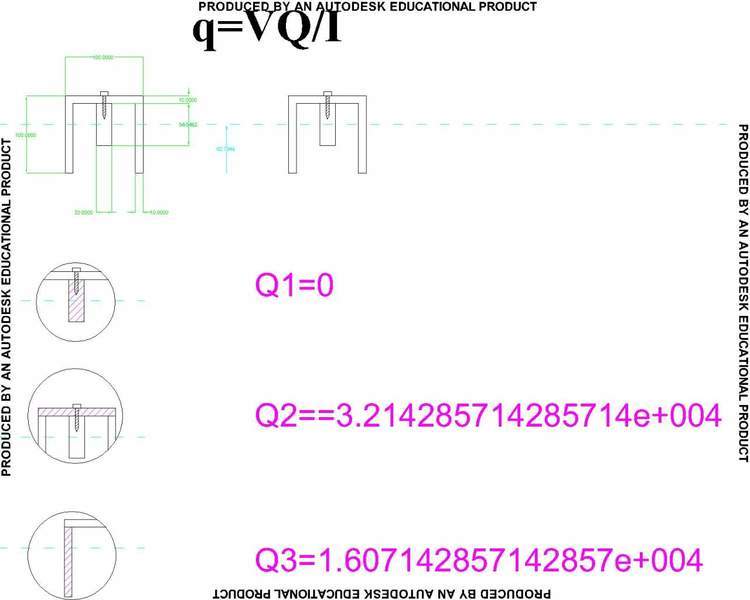
in a question i am asked to calculate the shearing force in a nail holding a cross section together, the cross section is showed in my diagram.

my problem was that after calcultions i found that the centroid of the entire cross section was the same as the centroid of the secondary piece(the block) being nailed to the channel cross section, meaning when i calculate the shear flow (looking only at the block) i get zero, because Q=0,(Q=y*A and y=0), q=VQ/I=0

i checked this by calculating the shear flow in 2 other ways and comparing and i really found that the shear flow at the point of the nail is zero, can this be?? is this a trick question?
shear.jpg
 
Physics news on Phys.org
In your drawing, you show a formula q=VQ/I Could you say exactly what you think q is, and Q, and their units? Please can you show all your working so that you can get better feedback?
 
I've given it more thought now. The channel section without the nailed blob would have zero shear flow at the centre, where the nail is. I can't check your calcs because the dimensions in the figure are too small or unclear to be readable. However the result does make some sense. There are always two ways to calculate the shear flow, and you have done it to show zero (the two 1.6's cancel the 3.2 to give zero). In some ways this is a trick question but I think about the practical outcome too. For this beam to work the central tail has to be 'stuck' to the remainder of the section, even though there is apparently no need for any fasteners there. A similar situation arises in flitched beams with (say) timber rectangular section strengthened with side plates of steel. These can be held together with a line of bolts down the centre. Paradoxically, the bolts have zero shear according to shear flow calcs, but they must be there or else the beam doesn't work. It's a bit like in analysis of pin-jointed trusses where members carrying zero force are still needed to make the truss work under a slightly different loading case. In your case, if the orientation of the loading were to change only slightly, those nails would develop a shear stress, and that is the practical interpretation. I hope another helper can further the enlightenment.
 
I had to blow up the picture to see it more clearly. It appears that you have a (wood) channel shaped section nailed to a (wood) rectangular shaped section. To calculate the shear flow, q, in units of force/length, at the nail, you need to find the Q of the total areas below the horizontal axis where the 2 sections meet (or the Q above that point, which yields the same result). You can't just use the Q of the rectangular piece,which is 0 (if you did the numbers correctly, I didn't check them). Problem is, once you determine the correct Q, which is non-zero, then you need to know V, the vertical shear, which is not given. Then you need to know the nail spacing to determine the shear force in the nails, which is also not given. As I see it.
 
Jay, are you sure about that?? V, and the spacing c are not that important to me let them remain parameters.

once i find the Q for the entire lower section (it will be 2*1.6=3.2 since q of the block is 0) how do i find the shear flow just through the nail- the Q=3.2 is the Q of the nail and the Q of the 2 legs and you said that i cannot calculate the Q of one part alone.
 
At some point I'll check your numbers, I can't read them very well on the picture. But I don't believe you are calculating Q (the first moment of area of the cross section) correctly. You want to calculate Q about the axis where the 2 sections are joined by the nail (that is extremely important, as Q changes depending on what axis you use). It is easier to calculate Q above that axis, because you just have one area to deal with, the 100 x10 (= 1000) rectangle. Then Q = 1000(y'), where y' is the distance from the centroid of that 100 X 10 rectangle to the centroid (neutral axis) of the entire section. (You can calculate Q using the area below the nailed axis, and get the same result). I is the moment of inertia of the entire cross section about the neutral axis.. Then, to calculate shear flow, q, at the nailed axis, q=VQ/I (units are force/length), and the nail force is q(c), where c is the nail spacing along the beam.
 
so (y') would be the distance between the neutral axis (yc=440/7=62.857142857142861) and the centroid of the top shape (y=95)

(y')= 95 - 440/7 = 225/7 = 32.142857142857146

Q=100*10*225/7= 225000/7 = 3.214285714285714e+004

which is what i had before, can you check this.
 
If you take a section just below the flange/webs interface, then Q is not the first moment of area 'above' that section (unless you want the combined shear flow in all three webs), but the first moment 'beyond' that section. So, on the attached sketch, if you wanted the shear stress at section AA, tau 2, you would take Q as 90*10*(90/2-440/7). If you want the shear stress at section B, tau 1, Q = 100*10*(100/2-440/7). This would be almost the same. If you want the shear stress at section C-C, you would get zero because Q just the left of CC is 50*10*(95-440/7) + 90*10*(90/2-440/7) which is zero, when paying attention to signs above and below the centroidal axis. You will notice my sketch does not include the 20 thick extra bit. Assuming its centroid coincides with that of the channel section, there will be a zero shear stress at the nail. Thanks to Jay for helping. I find this a difficult area too. Curiously it seems then that the 20 dimension is not relevant, as the centroids would always coincide.
 

Attachments

  • Dell 7 aug 100001.JPG
    Dell 7 aug 100001.JPG
    29.6 KB · Views: 684
Thanks, I stand corrected. No force in the nail implies that the nail is not needed, and that therefore there must be no slippage between the 2 sections under bending loads, even without the nail. I guess that's because the centroids line up.
 

Similar threads

  • · Replies 4 ·
Replies
4
Views
2K
  • · Replies 1 ·
Replies
1
Views
2K
  • · Replies 3 ·
Replies
3
Views
2K
  • · Replies 2 ·
Replies
2
Views
3K
  • · Replies 3 ·
Replies
3
Views
2K
  • · Replies 8 ·
Replies
8
Views
4K
  • · Replies 4 ·
Replies
4
Views
2K
Replies
1
Views
2K
  • · Replies 3 ·
Replies
3
Views
1K
  • · Replies 3 ·
Replies
3
Views
3K