Is Taking the Reciprocal a Valid Approach in Differentiating dpH/dV?

  • Context: Graduate 
  • Thread starter Thread starter Borek
  • Start date Start date
Click For Summary
SUMMARY

The discussion centers on the validity of taking the reciprocal when differentiating the equation for dpH/dV in the context of chemical equations involving pH and volume. The participants confirm that differentiating the equation and then taking the reciprocal is a valid mathematical approach, as shown through the relationship dy/dx = 1/(dx/dy). The conversation also highlights the importance of algebraic manipulation, particularly in simplifying logarithmic expressions and solving for volume (V) in terms of pH. The Gran method is referenced, emphasizing its relevance in this mathematical context.

PREREQUISITES
  • Understanding of calculus, specifically differentiation and reciprocals
  • Familiarity with logarithmic functions and their properties
  • Knowledge of chemical equations involving pH and concentration
  • Experience with algebraic manipulation of equations
NEXT STEPS
  • Study the Gran method for titration analysis in chemistry
  • Learn about the properties of logarithms in mathematical equations
  • Explore differentiation techniques in calculus, focusing on implicit differentiation
  • Investigate the relationship between pH, concentration, and volume in chemical reactions
USEFUL FOR

Chemists, mathematics students, and educators looking to deepen their understanding of the relationship between pH and volume in chemical equations, as well as those interested in the application of calculus in scientific contexts.

Borek
Mentor
Messages
29,170
Reaction score
4,598
I am reading an old paper and I have came to the passage shown in the picture:
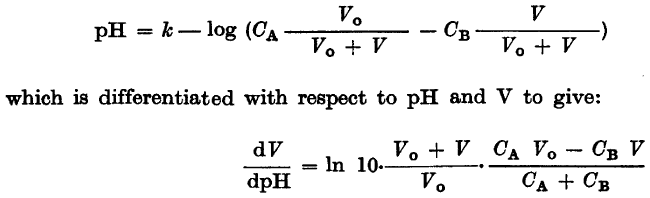
gunnar.png


k, CA, CB and V0 are all just some constants.

I think I know what they did - they differentiated the first equation calculating dpH/dV and then took reciprocals of both sides of the equation. Is it a valid approach?

I am not able to get the same result solving the first equation for V and calculating dV/dpH then.

Bear in mind I am mathemathically challenged and English is my second language, I can be missing something obvious.
 
Last edited:
Physics news on Phys.org
Yes, this is a valid approach. Let y=f(x). Obviously, dy/dx = df/dx. Differentiating y=f(x) with respect to y yields

1 = \frac{df}{dx}\,\frac{dx}{dy}

Solving for dx/dy,

\frac{dx}{dy} = \frac 1 {df/dx} = \frac 1 {dy/dx}
 
OK, thank you.

So going the other way (that is solving for V and differentiating), I should get the same result?
 
Borek said:
OK, thank you.

So going the other way (that is solving for V and differentiating), I should get the same result?

On the way there I think you slightly simplify and easier see the calculation if you combine terms inside the bracket of first eq. into a single fraction and then express that as

pH = k - log(CAV0 - CBV) + log(V0 + V) :smile:
 
I have to solve for V, having two logs doesn't make it easier.

I tried both manually and with TI 89, but I can't get the same result as the one printed. Will try later again.
 
Borek, I'll put this up here instead of PM as hopefully someone can check it in case of mistakes er typos. :biggrin:

For the differentiation

pH = k - log(\frac{C_AV_0 - C_BV}{V_0 + V})

= k - log(C_AV_0 - C_BV) +log(V_0 + V)

= k + \ln 10 [-\ln(C_AV_0 - C_BV) + \ln(V_0 + V)]

Then differentiating

\frac{dpH}{dV} = [\frac{- C_B}{C_AV_0 - C_BV} + \frac{1}{V_0 + V}].\ln 10

From this you can already see that the point where the LHS is infinite (the pH against V graph is vertical, or V against pH horizontal) is where
V = \frac{V_0C_A}{C_B}.The RHS fractions can be combined giving

[\frac{\ln10.(C_A - C_B)V_0}{(C_AV_0 - C_BV)(V_0 + V)}]

If you wanted to invert this into V = a function of \frac{dV}{dpH}, rearrange to

(C_AV_0 - C_BV)(V_0 + V) = (C_A - C_B)V_0.\ln 10.\frac{dV}{dpH}

call the RHS R, say, and then express V by solving the unlovely quadratic in V:

-V^2C_B + V V_0(C_A - C_B) + (C_A V_0^2 - R) = 0

You ought to get the same thing by inverting and differentiating but I think it is more tedious.

You said you want to invert the first equation anyway. I question whether you do :biggrin: - if it is for plotting it suffices to switch around axes when you plot rather than invert algebraically.

For inverting algebraically work with H rather than pH; and instead of k (which is probably a p something) I define k = - log M, (M = 10-k)

Then the first equation becomes

H = M + \frac{C_AV_0 - C_BV}{V_0 + V}

which eventually transforms to

V = [\frac{C_A - C_B}{C_B + H - M} + 1]V_0

or in terms of pH and k

V = [\frac{C_A - C_B}{C_B + 10^{-H} - 10^{-k}} + 1]V_0
 
Last edited:
epenguin said:
From this you can already see that the point where the LHS is infinite (the pH against V graph is vertical, or V against pH horizontal) is where
V = \frac{V_0C_A}{C_B}.

Hardly surprising - that's the equivalence point :smile:

You said you want to invert the first equation anyway.

Whatever I was doing was just to make sure I understand what is going on. And today I had a time to try again - everything is OK.

epenguin said:
call the RHS R, say, and then express V by solving the unlovely quadratic in V:

-V^2C_B + V V_0(C_A - C_B) + (C_A V_0^2 - R) = 0

Something is wrong, no need for quadratic here:

V = \frac {-(10^k - C_A 10^{pH}) V_0} {10^k + C_B 10^{pH}}

For inverting algebraically work with H rather than pH

Nah, that's about dV/dpH - volume vs potentiometric answer.

This is from the Gran method original paper, BTW.

k (which is probably a p something)

No, that's log(activity coefficient).

Thank's for the help. Yesterday I was not sure about this reciprocal thing - it seemed logical, but I have learned not to trust my instincts when it comes to anything more complicated than multiplication table.
 
Last edited:
I will work through it again with more calm and clearer head (also had computer trouble today). :blushing::biggrin:
We want to show the students how we make mistakes and are very 'umble. :approve:
 
epenguin said:
Borek, I'll put this up here instead of PM as hopefully someone can check it in case of mistakes er typos. :biggrin:

For the differentiation

pH = k - log(\frac{C_AV_0 - C_BV}{V_0 + V})

= k - log(C_AV_0 - C_BV) +log(V_0 + V)

= k + \ln 10 [-\ln(C_AV_0 - C_BV) + \ln(V_0 + V)]

Then differentiating

\frac{dpH}{dV} = [\frac{- C_B}{C_AV_0 - C_BV} + \frac{1}{V_0 + V}].\ln 10
Should that be +CB in the numerator (two minus-signs cancel each other)?
 

Similar threads

  • · Replies 30 ·
2
Replies
30
Views
6K
  • · Replies 10 ·
Replies
10
Views
2K
  • · Replies 1 ·
Replies
1
Views
3K
  • · Replies 19 ·
Replies
19
Views
4K
Replies
1
Views
1K
  • · Replies 40 ·
2
Replies
40
Views
7K
  • · Replies 5 ·
Replies
5
Views
2K
  • · Replies 1 ·
Replies
1
Views
2K
  • · Replies 6 ·
Replies
6
Views
11K
  • · Replies 1 ·
Replies
1
Views
3K