Is the Solution for Finding Hall Voltage Correct?

  • Thread starter Thread starter PhysicsTest
  • Start date Start date
  • Tags Tags
    Voltage
Click For Summary
SUMMARY

The forum discussion centers on the calculation of Hall voltage, specifically the equation for Hall voltage, \( V_H = \frac{BJd}{\rho w} \), and its derivation. Participants clarify the roles of electric fields and current density in the context of Hall effect, emphasizing that the Hall voltage arises from the Lorentz force acting on charge carriers. The correct formulation for Hall voltage is confirmed as \( V_H = \frac{B\sigma E_x d}{\rho} \), where \( \sigma \) is the conductivity related to charge carrier density and mobility. The discussion concludes with the necessity of knowing the mobility \( \mu \) to accurately calculate Hall voltage.

PREREQUISITES
  • Understanding of the Hall effect and its equations
  • Familiarity with electric fields and current density concepts
  • Knowledge of semiconductor physics, specifically charge carrier mobility
  • Basic grasp of Lorentz force and its implications in electromagnetism
NEXT STEPS
  • Research the relationship between charge carrier mobility and conductivity in semiconductors
  • Learn about the derivation and application of the Hall effect equations
  • Study the impact of temperature on semiconductor properties, particularly mobility
  • Explore practical applications of Hall voltage measurements in electronic devices
USEFUL FOR

Students and professionals in physics and electrical engineering, particularly those focusing on semiconductor technology and the Hall effect in materials science.

PhysicsTest
Messages
256
Reaction score
27
Homework Statement
a. Find the magnitude of the Hall voltage VH in an n-type germanium bar used in fig, having majority-carrier concentration ND = 10^17 /cm^3. Assume Bz=0.1 Wb/m^2, d=3 mm, Ex=5V/cm.
b. What happens to VH if an identical p-type germanium bar having NA=10^17/cm^3 is used in part a?
Relevant Equations
##V_H = Ed=Bvd = \frac{BJd} {\rho w} ##
The question is to find the Hall voltage
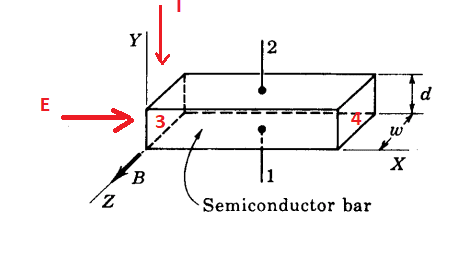
1610202843009.png

The magnetic field is in the +ve Z-direction, the electric field is in the +ve X-direction, the current will be in -ve Y direction.
There are many equations to find the hall voltages ##V_H = Ed=Bvd = \frac{BJd} {\rho w} ##. But i find the equation ##V_H = Ed## to solve and other parameters are not much of use.
a. n-type 4 will be more negative than 3 and ##V_H = 5*0.3V = 1.5V##
b. p-type 4 will be more positive than 3 and ##V_H = 5*0.3V = 1.5V##
Is the solution correct, or missing something?
 
Physics news on Phys.org
No I don't think it is correct. The E-field in the x direction ##E_x=5V/cm## is responsible for creating the current density ##J=\sigma E_x## according to Ohm's law.
It is the E-field in the y-direction ##E_y=Bv## that creates the hall voltage.
 
  • Like
Likes PhysicsTest
Delta2 said:
No I don't think it is correct. The E-field in the x direction ##E_x=5V/cm## is responsible for creating the current density ##J=\sigma E_x## according to Ohm's law.
It is the E-field in the y-direction ##E_y=Bv## that creates the hall voltage.
I disagree with the disagreement.

The interaction of the current flow and B field creates a Hall voltage that is perpendicular to both, think Lorentz force. The problem statement specifies the direction of both current direction, X-axis, and B-field direction, Z axis. This leave only the Y axis for the Hall voltage. Note that the Terminals "1" and "2" (sense terminals) are in the Y dimension. (But that graph sure shows an unusual axes orientation.)

As for the numerical solution, I have no idea! That must be left to those that have studied this in more detail.
 
Tom.G said:
I disagree with the disagreement.

The interaction of the current flow and B field creates a Hall voltage that is perpendicular to both, think Lorentz force. The problem statement specifies the direction of both current direction, X-axis, and B-field direction, Z axis. This leave only the Y axis for the Hall voltage. Note that the Terminals "1" and "2" (sense terminals) are in the Y dimension. (But that graph sure shows an unusual axes orientation.)

As for the numerical solution, I have no idea! That must be left to those that have studied this in more detail.
I don't understand where you disagree with me. We both say that the current is in the x-axis and that the hall voltage is in the y-axis. The way the OP did the calculation implies that the hall voltage is along the x-axis.
 
Perhaps it is a nomenclature difference.

Re-reading your two posts I see that we agree on the orientation of the Hall voltage.

I was thrown off by the use of 'E-field' being the cause of the Hall voltage. I was thinking of 'fields' being externally applied things, rather than being electron paths.

Sorry for any unnecessary confusion.

Tom
 
Tom.G said:
I was thrown off by the use of 'E-field' being the cause of the Hall voltage
I said that this E-field is in the y-direction. Of course the mechanism of hall voltage is known to me, it is not the electric field the real cause. It is the Lorentz force ##(\mathbf{v}\times\mathbf{B})q## that creates charge separation and a coulomb electric field ##\mathbf{E_H}## such that $$\mathbf{E_H}q=(\mathbf{v}\times\mathbf{B})q$$ and the hall voltage is of course $$V_H=E_Hd$$
 
Still not able to solve, not sure if some of the data is missing or to assume something. I understood the above discussion
##V_H = \frac{BJd} {\rho w} ## ->eq1
##J = \sigma E_x## ->eq2
substitute eq2 in eq1
##V_H = \frac{B\sigma E_x} {\rho w}## ->eq3
If conduction primarily due to charges of one sign, the conductivity ##\sigma## is related to mobility ##\mu## by
##\sigma = \mu \rho## -> eq4
substitute in eq3 to give
##V_H = \frac{B\mu E_x} {w} ## -> eq5
Now i do not know the value of ##\mu##. Is the above derivation correct? Can i assume its value at 300K which is a standard value i assume.
 
PhysicsTest said:
Still not able to solve, not sure if some of the data is missing or to assume something. I understood the above discussion
##V_H = \frac{BJd} {\rho w} ## ->eq1
##J = \sigma E_x## ->eq2
substitute eq2 in eq1
##V_H = \frac{B\sigma E_x} {\rho w}## ->eq3
If conduction primarily due to charges of one sign, the conductivity ##\sigma## is related to mobility ##\mu## by
##\sigma = \mu \rho## -> eq4
substitute in eq3 to give
##V_H = \frac{B\mu E_x} {w} ## -> eq5
Now i do not know the value of ##\mu##. Is the above derivation correct? Can i assume its value at 300K which is a standard value i assume.
In going from Eq1 to Eq3 (using Eq2) you have forgotten ##d##.
What is ##\rho##? The density of charge carriers?
 
Delta2 said:
In going from Eq1 to Eq3 (using Eq2) you have forgotten ##d##.
Sorry my mistake the eq(3) is
##V_H = \frac{B\sigma E_xd} { \rho w}## ->eq(3)
Delta2 said:
What is ##\rho##? The density of charge carriers?
Yes ##\rho## is the density of charge carriers
 
  • #10
I feel there is something wrong regarding the ##w## in eq(3). As far as I know $$V_H=Bvd, J=\rho v\Rightarrow V_H=\frac{BJd}{\rho}$$ so I really don't see how you get that ##w## there. Is this equation $$V_H=\frac{BJd}{\rho w}$$ taken straight from the book?
 
  • #11
I am really confused with all these equations
1610429340806.png

Yes it is the current I not the J the current density.
 
  • #12
PhysicsTest said:
I am really confused with all these equations
View attachment 276051
Yes it is the current I not the J the current density.
Ah this settles it, yes the book is right (and I was right too in post #10). It is $$I=JS=Jdw$$ that's how the last equality is explained. (##S## is the cross section of the semiconductor ##S=dw## according to the figure provided).
So to sum it up:
The correct (eq3) is $$V_H=\frac{B\sigma E_xd}{\rho}$$ and IF $$\sigma=\mu\rho$$ is correct then (eq3) leads to $$V_H=B\mu E_xd$$. I suppose from this last equation you can find the hall voltage, if you know ##\mu## as everything else is given.

Something else is the density of the charge carriers ##N_D## (or ##N_A##) given in ##cm^{-3}## or ##Cb\cdot cm^{-3}## because the ##\rho## appearing in the above equations has units of the latter case (##Cb\cdot cm^{-3}##).
 
  • Like
Likes PhysicsTest
  • #13
Delta2 said:
I suppose from this last equation you can find the hall voltage, if you know ##\mu## as everything else is given
But that is not given, can i assume a value?
Delta2 said:
Something else is the density of the charge carriers ##N_D## (or ##N_A##) given in ##cm^{-3}## or ##Cb\cdot cm^{-3}## because the ##\rho## appearing in the above equations has units of the latter case (##Cb\cdot cm^{-3}##).
I really did not understand this.
 
  • #14
PhysicsTest said:
But that is not given, can i assume a value?
Not sure, what is given is ##N_D## or ##N_A##. I think we must use those somehow (but in the correct units, see below). Look in book for table with the ##\sigma## of germanium at various temperatures. I am very unsure about the equation ##\sigma=\mu\rho##.
I really did not understand this.
I am asking in what units are the ##N_D## or ##N_A## given. In the OP it seems that the units are ##\frac{1}{cm^3}## or simply ##cm^{-3}##.
 
  • #15
i am not sure if the original question is wrong, i have taken from the book as it is

1610443864516.png

1610443997183.png

1610444087380.png

This is how i derived the equations. Generally in some of the previous questions i used to see ##N_D## units as ##atoms/cm^3##
 
  • #16
Ok i see. The only problem i see is whether the ##\rho## in this equation ##\sigma=\rho\mu## is the same quantity as the ##\rho## in this equation ##V_H=\frac{B\sigma E_xd}{\rho}##
Also what is q that appears in the equation for ##\sigma## in the image above. Is it the charge of the electron?

It seems that we need ##\mu## to calculate the hall voltage...
 
  • #17
Yes charge of the electron is "q" in the equation.
 
  • Like
Likes Delta2
  • #18
It seems to me that ##\rho=N_Dq## or ##\rho=-N_Aq## where q the charge of electron
 
  • Like
Likes PhysicsTest
  • #19
One question i wanted to ask is that an external voltage (electric field ##E_e##) is used to drive the current I. Because of magnetic field a force is applied on the charged electrons and holes and hence the Hall voltage (Hall electric field ##E_H##) is set up. Will there be a net electric field of ##E_e \text{ and } E_H## ?
 
  • #20
Yes there will be a net electric field from those two E-fields, but the effect of the field ##E_H## on the charge carriers is "neutralized" by the force ##(\mathbf{v}\times \mathbf{B})q## which is equal and opposite of the force ##E_Hq##. So ##E_H## is like it doesn't exist for the charge carriers, it doesn't affect their motion, it doesn't make a new current if that's what you were thinking of.
 
  • Like
Likes PhysicsTest

Similar threads

  • · Replies 1 ·
Replies
1
Views
2K
  • · Replies 2 ·
Replies
2
Views
2K
Replies
2
Views
1K
  • · Replies 3 ·
Replies
3
Views
3K
Replies
2
Views
2K
Replies
2
Views
2K
  • · Replies 1 ·
Replies
1
Views
2K
  • · Replies 1 ·
Replies
1
Views
2K
  • · Replies 2 ·
Replies
2
Views
905
Replies
2
Views
2K