Is the Solution for Finding Hall Voltage Correct?

  • Thread starter Thread starter PhysicsTest
  • Start date Start date
  • Tags Tags
    Voltage
Join the discussion
Ask a follow-up here, or get your own question answered by working scientists, mathematicians and engineers — people, not an autocomplete.
Real named experts · corrections over time · the nuance an AI answer skips
19 replies · 3K views
PhysicsTest
Messages
260
Reaction score
27
Homework Statement
a. Find the magnitude of the Hall voltage VH in an n-type germanium bar used in fig, having majority-carrier concentration ND = 10^17 /cm^3. Assume Bz=0.1 Wb/m^2, d=3 mm, Ex=5V/cm.
b. What happens to VH if an identical p-type germanium bar having NA=10^17/cm^3 is used in part a?
Relevant Equations
##V_H = Ed=Bvd = \frac{BJd} {\rho w} ##
The question is to find the Hall voltage
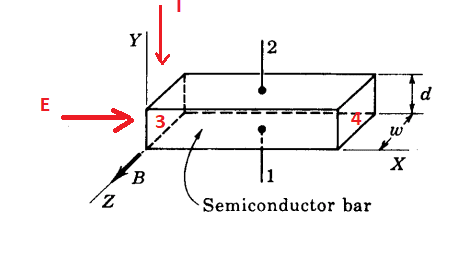
1610202843009.png

The magnetic field is in the +ve Z-direction, the electric field is in the +ve X-direction, the current will be in -ve Y direction.
There are many equations to find the hall voltages ##V_H = Ed=Bvd = \frac{BJd} {\rho w} ##. But i find the equation ##V_H = Ed## to solve and other parameters are not much of use.
a. n-type 4 will be more negative than 3 and ##V_H = 5*0.3V = 1.5V##
b. p-type 4 will be more positive than 3 and ##V_H = 5*0.3V = 1.5V##
Is the solution correct, or missing something?
 
Physics news on Phys.org
No I don't think it is correct. The E-field in the x direction ##E_x=5V/cm## is responsible for creating the current density ##J=\sigma E_x## according to Ohm's law.
It is the E-field in the y-direction ##E_y=Bv## that creates the hall voltage.
 
  • Like
Likes   Reactions: PhysicsTest
Delta2 said:
No I don't think it is correct. The E-field in the x direction ##E_x=5V/cm## is responsible for creating the current density ##J=\sigma E_x## according to Ohm's law.
It is the E-field in the y-direction ##E_y=Bv## that creates the hall voltage.
I disagree with the disagreement.

The interaction of the current flow and B field creates a Hall voltage that is perpendicular to both, think Lorentz force. The problem statement specifies the direction of both current direction, X-axis, and B-field direction, Z axis. This leave only the Y axis for the Hall voltage. Note that the Terminals "1" and "2" (sense terminals) are in the Y dimension. (But that graph sure shows an unusual axes orientation.)

As for the numerical solution, I have no idea! That must be left to those that have studied this in more detail.
 
Tom.G said:
I disagree with the disagreement.

The interaction of the current flow and B field creates a Hall voltage that is perpendicular to both, think Lorentz force. The problem statement specifies the direction of both current direction, X-axis, and B-field direction, Z axis. This leave only the Y axis for the Hall voltage. Note that the Terminals "1" and "2" (sense terminals) are in the Y dimension. (But that graph sure shows an unusual axes orientation.)

As for the numerical solution, I have no idea! That must be left to those that have studied this in more detail.
I don't understand where you disagree with me. We both say that the current is in the x-axis and that the hall voltage is in the y-axis. The way the OP did the calculation implies that the hall voltage is along the x-axis.
 
Perhaps it is a nomenclature difference.

Re-reading your two posts I see that we agree on the orientation of the Hall voltage.

I was thrown off by the use of 'E-field' being the cause of the Hall voltage. I was thinking of 'fields' being externally applied things, rather than being electron paths.

Sorry for any unnecessary confusion.

Tom
 
Tom.G said:
I was thrown off by the use of 'E-field' being the cause of the Hall voltage
I said that this E-field is in the y-direction. Of course the mechanism of hall voltage is known to me, it is not the electric field the real cause. It is the Lorentz force ##(\mathbf{v}\times\mathbf{B})q## that creates charge separation and a coulomb electric field ##\mathbf{E_H}## such that $$\mathbf{E_H}q=(\mathbf{v}\times\mathbf{B})q$$ and the hall voltage is of course $$V_H=E_Hd$$
 
Still not able to solve, not sure if some of the data is missing or to assume something. I understood the above discussion
##V_H = \frac{BJd} {\rho w} ## ->eq1
##J = \sigma E_x## ->eq2
substitute eq2 in eq1
##V_H = \frac{B\sigma E_x} {\rho w}## ->eq3
If conduction primarily due to charges of one sign, the conductivity ##\sigma## is related to mobility ##\mu## by
##\sigma = \mu \rho## -> eq4
substitute in eq3 to give
##V_H = \frac{B\mu E_x} {w} ## -> eq5
Now i do not know the value of ##\mu##. Is the above derivation correct? Can i assume its value at 300K which is a standard value i assume.
 
PhysicsTest said:
Still not able to solve, not sure if some of the data is missing or to assume something. I understood the above discussion
##V_H = \frac{BJd} {\rho w} ## ->eq1
##J = \sigma E_x## ->eq2
substitute eq2 in eq1
##V_H = \frac{B\sigma E_x} {\rho w}## ->eq3
If conduction primarily due to charges of one sign, the conductivity ##\sigma## is related to mobility ##\mu## by
##\sigma = \mu \rho## -> eq4
substitute in eq3 to give
##V_H = \frac{B\mu E_x} {w} ## -> eq5
Now i do not know the value of ##\mu##. Is the above derivation correct? Can i assume its value at 300K which is a standard value i assume.
In going from Eq1 to Eq3 (using Eq2) you have forgotten ##d##.
What is ##\rho##? The density of charge carriers?
 
Delta2 said:
In going from Eq1 to Eq3 (using Eq2) you have forgotten ##d##.
Sorry my mistake the eq(3) is
##V_H = \frac{B\sigma E_xd} { \rho w}## ->eq(3)
Delta2 said:
What is ##\rho##? The density of charge carriers?
Yes ##\rho## is the density of charge carriers
 
I feel there is something wrong regarding the ##w## in eq(3). As far as I know $$V_H=Bvd, J=\rho v\Rightarrow V_H=\frac{BJd}{\rho}$$ so I really don't see how you get that ##w## there. Is this equation $$V_H=\frac{BJd}{\rho w}$$ taken straight from the book?
 
I am really confused with all these equations
1610429340806.png

Yes it is the current I not the J the current density.
 
PhysicsTest said:
I am really confused with all these equations
View attachment 276051
Yes it is the current I not the J the current density.
Ah this settles it, yes the book is right (and I was right too in post #10). It is $$I=JS=Jdw$$ that's how the last equality is explained. (##S## is the cross section of the semiconductor ##S=dw## according to the figure provided).
So to sum it up:
The correct (eq3) is $$V_H=\frac{B\sigma E_xd}{\rho}$$ and IF $$\sigma=\mu\rho$$ is correct then (eq3) leads to $$V_H=B\mu E_xd$$. I suppose from this last equation you can find the hall voltage, if you know ##\mu## as everything else is given.

Something else is the density of the charge carriers ##N_D## (or ##N_A##) given in ##cm^{-3}## or ##Cb\cdot cm^{-3}## because the ##\rho## appearing in the above equations has units of the latter case (##Cb\cdot cm^{-3}##).
 
  • Like
Likes   Reactions: PhysicsTest
Delta2 said:
I suppose from this last equation you can find the hall voltage, if you know ##\mu## as everything else is given
But that is not given, can i assume a value?
Delta2 said:
Something else is the density of the charge carriers ##N_D## (or ##N_A##) given in ##cm^{-3}## or ##Cb\cdot cm^{-3}## because the ##\rho## appearing in the above equations has units of the latter case (##Cb\cdot cm^{-3}##).
I really did not understand this.
 
PhysicsTest said:
But that is not given, can i assume a value?
Not sure, what is given is ##N_D## or ##N_A##. I think we must use those somehow (but in the correct units, see below). Look in book for table with the ##\sigma## of germanium at various temperatures. I am very unsure about the equation ##\sigma=\mu\rho##.
I really did not understand this.
I am asking in what units are the ##N_D## or ##N_A## given. In the OP it seems that the units are ##\frac{1}{cm^3}## or simply ##cm^{-3}##.
 
i am not sure if the original question is wrong, i have taken from the book as it is

1610443864516.png

1610443997183.png

1610444087380.png

This is how i derived the equations. Generally in some of the previous questions i used to see ##N_D## units as ##atoms/cm^3##
 
Ok i see. The only problem i see is whether the ##\rho## in this equation ##\sigma=\rho\mu## is the same quantity as the ##\rho## in this equation ##V_H=\frac{B\sigma E_xd}{\rho}##
Also what is q that appears in the equation for ##\sigma## in the image above. Is it the charge of the electron?

It seems that we need ##\mu## to calculate the hall voltage...
 
Yes charge of the electron is "q" in the equation.
 
  • Like
Likes   Reactions: Delta2
One question i wanted to ask is that an external voltage (electric field ##E_e##) is used to drive the current I. Because of magnetic field a force is applied on the charged electrons and holes and hence the Hall voltage (Hall electric field ##E_H##) is set up. Will there be a net electric field of ##E_e \text{ and } E_H## ?
 
Yes there will be a net electric field from those two E-fields, but the effect of the field ##E_H## on the charge carriers is "neutralized" by the force ##(\mathbf{v}\times \mathbf{B})q## which is equal and opposite of the force ##E_Hq##. So ##E_H## is like it doesn't exist for the charge carriers, it doesn't affect their motion, it doesn't make a new current if that's what you were thinking of.
 
  • Like
Likes   Reactions: PhysicsTest