Undergrad Is this condition for infinite roots wrong?

Click For Summary
The discussion critiques a theorem and method presented in Stroud's "Engineering Mathematics," questioning the claim that every polynomial has two infinite roots at positive and negative infinity. It argues that the method for determining asymptotes yields incorrect results for high-degree polynomials. The conversation highlights that multiplying by y can introduce unmathematical solutions, particularly when y equals zero. A specific example is provided to illustrate the correct identification of asymptotes using homogeneous coordinates. Overall, the participants express skepticism about the accuracy of Stroud's explanations in this context.
vopros217
Messages
4
Reaction score
0
I found a strange theorem and a doubtful method in Stroud's book "Engineering mathematics":
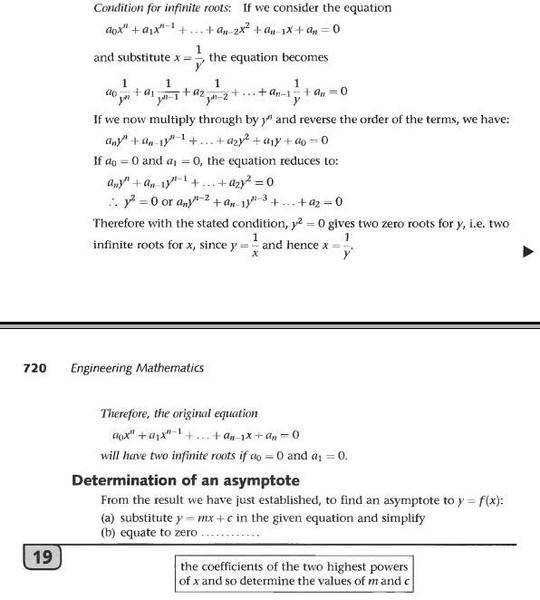
asymptote.JPG

I think, every polynomial equation will have two infinite roots (at +infinity and -infinity).
I also think that this method of the determination of an asymptote gives wrong results if f(x) is a polynomial with a high degree.
Are the theorem and the method in this book wrong?
 
Last edited:
Mathematics news on Phys.org
That doesn't make sense. Every polynomial has a largest power, so every polynomial has an infinite number of infinite roots?
Multiplying the equation by yn generates additional solutions for y=0, so it is not surprising that they produce unmathematical solutions for y=0 later. Of course y=0 is a solution to an equation where you multiplied both sides by 0.
 
  • Like
Likes vopros217
This looks strange but it is kind of correct. It seems the author absolutely butchered the method though. I think what the author likes to do is to compute infinite point and asymptotes in projective geometry using homogeneous coordinates. That uses a method kind of similar to what is in the OP, but the exact explanation of the book is very doubtful.

Something of the following would be correct though: consider ##y = \frac{x+2}{3x + 2}##. Then we have
$$3xy + 2y - x - 2 = 0$$
which gives rise to a homogeneous equation
$$3xy + 2yz - xz - 2z^2=0.$$
The points at infinity correspond to ##z=0##, which yields ##x=0## or ##y=0##. This gives us a result that the function has two asymptotes: one parallel to ##x=0## and one parallel to ##y=0## which is indeed correct.
 
  • Like
Likes vopros217
Statement is strange. if a_0\ and\ a_1 are both 0, then the first term should be a_2x^{n-2}.
 
  • Like
Likes vopros217
Thank you all. Stroud's textbook is mostly very good, but I stuck on that place.
 
Here is a little puzzle from the book 100 Geometric Games by Pierre Berloquin. The side of a small square is one meter long and the side of a larger square one and a half meters long. One vertex of the large square is at the center of the small square. The side of the large square cuts two sides of the small square into one- third parts and two-thirds parts. What is the area where the squares overlap?

Similar threads

  • · Replies 2 ·
Replies
2
Views
2K
  • · Replies 3 ·
Replies
3
Views
7K
  • · Replies 3 ·
Replies
3
Views
2K
  • · Replies 1 ·
Replies
1
Views
1K
  • · Replies 3 ·
Replies
3
Views
2K
Replies
3
Views
4K
  • · Replies 1 ·
Replies
1
Views
3K
  • · Replies 35 ·
2
Replies
35
Views
2K
Replies
1
Views
4K
  • · Replies 22 ·
Replies
22
Views
2K