Is this correct? - Gas Law Question

  • Thread starter Thread starter bcjochim07
  • Start date Start date
  • Tags Tags
    Gas Gas law Law
Click For Summary
SUMMARY

The discussion centers on calculating the compression of a spring in a gas cylinder when the temperature is increased from 16 degrees Celsius to 160 degrees Celsius. The initial conditions include a cross-sectional area of 10 cm2, a gas amount of 0.005 mol, and a spring constant of 1500 N/m. The calculations utilize the ideal gas law (PV=nRT) and the relationship between pressure and temperature (P1/T1 = P2/T2) to derive the spring compression, ultimately determining that the spring compresses approximately 1.94 cm when the gas is heated.

PREREQUISITES
  • Understanding of the Ideal Gas Law (PV=nRT)
  • Knowledge of pressure-temperature relationships (P1/T1 = P2/T2)
  • Familiarity with spring mechanics and Hooke's Law (F=kx)
  • Basic algebra for solving equations involving multiple variables
NEXT STEPS
  • Study the derivation and application of the Ideal Gas Law in various scenarios
  • Learn about the relationship between pressure, volume, and temperature in gas systems
  • Explore advanced spring mechanics and applications of Hooke's Law
  • Investigate real-world applications of gas laws in engineering and physics
USEFUL FOR

Students studying thermodynamics, physics enthusiasts, and engineers working with gas systems and mechanical springs will benefit from this discussion.

bcjochim07
Messages
366
Reaction score
0
Is this correct? -- Gas Law Question
Homework Statement


cylinderpressure.jpg

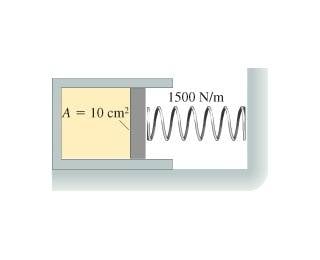
The cylinder in the figure has a moveable piston attached to a spring. The cylinder's cross sectional area is 10 cm^2 and it contains .005 mol of gas. The spring constant is 1500 N/m. At 16 degrees Celsius, the spring is neither stretched nor compressed. How far is the spring compressed when the gas temperature is raised to 160 degrees Celsius?


Homework Equations


The Attempt at a Solution


P1/T1 = P2/T2

16 degrees C = 289 K 160 degrees C = 433 K

10cm^2 * (1m/100cm)^2 = .001 m^2

Since the spring is not exerting any force on the piston initially, the pressure inside the cylinder is equal to the air pressure (1 atm = 101300 Pa)

(101300 Pa)/(289K) = P2/(433 K)

P2=151775 Pa and P2= (1500N/m)x/(.001 m^2) + (101300 Pa)

x=.034 m = 3.4 cm
 
Physics news on Phys.org
Hi bcjochim07,

bcjochim07 said:

Homework Statement


View attachment 13865
The cylinder in the figure has a moveable piston attached to a spring. The cylinder's cross sectional area is 10 cm^2 and it contains .005 mol of gas. The spring constant is 1500 N/m. At 16 degrees Celsius, the spring is neither stretched nor compressed. How far is the spring compressed when the gas temperature is raised to 160 degrees Celsius?


Homework Equations


The Attempt at a Solution


P1/T1 = P2/T2

This expression applies for cases when the volume is constant; I think you'll need to use the form with the volumes in it.
 
Oh yeah, how could I forget?

So the initial volume can be found:
PV=nRT (101,300 Pa)(V1)=(.005mol)(8.31)(289 K)
V1= .0001185 m^3

P1V1/T1 = P2V2/T2 P2= 101300 Pa + (1500N/m)x/.001 m^2 and
V2= V1 + Ax where A is the area of the end of the cylinder
V2= .0001185m^3 + (.001m^2)x

(101300 Pa)(.000185 m^3)/(289K) = (101300 Pa + 1500x/.001 m^2)(.0001185 + .001x)(1/433K)

.0648 = (101300 + 1500000x)(.0001185 +.001x)(1/433)
.0648 = -.0368 + .644 x + 3.46x^2

[-.644 +/- sqrt (.92)]/6.92

x= (-.644 + 1.03)/6.92 = .0455 m = 4.55 cm
 
Last edited:
Is this correct?
 
I think you have a few errors here.

bcjochim07 said:
Oh yeah, how could I forget?

So the initial volume can be found:
PV=nRT (101,300 Pa)(V1)=(.005mol)(8.31)(289 K)
V1= .0001185 m^3

P1V1/T1 = P2V2/T2 P2= 101300 Pa + (1500N/m)x/.001 m^2 and
V2= V1 + Ax where A is the area of the end of the cylinder
V2= .0001185m^3 + (.001m^2)x

(101300 Pa)(.000185 m^3)/(289K) = (101300 Pa + 1500x/.001 m^2)(.0001185 + .001x)(1/433K)

On the left hand side you have the wrong volume (you're missing a one) that gives the wrong answer on the left side of the next line.

.0648 = (101300 + 1500000x)(.0001185 +.001x)(1/433)
.0648 = -.0368 + .644 x + 3.46x^2

I think you also made a calculation error in going between these two lines on the right hand side. The right hand side of (101300 + 1500000x)(.0001185 +.001x)(1/433) has all positive numbers, but you got a negative number on the next line.
 
Ok, let's see if I can get it right

(101300Pa)(.0001185 m^3)/(289K) = (101300 Pa + 1500x/.001 m^2)(.0001185 m^3 + .001x)(1/433K)

.0415 = (101300 + 1500000x)(.0001185 + .001x)(1/433)
.0415 = (12.00 + 101.3x + 177.75x + 1500x^2)(1/433)
.0415 = 3.46x^2 + .234x + .4105x + .0277
0 = 3.46x^2 + .644x - .0138
[-.644 +/- sqrt (.606)]/6.92
x= .0194 m = 1.94 cm
 
Is that right?
 
That looks right to me.
 

Similar threads

  • · Replies 8 ·
Replies
8
Views
2K
  • · Replies 6 ·
Replies
6
Views
2K
Replies
12
Views
2K
  • · Replies 3 ·
Replies
3
Views
2K
  • · Replies 8 ·
Replies
8
Views
2K
  • · Replies 2 ·
Replies
2
Views
2K
  • · Replies 4 ·
Replies
4
Views
3K
Replies
2
Views
2K
  • · Replies 11 ·
Replies
11
Views
4K
Replies
3
Views
2K