Is this correct? - Gas Law Question

  • Thread starter Thread starter bcjochim07
  • Start date Start date
  • Tags Tags
    Gas Gas law Law
Click For Summary

Homework Help Overview

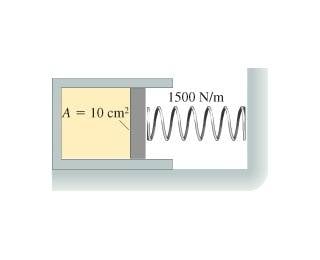
The problem involves a gas law scenario with a movable piston and a spring in a cylinder. The cylinder has a specified cross-sectional area and contains a certain amount of gas at an initial temperature. The question asks how far the spring is compressed when the gas temperature is increased.

Discussion Character

  • Exploratory, Assumption checking, Mathematical reasoning

Approaches and Questions Raised

  • Participants discuss the application of gas laws, particularly the relationship between pressure, volume, and temperature. Some question the use of specific equations under the assumption of constant volume, while others explore the initial volume calculation and the effects of temperature change on pressure and volume.

Discussion Status

There are multiple interpretations of the problem, with participants providing different approaches to the calculations. Some have pointed out potential errors in previous calculations and assumptions, while others are attempting to clarify the correct application of gas laws. Guidance has been offered regarding the setup of equations and the need for careful consideration of the variables involved.

Contextual Notes

Participants are working within the constraints of a homework assignment, which may limit the information available or the methods that can be used. There is an ongoing discussion about the accuracy of calculations and the assumptions made regarding the system's behavior.

bcjochim07
Messages
366
Reaction score
0
Is this correct? -- Gas Law Question
Homework Statement


cylinderpressure.jpg

The cylinder in the figure has a moveable piston attached to a spring. The cylinder's cross sectional area is 10 cm^2 and it contains .005 mol of gas. The spring constant is 1500 N/m. At 16 degrees Celsius, the spring is neither stretched nor compressed. How far is the spring compressed when the gas temperature is raised to 160 degrees Celsius?


Homework Equations


The Attempt at a Solution


P1/T1 = P2/T2

16 degrees C = 289 K 160 degrees C = 433 K

10cm^2 * (1m/100cm)^2 = .001 m^2

Since the spring is not exerting any force on the piston initially, the pressure inside the cylinder is equal to the air pressure (1 atm = 101300 Pa)

(101300 Pa)/(289K) = P2/(433 K)

P2=151775 Pa and P2= (1500N/m)x/(.001 m^2) + (101300 Pa)

x=.034 m = 3.4 cm
 
Physics news on Phys.org
Hi bcjochim07,

bcjochim07 said:

Homework Statement


View attachment 13865
The cylinder in the figure has a moveable piston attached to a spring. The cylinder's cross sectional area is 10 cm^2 and it contains .005 mol of gas. The spring constant is 1500 N/m. At 16 degrees Celsius, the spring is neither stretched nor compressed. How far is the spring compressed when the gas temperature is raised to 160 degrees Celsius?


Homework Equations


The Attempt at a Solution


P1/T1 = P2/T2

This expression applies for cases when the volume is constant; I think you'll need to use the form with the volumes in it.
 
Oh yeah, how could I forget?

So the initial volume can be found:
PV=nRT (101,300 Pa)(V1)=(.005mol)(8.31)(289 K)
V1= .0001185 m^3

P1V1/T1 = P2V2/T2 P2= 101300 Pa + (1500N/m)x/.001 m^2 and
V2= V1 + Ax where A is the area of the end of the cylinder
V2= .0001185m^3 + (.001m^2)x

(101300 Pa)(.000185 m^3)/(289K) = (101300 Pa + 1500x/.001 m^2)(.0001185 + .001x)(1/433K)

.0648 = (101300 + 1500000x)(.0001185 +.001x)(1/433)
.0648 = -.0368 + .644 x + 3.46x^2

[-.644 +/- sqrt (.92)]/6.92

x= (-.644 + 1.03)/6.92 = .0455 m = 4.55 cm
 
Last edited:
Is this correct?
 
I think you have a few errors here.

bcjochim07 said:
Oh yeah, how could I forget?

So the initial volume can be found:
PV=nRT (101,300 Pa)(V1)=(.005mol)(8.31)(289 K)
V1= .0001185 m^3

P1V1/T1 = P2V2/T2 P2= 101300 Pa + (1500N/m)x/.001 m^2 and
V2= V1 + Ax where A is the area of the end of the cylinder
V2= .0001185m^3 + (.001m^2)x

(101300 Pa)(.000185 m^3)/(289K) = (101300 Pa + 1500x/.001 m^2)(.0001185 + .001x)(1/433K)

On the left hand side you have the wrong volume (you're missing a one) that gives the wrong answer on the left side of the next line.

.0648 = (101300 + 1500000x)(.0001185 +.001x)(1/433)
.0648 = -.0368 + .644 x + 3.46x^2

I think you also made a calculation error in going between these two lines on the right hand side. The right hand side of (101300 + 1500000x)(.0001185 +.001x)(1/433) has all positive numbers, but you got a negative number on the next line.
 
Ok, let's see if I can get it right

(101300Pa)(.0001185 m^3)/(289K) = (101300 Pa + 1500x/.001 m^2)(.0001185 m^3 + .001x)(1/433K)

.0415 = (101300 + 1500000x)(.0001185 + .001x)(1/433)
.0415 = (12.00 + 101.3x + 177.75x + 1500x^2)(1/433)
.0415 = 3.46x^2 + .234x + .4105x + .0277
0 = 3.46x^2 + .644x - .0138
[-.644 +/- sqrt (.606)]/6.92
x= .0194 m = 1.94 cm
 
Is that right?
 
That looks right to me.
 

Similar threads

  • · Replies 8 ·
Replies
8
Views
2K
  • · Replies 6 ·
Replies
6
Views
2K
Replies
12
Views
3K
  • · Replies 3 ·
Replies
3
Views
2K
  • · Replies 8 ·
Replies
8
Views
2K
  • · Replies 2 ·
Replies
2
Views
2K
  • · Replies 4 ·
Replies
4
Views
3K
Replies
2
Views
2K
  • · Replies 11 ·
Replies
11
Views
4K
Replies
3
Views
2K